ElevenLabs Pricing Explained 2026: What You’ll Really Pay (And Which Plan Fits You)
Let’s talk about ElevenLabs pricing, because it’s the question that stops most people right before they hit the sign-up button. You’ve heard the voices are impressive. You’ve maybe even heard a sample or two. But then you open the pricing page and see credits, tiers, commercial licenses, and a row of numbers that don’t obviously mean anything. I get it. Nobody wants to pay for the wrong plan, or worse, pay for a tool that ends up gathering dust.
So here’s the plain-English version, with no jargon and no sales pitch dressed up as advice.
The Real Reason Pricing Pages Feel Confusing
Most software pricing is easy. You pick a plan, you pay a number, you get the thing.
AI voice tools work differently. You’re not paying for “access” so much as you’re paying for how much audio you generate. That’s where credits come in, and credits are where people get lost.
Here’s the situation a lot of creators end up in. You sign up for something cheap, excited to finally fix your voiceover problem. You generate a few scripts. You redo a couple of lines because the pacing felt off. Suddenly the month’s allowance is nearly gone and you’re only halfway through your project. Now you’re annoyed, you feel like you picked wrong, and you start wondering whether the whole thing was a waste.
The opposite happens too. Someone panics, buys a big plan “just in case,” and uses a tenth of it. That’s money out of your pocket for nothing.
Neither of these is a tool problem. It’s an information problem. Nobody explained, in normal words, how the numbers translate into actual audio you’d use.
What Bad Voiceovers Are Already Costing You
Before we get into the plans, I want to flip the question around, because “how much does it cost?” only makes sense next to “what does it cost me not to have it?”
Think about what you do today for voice. Maybe you record yourself. That costs you time, and time is the most expensive thing a creator has. An hour spent fighting a microphone is an hour you didn’t spend writing, filming, or promoting.
Maybe you use a free text-to-speech tool. That one’s free in dollars but expensive in other ways. Audio that sounds flat and robotic makes viewers click away faster. Lower watch time means less reach. Less reach means fewer subscribers, fewer sales, and less income. It’s a quiet cost, and it never shows up on a receipt.
Or maybe you hire voice actors. That’s the clearest cost of all. Professional narration can run into hundreds of dollars for a short project, and thousands for something like an audiobook. Every script change means another round of back-and-forth.
When you put it that way, a monthly subscription that costs less than a few lunches suddenly looks different. Not automatically cheap, and not automatically a good deal, but worth a fair comparison.
So, What Is ElevenLabs?
ElevenLabs is an AI voice platform. You type or paste your text, choose a voice, and it reads it back in a voice that sounds remarkably human.
What makes it stand out is the delivery. Many older tools just read words in order. ElevenLabs seems to understand the sentence. Questions rise at the end. Pauses fall where a real person would breathe. Excited lines sound excited and serious lines sound calm. It’s the difference between audio people tolerate and audio people actually finish listening to.
And it’s more than a text-to-speech box. You also get a large library of voices in different accents and styles, voice cloning so you can create a digital version of your own voice (with proper permission, always), dubbing across many languages, transcription, sound effects, voice agents for conversations, and an API for people building their own apps.
You don’t need all of that on day one. But it explains why the pricing has several layers. Different people use very different amounts, so the plans are built around usage.
ElevenLabs Pricing: Every Plan in Plain English
Here’s the part you came for. One honest warning first: ElevenLabs adjusts its plans and numbers from time to time, and different sources report slightly different figures. Treat everything below as a guide, and always check the live pricing page for the exact numbers before you pay.
With that said, here’s the general shape of the lineup.
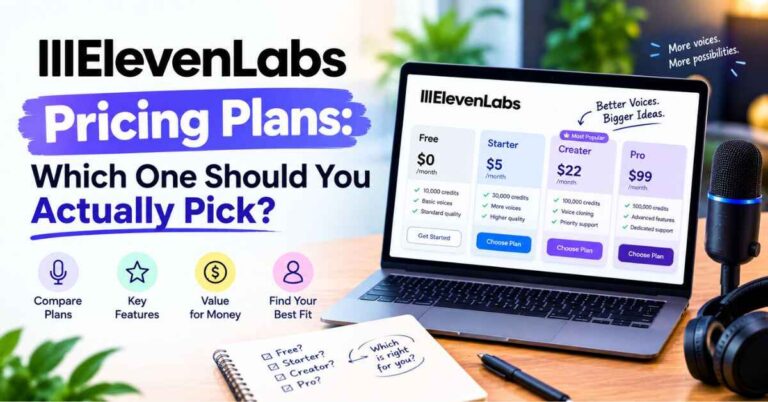
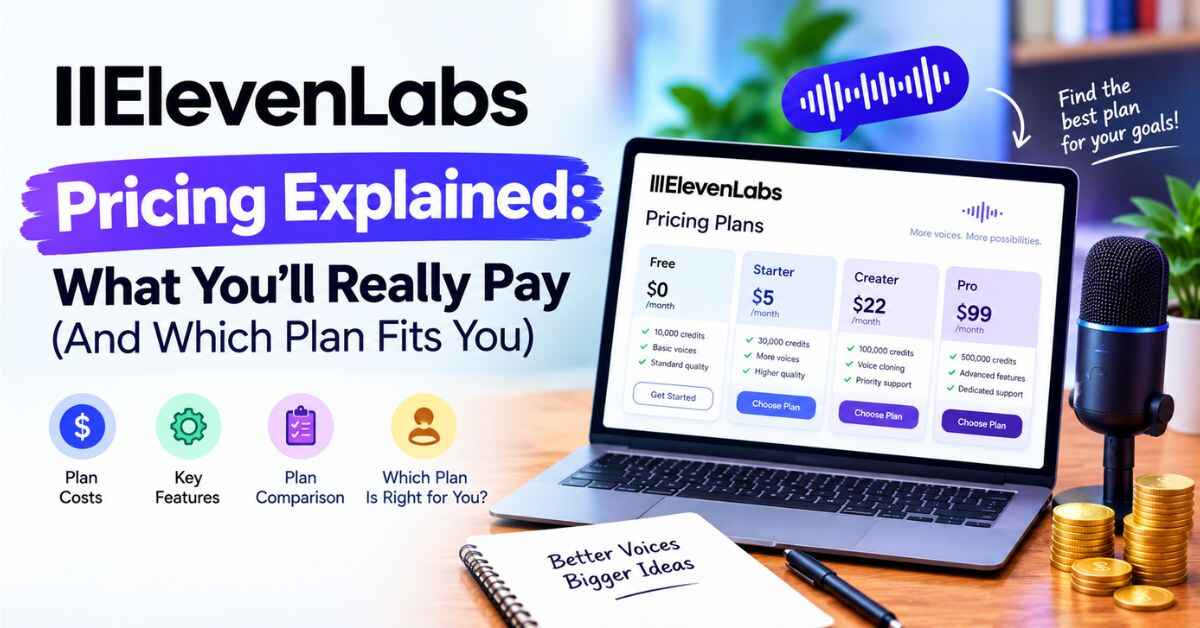
Free plan. The free tier comes with 10,000 credits per month. That works out to roughly 10 minutes of audio, and it’s meant for non-commercial use. This is your test drive. It’s enough to hear the voices, try a few scripts, and decide whether the quality is what you’re after. It’s not meant for monetized projects. smallestgrowwstacks
Starter. The entry-level paid plan sits at about $5 a month, with some trackers listing it at $6 depending on billing. This is where small commercial projects begin. If you’re a new creator posting short videos or a small channel, this is usually the first step up. codaone
Creator. Creator is listed at around $22 a month. You’ll sometimes see an introductory discount on the first month. This tier gives you a much bigger credit allowance, which is why it tends to be the sweet spot for people who publish regularly. If you make a few videos a week, or you’re turning blog posts into audio, this is probably the neighborhood you’ll end up in. codaone
Pro. Pro runs about $99 a month. It’s built for heavier production, such as agencies, full-time creators, and people producing long-form audio like audiobooks or courses on a regular basis. It also unlocks higher-quality output options. codaone
Scale. Scale is listed around $299 a month, though some sources show a slightly higher figure. This is for teams and businesses with serious volume. aiproductivity
Business. The Business tier was lowered to $990 a month in June 2026, after sitting higher earlier in the year. This is the level where companies run large-scale voice operations with multiple users. costbench
Enterprise. Custom pricing for large organizations that need extra security, compliance, and support. If you’re reading this as an individual creator, you can safely ignore this one.
One more thing worth knowing: paying annually typically saves you around 17 percent, so if you’re confident you’ll stick with it, yearly billing is worth a look. aiproductivity
Notice something about that list. The majority of bloggers, YouTubers, course creators, and small business owners will live somewhere between Free and Creator. The higher tiers exist for teams and companies. Many creators find that the lower-priced tiers cover everything they need.
👉 Want to hear the voices before you think about money? Try ElevenLabs free here and paste in a few lines of your own script.
How Credits Actually Work (The Part Nobody Explains)
Credits are just the currency ElevenLabs uses to measure how much audio you generate. Think of them like data on a phone plan. You get a monthly allowance, you spend it as you go, and it refills when your billing cycle resets.
The rough rule of thumb is that more characters of text means more credits used. A short script burns very little. A long course lesson burns more. And if you regenerate the same line three times to get the delivery right, that costs three times.
This is the main reason I’d tell anyone to be a little thoughtful about how they work. Write your script carefully before you generate. Read it out loud once. Fix awkward sentences in the text, not in the audio. A tidy script means fewer retakes, and fewer retakes means your allowance goes further.
Here’s a simple way to estimate what you need:
- Figure out how many minutes of finished audio you produce in a typical month.
- Add about 30 percent for retakes and experiments.
- Compare that number to what each plan includes.
If you publish two five-minute videos a week, that’s about 40 minutes of audio a month before retakes. That tells you quickly whether a lower tier will do or whether you need to move up.
A Few Real-Life Examples (So This Isn’t All Theory)
Numbers on a page only mean so much. Let me show you how this plays out for different kinds of people.
The weekend blogger. Picture someone with a travel blog and fifty solid articles. She wants to add an audio version to her best posts, one or two a week. Her total audio each month is small. She starts on the free plan to test the voices, then moves to a low-cost paid tier when she’s ready to put the audio on her site. The monthly cost is smaller than a coffee habit, and her older posts suddenly get a second life as audio that people can listen to on the go.
The faceless YouTuber. A guy runs a channel built on explainer videos. He posts three times a week, each video around eight minutes. That’s a lot of audio, and he can’t afford to spend half his day on voice recordings. For him, a mid-level plan makes sense, because the time he saves each week is worth far more than the subscription. Where he used to spend an afternoon per video on voice, now it takes minutes.
The course creator. A woman sells an online course with several hours of lessons. Every time the software she teaches updates, her lessons go out of date. With AI narration, she edits the script and regenerates the audio instead of re-recording whole modules. The higher credit allowance on a bigger plan pays for itself the first time she avoids a re-record.
The local shop owner. A small business owner wants a polished phone greeting and a few product videos. She doesn’t need much audio, so she uses a low-tier plan for one month, gets everything done in a single evening, and then pauses or downgrades. That kind of flexibility is the hidden advantage of monthly plans.
The creator going global. A tech YouTuber takes his top videos and creates Spanish and Portuguese versions. Dubbing eats more credits, so he plans for it and picks a plan that matches. Same content, brand new audience, and no extra filming.
Each of these people uses a different tier, and each one lands on a price that makes sense for their situation. That’s really the whole point of the structure.
Also read: ElevenLabs Review 2026: The AI Voice Tool That Finally Made Voiceovers Feel Easy
Is ElevenLabs Worth the Money? My Honest Take
Let me answer this the way I’d answer it if you were sitting across from me.
If you only need one tiny voiceover once in a blue moon, the free plan, or one month of a low tier, is probably all you need. Don’t commit to anything bigger.
If you create content regularly and voice is part of it, then yes, I think it’s worth the money. Here’s the quick math that convinced me. Suppose you save two hours per video. If you make four videos a month, that’s eight hours back. What’s an hour of your time worth? Even at a modest number, the savings dwarf a plan in the Creator range.
And that’s before you count the quality gain. Audio that sounds real keeps people watching. People who keep watching subscribe, buy, and share. It’s hard to put an exact price on that, but anyone who has watched a video lose viewers in the first thirty seconds knows how much it matters.
The other way to see it is by comparison. Hiring a human voice actor for a short project often costs more in a single job than a month of a mid-level plan, and you get unlimited revisions without sending an email. That’s a very different deal.
What I Like Most About How It’s Priced
A few things stand out to me.
You can start for free. I always trust a tool more when it lets me test it without a credit card feeling over my shoulder. You can hear the quality and decide for yourself.
The ladder makes sense. Casual users pay little. Heavy users pay more. You’re not subsidizing someone else’s enterprise features while making one video a month.
Monthly plans give you room to adjust. Busy season? Move up. Slow month? Move down. You’re not locked into a giant commitment.
Commercial rights are clearly separated. The free plan is for experimenting, and paid plans are where you can use audio in projects that earn money. It’s easy to understand where the line is.
The time savings are real. The subscription isn’t buying you a gadget. It’s buying back hours you’d otherwise lose to retakes and editing.
👉 Curious which tier would fit your workload? Start with a free ElevenLabs account and see how much audio your own scripts actually use.
Let’s Talk About the Downsides
Any review that’s pure praise isn’t worth trusting, so here’s the honest side of things.
Credits can disappear faster than you expect. Especially if you regenerate a lot. The fix is to polish your script first and only generate when you’re happy with the text.
Pricing details change. I’ve seen different numbers on different websites, partly because plans have been adjusted during the year. That’s why I keep telling you to check the official page before paying.
Longer projects need a bigger plan. If you’re producing audiobooks or hours of course content, you’ll burn through lower tiers quickly. Plan for that rather than being surprised.
Some sounds need tweaking. Unusual names, acronyms, and technical words sometimes need a phonetic spelling or an adjusted comma to sound right. It’s a small fix, but it costs a retake now and then.
It won’t replace a human performer in every case. For a big brand film or something that depends on heavy emotional acting, a professional actor may still be the better call. For everyday content, AI voice is more than good enough.
None of these is a dealbreaker. They’re just the things I’d want a friend to tell me before I signed up.
How to Pick the Right Plan Without Overthinking It
If you’re still on the fence, here’s a simple way to decide.
Start with the free plan. Paste in a paragraph from something you’ve already written. Listen. If the voice makes you think “I could publish that,” you’ve answered the biggest question already.
Then move to the lowest paid plan that covers your real needs. Don’t buy for the person you hope to become next year. Buy for the creator you are this month. You can always move up when your workload grows.
Track your usage for one month. After a few weeks you’ll know exactly how many credits you burn. That’s better information than any guess.
Upgrade only when you feel the limit. If you hit the ceiling and you’re glad you did, because it means you’re publishing a lot, then it’s time for the next tier. That’s a good problem to have.
Consider annual billing once you’re sure. If you’ve used it for a couple of months and it’s become part of your routine, paying yearly can save you real money.
That’s the whole strategy. Test, start small, measure, and upgrade when it makes sense.
Common Questions About ElevenLabs Pricing
Is there a free plan?
Yes. It’s limited in monthly credits and meant for non-commercial use, so it’s perfect for testing.
Which plan do most creators choose?
Most bloggers, YouTubers, and course creators end up on one of the lower or middle paid tiers. The higher plans are aimed at teams and businesses.
Can I use the audio commercially?
Commercial use is tied to paid plans. Check the current terms on the official site before you monetize anything.
What happens if I run out of credits?
You can wait until your allowance resets, move up to a higher plan, or in some cases add extra usage. The specifics depend on your plan, so check the details on the pricing page.
Can I cancel or change plans?
Monthly plans give you flexibility to move up, move down, or stop. Look at the current billing terms on the site to be sure.
Do the prices stay the same all year?
Not always. Plans and numbers get adjusted from time to time, which is why I recommend confirming on the official page.
Final Thoughts
Here’s what I’d want you to take away.
Pricing pages look more complicated than they are. Underneath all the tiers, it’s a simple idea: the more audio you make, the more you pay. If you’re just getting started, you can try it for free. If you’re publishing regularly, a modest plan usually pays for itself in time saved alone.
The real cost of AI voice isn’t the subscription. The real cost is another year of dreading the voiceover step, publishing less than you want to, or putting out audio that doesn’t do your work justice. When that part of the process gets easier, you finish more projects, and finishing is where growth comes from.
ElevenLabs won’t write your script or find your audience. But it takes one of the most draining parts of content creation off your plate, and it does it well.
If you’ve been curious, the lowest-risk move is also the simplest. Open a free account, drop in one paragraph, and press play. You’ll know within a minute whether it belongs in your workflow.
👉 Ready to hear the difference for yourself? Check out ElevenLabs and its current plans here and see which one fits the way you create.
Affiliate Disclaimer
Quick heads-up: some links in this post are affiliate links. If you click one and decide to sign up, I may earn a small commission at no extra cost to you. It helps keep this blog running. I only recommend tools I believe are genuinely useful, and my opinions are my own. Prices change, so please check the official site for current details and pick what fits your needs best.