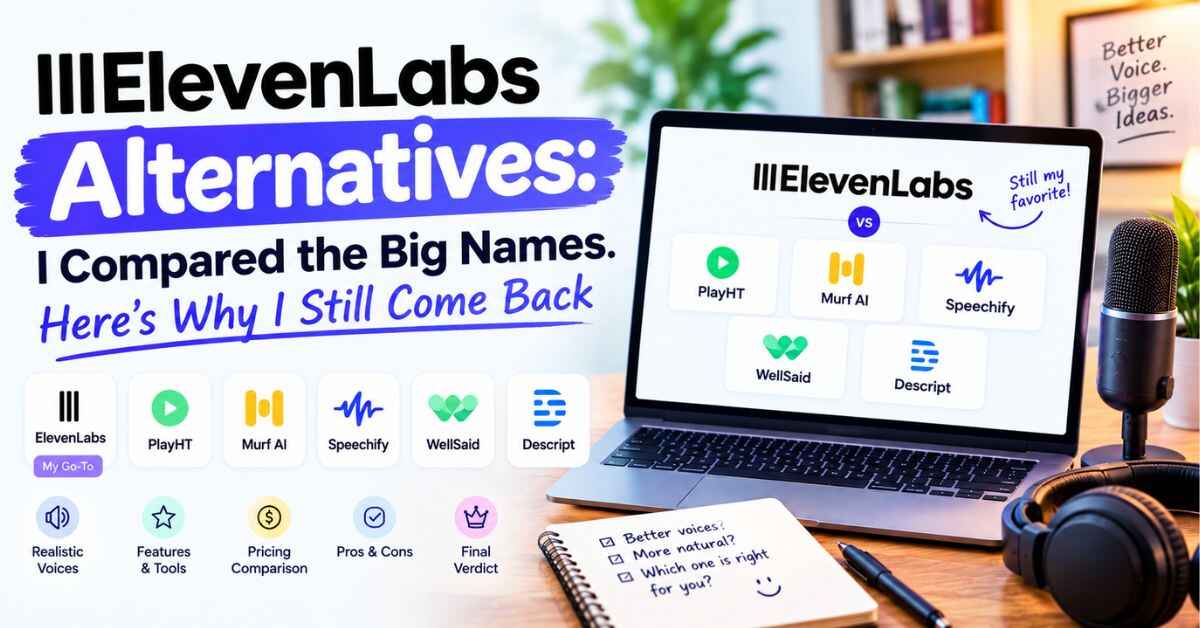
ElevenLabs Alternatives: I Compared the Big Names. Here’s Why I Still Come Back
If you’re hunting for ElevenLabs alternatives, I’m guessing one of three things happened. You saw the price and winced. You heard a sample that sounded too good and you’re wondering what the catch is. Or you’re the careful type who never buys the first thing you find. Honestly, I respect all three. I’m the third one myself.
So I did what I’d want a friend to do for me. I looked at the main competitors, figured out who each one is really for, and asked a simple question: if you switched, what would you gain and what would you lose?
Why Everyone Ends Up Comparing Voice Tools
Here’s how it usually goes.
You start with a project. Maybe it’s a YouTube channel, an online course, a podcast, or audio versions of your blog posts. You need a voice, so you type “AI voice generator” into Google. Ten minutes later you’ve got fifteen tabs open, and every one of them says it’s “the most realistic” tool on the market.
Then you try a few. One sounds fine for the first sentence, then slides into a flat, sleepy tone. Another gives you twenty voices, but half of them sound like an airport announcement. A third looks great until you realize the free version won’t let you download anything. By the end of the evening you’re tired, a little annoyed, and no closer to a decision.
That’s the real problem. It’s not a lack of options. It’s too many options that sound the same on the landing page and very different once you press play.
The Hidden Cost of Picking the Wrong Tool
I want to be honest about what’s at stake, because switching tools halfway through a project hurts more than people expect.
Say you pick a cheap tool, build your whole workflow around it, and then discover the voices can’t handle emotion. Your storytelling videos sound like someone reading a phone book. Now you’ve got dozens of finished videos with audio you’re not proud of, and redoing them means more hours and more money.
Or say you pick a tool made for corporate training, and your project is a warm, personal podcast. It’ll work, but it won’t feel right, and listeners can tell. They may not know why, but they’ll drift away.
Or say you choose something locked to one language, then your audience grows overseas and you can’t reach them without starting over.
Every one of these mistakes comes from the same place: choosing a tool before knowing what you need. So before we compare names, let’s get clear on what actually matters.
What to Look For in a Voice Tool (Before You Compare Anything)
Here’s the short list I use. It’s boring, but it saves a lot of regret.
Realism. Does it sound like a person, across a whole paragraph and not just one sentence?
Emotional range. Can it handle excitement, calm, humor, and seriousness without sounding forced?
Voice variety. Are there enough accents, ages, and tones to find something that fits your brand?
Cloning. Can you create a digital version of your own voice, with proper permission?
Languages. Can it help you reach people beyond your own language?
Ease of use. Can you get a good result in your first sitting, without a tutorial?
Real cost. Not just the sticker price, but what you’d actually pay for the amount of audio you make.
Keep these in mind as we go through the field. Also read: ElevenLabs Review 2026: The AI Voice Tool That Finally Made Voiceovers Feel Easy
So, What Is ElevenLabs?
Before I compare it to anything, let me explain what it is, in case you’re new.
ElevenLabs is an AI voice platform. You type or paste your script, pick a voice, and it reads your words back in a voice that sounds startlingly human. The difference is in the delivery. Questions rise at the end. Pauses land where a real person would breathe. Excited lines sound excited, and serious ones sound calm.
Beyond basic text to speech, there’s a big voice library, voice cloning, dubbing into many languages, transcription, sound effects, voice agents for conversations, and an API for people building their own apps. One review roundup sums up the market pretty neatly: Murf is better for video producers, while ElevenLabs is better for pure voice quality.
That’s the lens I want you to keep as we look at the others. Different tools are built for different jobs, and the “best” one depends on yours.
👉 Want to hear what the fuss is about before you compare anything? Try ElevenLabs free here and drop in a paragraph of your own writing.
ElevenLabs Alternatives: How the Main Options Really Compare
Let me walk through the names you’ll see most often, in plain language, with where each one shines and where it doesn’t.
Murf AI: Clean, Tidy, and Built for Business
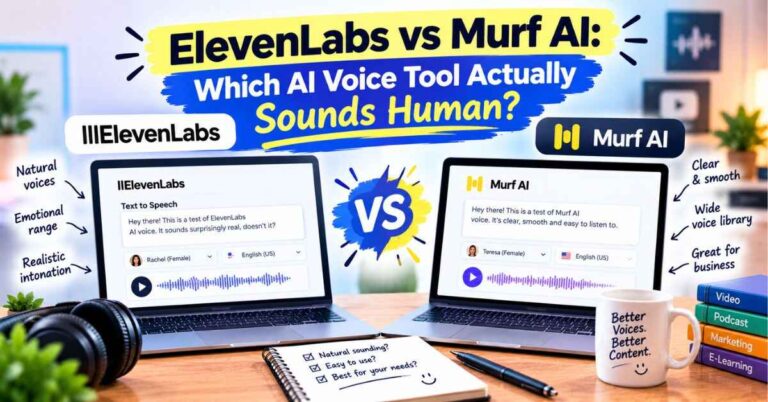
Murf is one of the most common names you’ll run into. It turns a script into a clean voiceover inside a friendly, browser-based editor that almost anyone can pick up. That ease is real, and for corporate explainers, training videos, and presentations, it does the job well.
Where it falls short is emotion. Reviewers tend to find its expressiveness trails ElevenLabs and WellSaid on emotional, long-form content, and the gap shows on storytelling and audiobooks.
Good fit: business narration and presentations. Less ideal: anything where feeling matters.
WellSaid Labs: Polished and Enterprise-Focused
WellSaid is aimed squarely at companies. It focuses on enterprise customers who need brand-consistent, compliance-ready voice generation. Another source points out that its voices come exclusively from consenting, compensated voice actors, which is a genuinely ethical approach, though it adds that ElevenLabs has more versatile cloning.
The trade-off is value for solo creators. There’s no free plan, and pricing starts around 49 dollars. If you’re a blogger or a small YouTuber, that’s a steep entry point just to try it.
Good fit: larger teams with strict brand and compliance needs. Less ideal: individual creators who want to test before paying.
Speechify: Built for Listening, Not Producing
Speechify is a different animal. It’s designed for reading, converting web articles, PDFs, and ebooks into natural audio with a mobile-first experience, while ElevenLabs is better for voice production.
If you want to listen to articles on your commute, Speechify is great. If you want to produce voiceovers for your own videos, you’re shopping in the wrong aisle.
Good fit: students and anyone who wants to listen to text. Less ideal: creators making audio for an audience.
Resemble AI: Strong on Cloning
If voice cloning is your whole reason for shopping, Resemble AI deserves a look. Play.ht and Resemble AI come closest to ElevenLabs’ voice quality, and Resemble specializes in cloning.
It’s a serious option for people with cloning-heavy projects. For everyday creators who also want a big library of ready-made voices, dubbing, and sound effects in one place, the broader platform tends to feel more convenient.
Good fit: cloning-first projects. Less ideal: people who want an all-in-one toolkit.
Cartesia: Speed Over Everything
Cartesia is popular with developers building real-time voice agents. One roundup lists its latency at around 90 milliseconds, aimed at low-latency agents. That speed matters if you’re building a phone bot. It matters a lot less if you’re narrating a YouTube video.
Good fit: developers building live conversational agents. Less ideal: content creators.
PlayHT: Be Careful With the Older Reviews
You’ll see PlayHT in plenty of older roundups, often near the top, with a very wide language count. But here’s a heads-up. ElevenLabs’s own blog states that PlayHT is no longer available. That’s a source with an obvious interest, so I’d verify it yourself before deciding anything. Still, it’s a good reminder to check that a tool is actually active and well supported before you build your workflow around it.
Good fit: only if it’s confirmed available. Less ideal: anyone who hasn’t checked.
The Big Cloud Options (Google, Microsoft, Amazon)
The large cloud providers also offer text to speech, and they’re solid for developers who want to plug voices into larger systems. They’re not really built for creators who want a polished voiceover tonight with a friendly interface. If you’re a developer already living in those ecosystems, they can make sense. If you’re a creator, you’ll probably find them more work than they’re worth.
Why I Keep Coming Back to ElevenLabs
After going through the field, here’s where I land and why.
The voices feel more human. Most alternatives are decent. Few feel convincing across a long script. In one comparison of tools, ElevenLabs came out as the better call when voice realism and cloning matter. That matches what I hear when I listen.
It’s one place for many jobs. Voice generation, cloning, dubbing, sound effects, transcription, and agents, all under one roof. Using five separate tools for five tasks gets tiring fast.
The voice library is huge. One comparison table lists over 1,200 voices for ElevenLabs. That kind of variety makes it easier to find something that fits your brand instead of settling.
It’s easy to start. There’s a free plan, and you can get a great result on day one without reading a manual.
It keeps growing. The company reportedly raised a large funding round in early 2026 at a very high valuation. I’m not an investor, so I won’t over-read that, but it suggests the platform isn’t going anywhere, and that matters when you build your workflow around it.
Real-Life Examples: Who Should Pick What?
Let me make this practical, with a few relatable scenarios.
The faceless YouTuber. He posts three videos a week and needs a voice with personality. A corporate-style tool would sound too stiff. ElevenLabs gives him natural pacing and a wide range of voices to choose from. He saves hours every week, and his audience actually finishes the videos.
The online course creator. She teaches software that updates every few months. She needs to change lessons quickly without re-recording everything. Any good AI voice helps, but with ElevenLabs she can edit a line, regenerate it, and keep the voice consistent across her whole course.
The corporate trainer. He makes plain, polished modules for employees, and brand compliance is his top priority. Here, a tool like WellSaid or Murf could be a perfectly good choice. I’d be doing you a disservice if I pretended otherwise.
The commuter who loves audio. She wants her saved articles read aloud while she walks. Speechify is made for her. She doesn’t need a production tool at all.
The developer building a phone bot. He needs responses in a fraction of a second. A low-latency specialist like Cartesia may serve him better than a creator-focused tool.
The global creator. A tech channel owner wants Spanish and Portuguese versions of his best videos. He needs strong voices across languages and a simple workflow. ElevenLabs gives him dubbing and many languages without stitching together separate tools.
The self-published author. She wants an audiobook but can’t afford a studio. She needs emotion, pacing, and consistency over hours of audio. This is where expressive voices matter most, and where cheaper, flatter tools tend to disappoint.
Notice that I’m not saying ElevenLabs wins every time. It doesn’t. But for most creators, the kind of person reading a blog like this, it’s the one that fits best.
👉 Not sure which one fits your project? The fastest test is hearing your own script. Open a free ElevenLabs account and compare it with anything else you’ve tried.
Let’s Be Honest About the Downsides
If I only praised ElevenLabs, you’d be right not to trust me. So here’s the other side.
The real cost can be higher than the sticker price. One review notes that real production costs can run two to three times higher than plan pricing suggests. That’s usually from retakes and long projects eating credits. The fix is to polish your script first and generate only when you’re happy with the text.
It uses a credit system. If you want a single flat fee for everything, a credit-based model can feel less predictable. Some alternatives are simpler in that regard. If predictability is your top concern, that’s worth weighing.
Long-form audio can need checking. The same review mentions that voice drift on long-form content is still an issue. If you’re making a very long audiobook, plan to listen through and regenerate any sections that wander.
Some words need a nudge. Unusual names, acronyms, and technical terms sometimes need a phonetic spelling or a punctuation tweak.
It’s not the right tool for every job. If you’re a developer building real-time agents, a corporate team with strict compliance needs, or someone who just wants to listen to articles, one of the specialists may fit better.
None of this is a dealbreaker for most creators. It’s just what I’d want a friend to tell me before I signed up.
How to Choose Without Overthinking It
If you’re still undecided, here’s a simple method.
Step one: write down your real use case. Is it YouTube, courses, audiobooks, a phone bot, or listening to articles? The answer narrows the field immediately.
Step two: test with your own script. Don’t judge by a demo. Paste in a paragraph from your own work. Your script, your voice, your verdict.
Step three: listen for the third sentence, not the first. Almost every tool sounds good for one line. The real test is whether it still sounds human after a full paragraph.
Step four: check the real cost. Estimate how many minutes of audio you make a month, add a third for retakes, and compare that to what each plan includes.
Step five: start small. Use a free plan or a low tier for a month. You can always move up or switch later.
Do that, and you’ll make a good decision whichever tool you land on.
Is ElevenLabs Worth It Compared to the Alternatives?
For most creators, bloggers, YouTubers, course makers, and small business owners, yes. That’s my honest answer.
The alternatives aren’t bad. Some are excellent for specific jobs. But when you want voices that feel human, a big library, cloning, dubbing, and a simple workflow in one place, ElevenLabs keeps coming out on top for me.
The biggest thing it changed for me wasn’t technical. It was mental. I stopped dreading the voiceover step. When the part of the process that used to drain your energy becomes the easy part, you finish more projects and you actually publish. That’s what changes results.
If you’ve been stuck comparing tabs for days, my advice is to stop reading and start listening. A free test with your own words will tell you more than any list, including this one.
Quick FAQ
What is the best ElevenLabs alternative?
It depends on the job. Murf suits business narration, WellSaid suits enterprise teams, Speechify suits listening to text, Resemble AI suits cloning, and Cartesia suits real-time agents.
Is there a free alternative?
Several tools have free tiers or trials, though limits vary. ElevenLabs also has a free plan you can use to test the voices.
Which alternative sounds the most natural?
Opinions differ, but multiple comparisons put ElevenLabs ahead on voice realism, with a few others close behind on specific strengths.
Is ElevenLabs better than Murf?
For emotional, long-form, or storytelling content, many reviewers favor ElevenLabs. For simple corporate narration in an easy editor, Murf can be a solid choice.
Can I use any of these commercially?
Commercial rights usually depend on the paid plan. Check each tool’s current terms before you monetize anything.
Should I try more than one tool?
Yes, especially at first. Use the same script in each and compare. Your own content is the best test.
Final Thoughts
Searching for ElevenLabs alternatives is a smart move. You should compare before you commit. Just remember that “best” depends on what you’re making, not on which website shouts the loudest.
If you’re a creator who wants natural-sounding voices, a big library, cloning, and room to grow, I think you’ll find ElevenLabs hard to beat. If you’re a developer, a big enterprise, or someone who just wants to listen to articles, one of the specialists may serve you better, and that’s fine too.
What I’d hate is for you to spend another week lost in tabs while your project sits unfinished. The quickest way out is the simplest one. Pick a paragraph you’ve already written, hear it in a natural voice, and trust your ears.
👉 Ready to run the one test that matters? Try ElevenLabs with a free account and hear how your own words sound.
Affiliate Disclaimer
Quick heads-up: some links in this post are affiliate links. If you click one and decide to sign up, I may earn a small commission at no extra cost to you. It helps keep this blog running. I only recommend tools I believe are genuinely useful, and my opinions are my own. Features and prices change, so please check each tool’s official site and pick what fits you best.