ClickFunnels vs Kajabi 2026: Do You Need a Sales Machine or a Course Platform?
If you’re stuck on ClickFunnels vs Kajabi, you’re probably a coach, a creator, or someone with knowledge worth selling. You’ve heard both names in every online business group, and now you’re trying to figure out which one deserves your money.
Here’s something that might save you a few hours. These two tools look like rivals, but they were built for different jobs. One is built to help you sell. The other is built to help you teach. Both can overlap a little, which is exactly why the choice feels muddy.
So let me walk you through it in plain language. I’ll cover what each tool does best, where each one falls short, and who should pick which. And I’ll tell you honestly where I think ClickFunnels is the stronger choice. Let’s start with the question that clears up most of the confusion.
The Question Nobody Asks First
Before you compare features, prices, or templates, ask yourself this: “What is my biggest problem right now?”
Is it getting people to say yes? Or is it delivering a great experience once they’ve said yes?
Those are two very different problems.
Say you’ve built a 6-week course. It’s good. You’ve put real time into it. Now you need to do two things. First, convince strangers to buy it. Second, give those buyers a clean place to watch lessons, download worksheets, and ask questions.
The first job is selling. The second job is teaching. Most people only think about the second one, because that’s the part they care about. They spend weeks picking a course platform and perfecting the classroom, and then they realize nobody has found the front door.
I’ve seen this happen more than once. A beautiful course sitting behind a plain checkout page with no follow-up, no clear offer, and no way to turn curious visitors into buyers. The classroom was great. The sales path was an afterthought.
That’s the heart of the ClickFunnels vs Kajabi decision.
What Happens When You Solve Only Half the Problem
Let me give you two quick stories. Both are made up, but you’ll probably recognize them.
Story one. A fitness coach picks a course platform because it looks polished. She spends three weeks building her lessons, uploading videos, and setting up the member area. It’s beautiful. She launches, shares the link, and gets a handful of sales from friends and family. Then it goes quiet. Her sales page is basic. There’s no free offer to build a list. No follow-up emails. No special price for people on the fence. She starts wondering if her course isn’t good enough. It’s not the course. It’s the path to the course.
Story two. A consultant builds a clever funnel. A free guide, a thank-you page, a limited-time offer, a clean checkout. It converts nicely. Then buyers ask, “Where do I log in?” He realizes he needs a place to host his lessons, and he starts duct-taping a membership tool onto the funnel.
Both of them solved half the problem. Both ended up adding tools they hadn’t planned to pay for.
Neither mistake is fatal. But it’s worth knowing which half you’re solving before you commit. Also read: ClickFunnels Review: Is It the Easiest Way to Turn Visitors Into Paying Customers?
First, What Is ClickFunnels?
Let’s make sure we’re on the same page about each tool. Starting with ClickFunnels.
ClickFunnels is a platform that lets you build the whole path a customer takes, from the first click to the final purchase, in one place.
That path is called a funnel. Think of a good restaurant. You walk in, you get a clear menu, you order, someone suggests dessert, you pay, and a few days later you get a thank-you note. Every step flows into the next one.
A funnel does that for your online business. Instead of dropping visitors onto a busy website where they wander off, you guide them one step at a time toward one action: sign up, book a call, or buy.
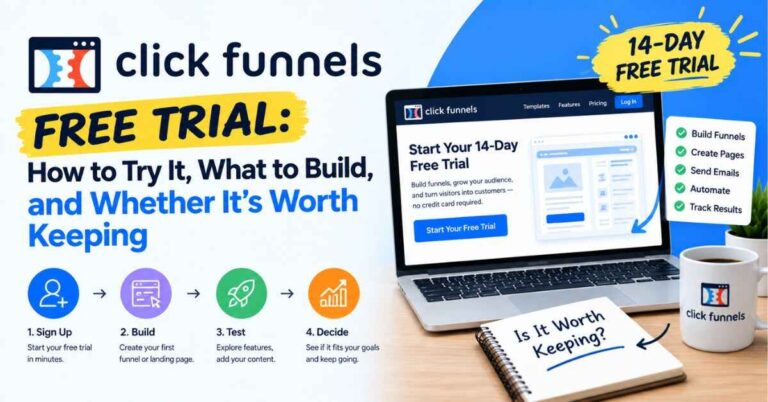
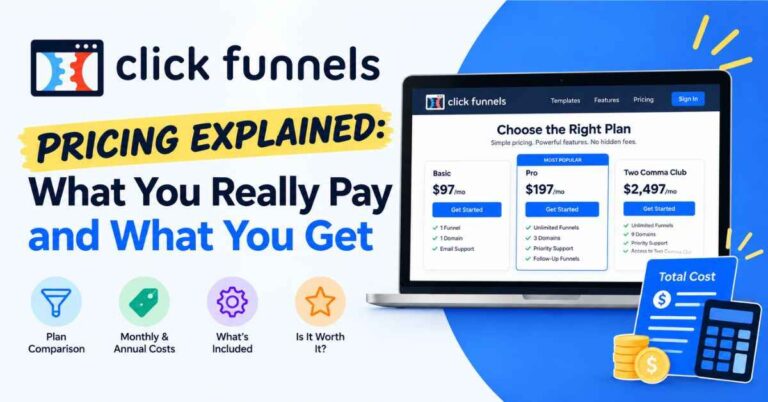
Inside ClickFunnels you get pages, checkout, order bumps and upsells, email tools, and automation. It’s been around since 2014, so it isn’t a new app that might vanish. Plans run from Launch at $97 a month to Scale at $197 and Optimize at $297, plus an annual-only plan for larger operations. Every plan includes unlimited funnels, pages, and visitors, and there’s a 14-day trial so you can look around first.
And What Is Kajabi?
Kajabi is a platform built for creators who sell knowledge: courses, coaching, memberships, and communities.
Its center of gravity is the learning experience. You upload lessons, organize them into a course, build a member area, and deliver content in a polished, professional way. It also includes email marketing, landing pages, and some sales tools, so you can run a business from one account.
It’s a premium product with premium pricing. After a pricing overhaul in early 2026, it now runs on three plans: Basic, Growth, and Pro. Annual pricing lands around $143, $199, and $399 a month, and monthly billing costs more. There’s a 14-day free trial.
One thing worth knowing: Kajabi caps your contacts and products by plan, and some features people expect, like an affiliate program and advanced automations, only appear on the higher tiers. If you use your own Stripe account, there’s an extra surcharge on top of Stripe’s normal fees.
I’m saying this not to scare you off. Kajabi is a genuinely good platform. It just helps to know what you’d be paying for.
ClickFunnels vs Kajabi: The Real Differences
Let’s skip the giant feature charts and talk about what you’d actually notice day to day.
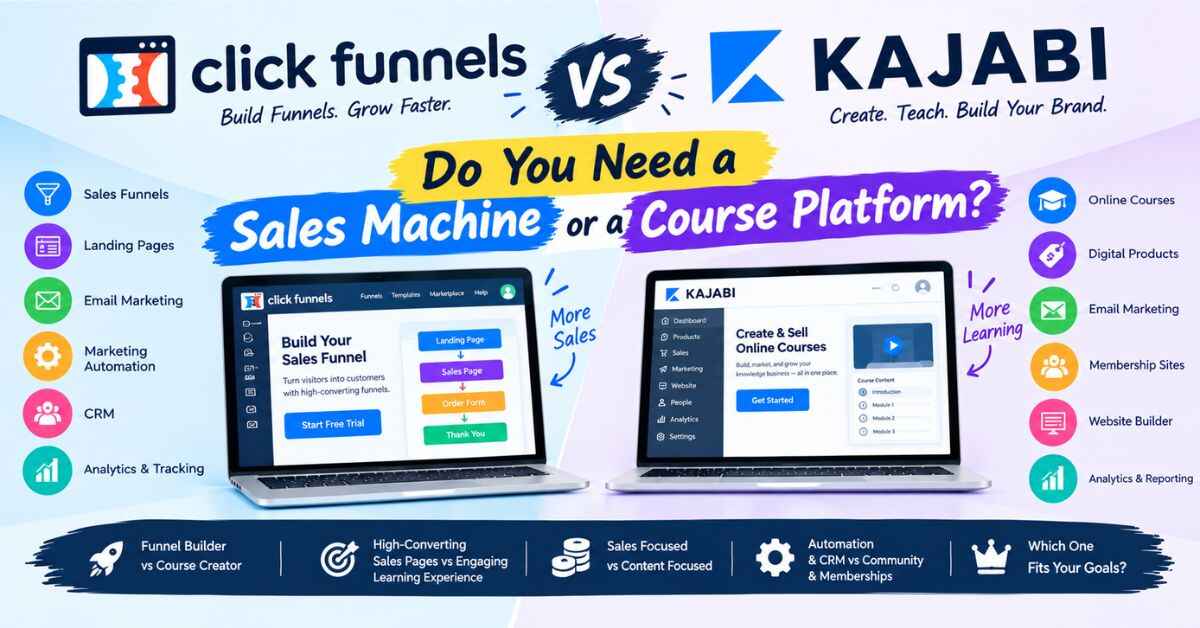
Main job
ClickFunnels is built to sell. Pages, checkout, upsells, and follow-up are the heart of the design.
Kajabi is built to teach and deliver. Courses, memberships, and communities are the heart of the design.
Both can do a bit of the other’s job. But you’ll feel the difference quickly. ClickFunnels feels like a sales system. Kajabi feels like a classroom with a store attached.
Conversion tools
This is where I think ClickFunnels pulls ahead. Checkout pages, order bumps, and one-click upsells are part of the design. Someone who came in for a $27 product might happily add a $17 extra at checkout. That small bump adds up without needing more traffic.
Kajabi has sales pages and checkout too, but they’re not the center of the product.
Course delivery
Here’s the other side. Kajabi wins on teaching tools. If you need structured lessons, student progress, a polished member area, and a community, Kajabi was built for that.
ClickFunnels isn’t a full learning management system. It can handle selling a course and delivering access, but it won’t match a dedicated course platform for heavy student features. I’d rather tell you that upfront than have you find out later.
Pricing
ClickFunnels starts at $97 a month on Launch. Every plan includes unlimited funnels, pages, and visitors.
Kajabi’s plans start higher on monthly billing and tie limits to contacts and products. A bigger list or a bigger catalog pushes you up a tier. For many creators, that’s fine and worth it. For someone who mostly wants to sell, it can feel like paying for a classroom they aren’t using yet.
Learning curve
Both are approachable. ClickFunnels is a drag-and-drop builder where you pick a funnel type, choose a template, click a headline, and type your own words. If you’ve ever made a slideshow, you’ll feel okay. A basic funnel can be live in a day or two.
Kajabi is also friendly, and many creators love how polished it feels. Because it covers the whole course experience, there’s more to set up before you launch.
Room to grow
ClickFunnels grows with you. Scale adds unlimited domains, webhooks, API access, the code editor, and more advanced automation. Optimize adds an Affiliate Center so you can run your own affiliate program.
Kajabi grows through its higher tiers, which add more products, contacts, admins, and features like affiliate tools.
👉 Curious what it feels like to build a sales path instead of a classroom? You can look around with the free trial and see for yourself:
Where Kajabi Wins
I promised an honest comparison, so here’s the other side. Kajabi has real strengths.
It’s built for teaching. If your business is courses, memberships, or a community, Kajabi’s structure fits that naturally.
It looks polished. Students get a clean, professional experience, which matters if you charge premium prices.
It’s one account for a lot. Courses, email, pages, and community tools sit together.
It has no transaction fees through Kajabi Payments. That’s a plus when you’re selling regularly.
If your top priority is delivering an excellent learning experience, Kajabi is a legitimate pick, and I wouldn’t try to talk you out of it.
Where ClickFunnels Wins
Now let me tell you where I think ClickFunnels pulls ahead, especially for people who need customers first.
It’s built around conversion. The structure of a funnel is designed to move someone toward a purchase, step by step, instead of dropping them on a page and hoping.
It’s easier to start with. Pick a funnel type, pick a template, change the words. That’s a very short path from “I have an idea” to “my page is live.”
Templates built around selling. Lead capture, product sales, webinars, call booking. You aren’t staring at a blank page. A few templates look a little dated, but they’re easy to restyle.
Checkout and upsells built in. More value from each customer without more traffic.
Everything lives in one place. Pages, checkout, email, contacts, and automation sit in one account. Fewer logins, fewer connections, fewer things to break.
Follow-up runs on its own. Most people don’t buy the first time. You can write a short email sequence once and let it run: a welcome note on Monday, a tip on Wednesday, a gentle nudge on Friday.
No limits on funnels, pages, or visitors. On every plan. If a post goes viral, you won’t get a surprise bill for the attention.
It works for more than courses. Coaches, consultants, local businesses, product sellers, and marketers all use funnels. If you ever sell something besides a course, you won’t need a different tool.
Who Should Pick Which?
Let me make this practical.
Pick ClickFunnels if:
- Your biggest challenge is getting people to buy
- You want a clear path from first click to checkout to follow-up
- You sell more than just courses, like coaching, services, or products
- You’d rather launch quickly than build a full classroom first
- You like predictable pricing that doesn’t depend on how many students you have
Pick Kajabi if:
- Your business is built around courses, memberships, or a community
- You already have an audience and mostly need a great place to teach
- A polished student experience matters more than sales tactics
- You’re comfortable paying premium prices for an all-in-one classroom
A simple rule of thumb: if your main question is “how do I get people to buy?”, start with ClickFunnels. If your main question is “how do I deliver and organize my teaching?”, Kajabi deserves a serious look.
And some people use both. A funnel to sell, a course platform to deliver. That’s a perfectly reasonable setup if your budget allows.
Real-Life Examples
Sometimes it’s easier to picture the thing than to read about it. Here are a few setups and which direction tends to make sense.
The coach with a $500 program. She wants an application funnel that filters out casual browsers, a booking page, and automatic reminder emails. ClickFunnels fits nicely, since the whole sales path lives in one place.
The first-time course creator. He has a short course and a small audience. He wants a sales page, checkout, and a few follow-up emails. ClickFunnels covers that without a big learning curve.
The established membership owner. She runs a large membership with lots of lessons, a community, and hundreds of students. Kajabi’s classroom tools are a strong match.
The consultant who sells services. He doesn’t have a course at all. He wants to turn a free guide into booked calls. ClickFunnels is the natural fit, since Kajabi would be more than he needs.
The product seller with one hero item. She’d rather spotlight a single product with a clear page and offer a bundle at checkout. ClickFunnels is a natural match.
The marketer building an email list. A blogger offers a free checklist, collects emails, and sends a short series recommending a paid resource. Simple, and ClickFunnels handles it easily.
Notice that nobody here gets a “universal winner.” There’s only a best match for where you are right now.
👉 If one of those stories sounded like you, the fastest way to find out is to open a template and spend ten minutes with it:
What About Price?
Let’s talk about it head on, because Kajabi’s pricing is a big part of why people search for this comparison.
Kajabi is a premium platform, and its plans cost more than ClickFunnels’ entry plan, especially on monthly billing. You also pay more as your contacts and product counts grow, and a few features sit on higher tiers.
ClickFunnels starts at $97 a month on Launch, which is where most beginners begin. Scale at $197 and Optimize at $297 add more room and advanced features. Paying yearly lowers the monthly cost. Email sending carries a small extra charge.
Here’s how I’d think about it. Ask, “What is one new customer worth to me?” If you sell a $500 coaching package and a funnel helps you land one extra client a month, it covers itself many times over. If you sell a $20 ebook, you’ll need more volume, though a funnel can also build your email list and sell add-ons.
Cost isn’t only the monthly fee. It’s also what you’re paying for. If you don’t have steady sales yet, a pricey classroom might be solving a problem you don’t have. A sales path might be the better first investment.
Both tools offer a 14-day trial. Try them with the same small project and see which feels more natural. Check each signup page for what’s required to start.
The Honest Downsides of ClickFunnels
I’d rather be upfront than pretend this tool is perfect.
It isn’t a full course platform. If heavy student tracking, community spaces, and a polished classroom are central to your business, Kajabi may serve you better.
It costs more than some lighter tools. If you only need one landing page, a simpler option will cost less. ClickFunnels pays off when you use more than one piece of it.
The dashboard can feel busy at first. There’s a lot inside, so give yourself a couple of days and follow the training. Most people catch on quickly.
Some templates feel a bit old. It’s an easy fix, since you can restyle them.
Email sending carries a small extra charge on top of your plan, so it’s worth keeping an eye on as your list grows.
And it won’t create your offer for you. This one applies to every tool on this list. If your offer is unclear or nobody wants it, no software will fix that.
That’s why some people say a tool “didn’t work” for them. They expected the software to do the thinking. It won’t, but it makes the doing much easier.
Tips Before You Choose
A few small habits will save you a headache, whichever way you go.
Name your biggest problem first. Is it getting buyers, or serving them? Pick the tool that solves that one.
Write down what you actually need. Pages? Checkout? Courses? Community? Automation? A short list keeps you from being dazzled by features you’ll never use.
Check how pricing scales. Ask what happens to your bill when your list or product count doubles.
Try both with the same project. Build one real funnel or one real lesson, not a practice one.
Don’t buy more than you need. Start with the plan that fits today. Moving up later is easy.
Pick one and commit for a month. Tool-hopping is one of the most expensive habits in online business.
My Take
After looking at both, here’s where I land.
Kajabi is a polished, capable platform, and for course and membership creators who care most about the student experience, it’s a strong choice. I won’t pretend otherwise.
But for most people reading this, someone with an offer who needs customers, I think ClickFunnels is the better first move. A great classroom doesn’t help if nobody walks through the door. ClickFunnels gives you the sales path: pages, checkout, upsells, and follow-up, in one place, without making you build a whole school before your first sale.
You don’t need the fanciest tool. You need a good fit, used consistently, with a clear offer behind it.
Final Thoughts
Comparing tools can feel productive, but at some point it turns into procrastination. If you’ve read this far, you probably already have a gut feeling about which one suits you.
Trust that feeling, then test it. Pick a template, build one small funnel, publish it, and watch what people do. You’ll learn more in one weekend of building than in a month of reading comparisons, even a helpful one like this, I hope.
👉 Ready to see if ClickFunnels fits the way you work? Take a look around and check the current trial details here:
Quick note before you go: some links in this post are affiliate links. If you sign up through one, I may earn a small commission at no extra cost to you. I only recommend tools I think are genuinely useful, and the opinions here are my own. Thanks for reading, and for supporting the site.