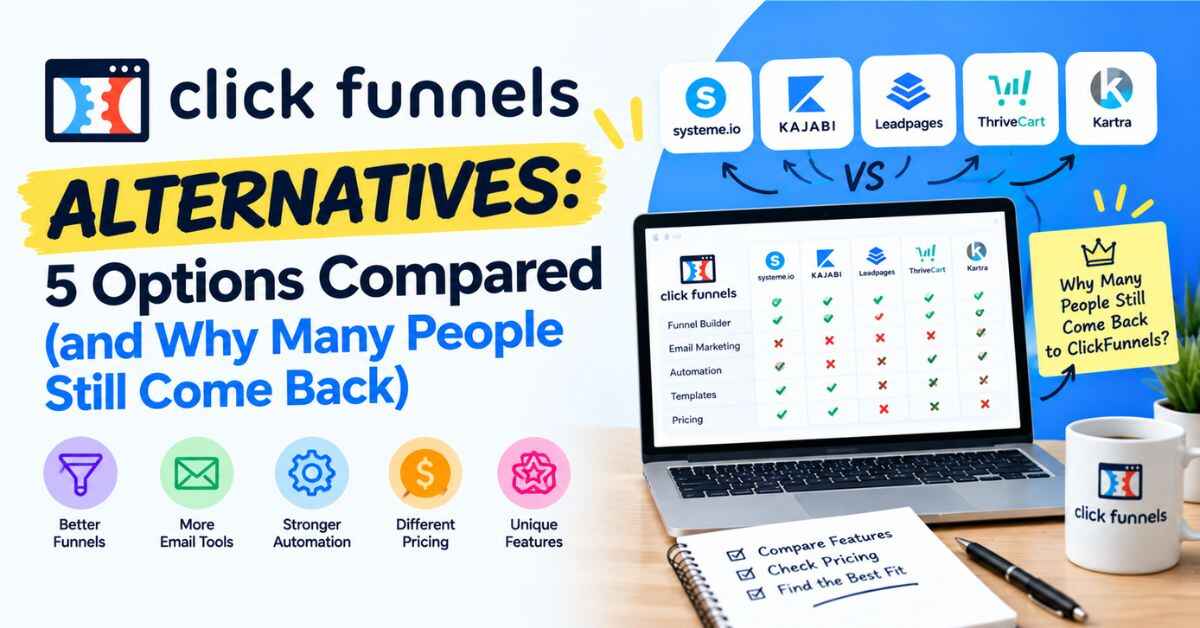
ClickFunnels Alternatives: 5 Options Compared (and Why Many People Still Come Back)
If you’re searching for ClickFunnels alternatives, I’m guessing one of three things is happening. Maybe the price made you wince. Maybe a friend swears by a different tool. Or maybe you just don’t like making a big decision without seeing what else is out there.
All fair. I’d do the same.
So here’s what I’m going to do. I’ll walk you through the main alternatives, what each one is good at, and where each one falls short. Then I’ll tell you honestly where ClickFunnels fits in, because I think it’s still the better choice for a lot of people, just not everyone. By the end you’ll know which direction makes sense for you.
Let’s start with why this decision feels so slippery in the first place.
Why “Just Compare Them” Is Harder Than It Sounds
Picture this. You open a browser tab to compare funnel builders. Twenty minutes later you have eleven tabs open, three pricing pages that don’t match, and a spreadsheet you started and abandoned.
Every tool says it’s the best. Every list online puts a different tool at number one, and surprise, that tool often happens to be the one paying the blogger. Prices are listed as “starting at,” which rarely matches what you’d pay for what you need. Features are described in a language you only half understand.
Meanwhile, your offer is sitting there. Your idea, your product, your service. It’s not reaching anyone while you debate software.
I’ve watched people stay stuck in this loop for months. They tell themselves they’re doing research. What they’re really doing is delaying the part where they get customers.
That’s the first problem. The second one is quieter, and it costs more.
The Real Cost of Picking Wrong
Here’s what happens when you pick a tool that doesn’t match your needs.
If it’s too simple, you start bolting things onto it. A plugin here, an extra service there. Before long you’re paying for five tools, and they don’t always get along. A form stops syncing, a payment doesn’t unlock the right page, and you lose sales without knowing it.
If it’s too complicated, you spend your first month watching tutorials and building nothing. Momentum dies. Excitement fades. The tool becomes a monthly charge you feel guilty about.
And if it’s the wrong shape entirely, say a landing page tool when you really need checkout and email, you end up switching later. Switching means rebuilding pages, moving contacts, and re-learning menus. That’s a weekend you’ll never get back.
So yes, price matters. But fit matters more. A $97 tool that fits is cheaper than a $30 tool you outgrow in three months.
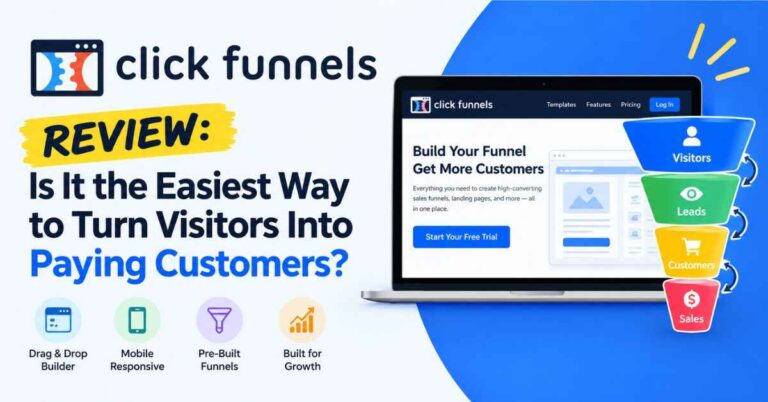
Keep that in mind as we go through the options. Also read: ClickFunnels Review: Is It the Easiest Way to Turn Visitors Into Paying Customers?
First, What Is ClickFunnels?
Since we’re comparing things, let’s make sure we all know what the baseline is.
ClickFunnels is a platform that lets you build the whole path a customer takes, from the first click to the final purchase, in one place.
That path is called a funnel. Think of a good restaurant. You walk in, you get a clear menu, you order, someone suggests dessert, you pay, and a few days later you get a thank-you note. Every step leads naturally to the next one.
A funnel does that for your online business. Instead of dropping visitors onto a busy website where they wander off, you guide them one step at a time toward one action: sign up, book a call, or buy.
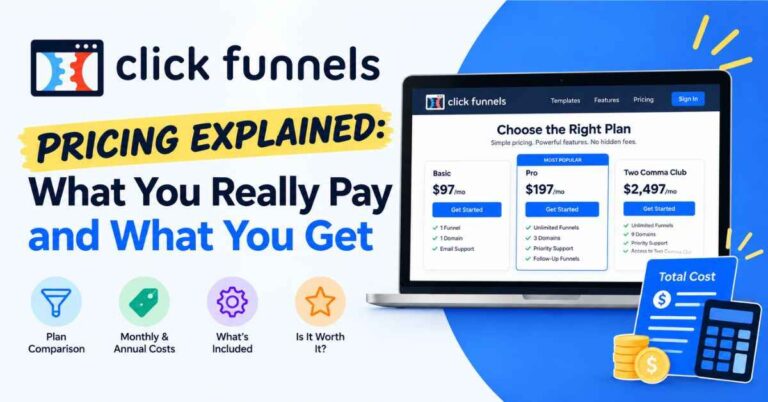
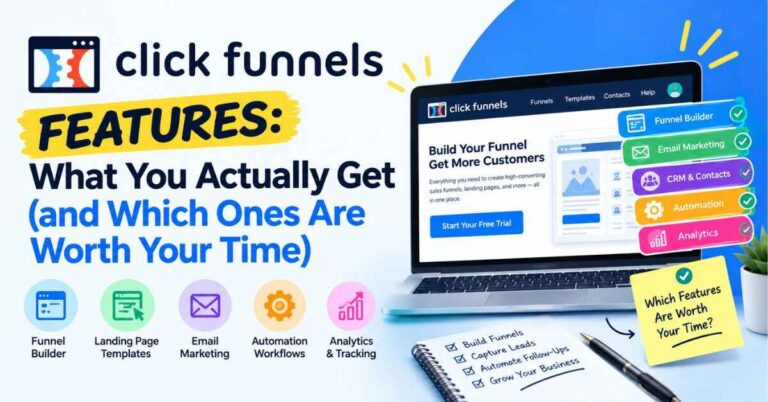
Inside ClickFunnels you get the pages, the checkout, order bumps and upsells, email tools, and automation. It’s been around since 2014, so it isn’t a new app that might disappear. And the pricing is straightforward: Launch at $97 a month, Scale at $197, Optimize at $297, plus an annual-only Dominate plan for larger operations. Paying yearly lowers the monthly cost, and email sending has a small extra charge.
Now let’s look at what else is out there.
ClickFunnels Alternatives: The Main Contenders
I’m going to keep this simple. For each one, I’ll tell you what it’s good at, where it struggles, and who it’s best for.
1. Systeme.io: the budget pick
If your main concern is cost, this is usually the first name that comes up. Systeme.io offers a free plan and low-priced paid plans, and it covers funnels, email, courses, and checkout.
Where it shines: Price. For a solo seller who wants a lot for very little, it’s hard to beat. It’s a good fit for beginners watching every dollar.
Where it falls short: It’s simpler and has less depth than a funnel-focused tool. Templates and design flexibility tend to be more basic, and advanced funnel features like the ones ClickFunnels is known for are lighter.
Best for: Solopreneurs and small sellers who want an affordable all-in-one and don’t need advanced funnel features.
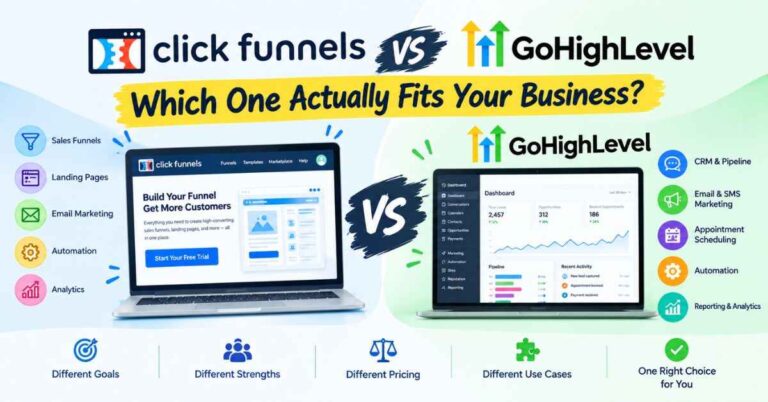
2. GoHighLevel: the agency pick
GoHighLevel is a heavyweight built around CRM and automation, and it’s especially popular with agencies who manage multiple client accounts. Its starter plan has the same headline price as ClickFunnels Launch.
Where it shines: Deep CRM, client management, and the ability to run lots of accounts under one roof. If you’re an agency, this is a serious contender.
Where it falls short: The learning curve is steep, and the interface feels busier. Some usage-based charges, like texting and certain add-ons, are billed separately, so the real cost can climb.
Best for: Agencies and service businesses that need CRM muscle and client management.
3. Kartra: the course creator’s all-in-one
Kartra is another all-in-one with a long list of features, including strong automation and checkout.
Where it shines: Depth. It does a lot, and it can handle more complex setups, especially for course creators and membership-style businesses.
Where it falls short: It tends to cost more as you grow, since pricing climbs with your contact list, and the amount of stuff inside can be overwhelming for beginners.
Best for: Course creators and businesses that want heavy automation and are happy to pay for it.
4. Leadpages and Unbounce: the page-first tools
If all you need is great landing pages, these are focused tools built around exactly that. Some of them also offer features like testing and analytics on certain plans.
Where they shine: Page design and lead capture. They’re often simpler to learn because they do fewer things.
Where they fall short: They aren’t full funnel platforms. If you need checkout, upsells, email, and automation in the same place, you’ll end up adding other tools.
Best for: People who already have email and checkout sorted elsewhere and just need pages.
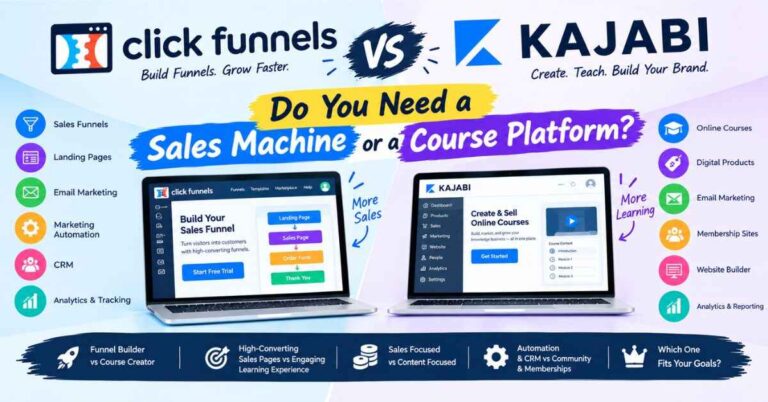
5. Kajabi: the course platform
Kajabi leans toward courses, memberships, and communities.
Where it shines: Delivering and organizing educational content, with a polished experience for students.
Where it falls short: It’s usually one of the pricier options, and it isn’t built around funnel tactics like order bumps and sales sequences the way ClickFunnels is.
Best for: Established course creators who care most about the student experience.
👉 Want to see how ClickFunnels stacks up with your own eyes? You can look inside and try it out here:
So Where Does ClickFunnels Fit?
Here’s the honest picture.
ClickFunnels isn’t the cheapest. Systeme.io beats it on price, and that’s just a fact. It isn’t the best for agency-scale CRM either, since GoHighLevel is built for that. And it isn’t a dedicated course platform like Kajabi.
What ClickFunnels is great at is one specific thing: helping you build a clear path from visitor to buyer, fast, in one place. One recent comparison I read described it as still the strongest pure funnel builder among the tools it looked at, and others point to its edge in funnel optimization. That lines up with what I hear from people who use it.
Think of it this way. Some tools are Swiss Army knives. Some are specialized power tools. ClickFunnels is a really good, sharp knife for one job: turning attention into sales. If that’s your job, it’s a strong pick.
What You Actually Get With ClickFunnels
Let me skip the long feature list and talk about what helps in real life.
It doesn’t require a tech background. The builder is drag and drop. You pick a template, click a headline, type your own words, and swap the image. If you’ve ever made a slideshow, you’ll feel okay here. A basic funnel can be live in a day or two.
Templates save you from the blank page. There are ready-made layouts for collecting leads, selling products, running webinars, and booking calls. They’re built around setups lots of marketers have already used. Some look a little dated, but they’re easy to restyle.
It’s built around selling. Checkout pages, order bumps, and one-click upsells are part of the design. Someone who came in for a $27 product might happily add a $17 extra at checkout. That small bump adds up, and on a plain website it takes extra plugins to pull off.
Everything lives in one place. Pages, checkout, email, contacts, and automation sit in one account. Fewer logins, fewer connections, fewer things to break.
Follow-up runs on its own. Most people don’t buy the first time. You can write a short email sequence once and let it run: a welcome note on Monday, a tip on Wednesday, a gentle nudge on Friday.
No limits on funnels, pages, or visitors. On the current plans you’re not counting pages or watching a traffic meter. If a post goes viral, you won’t get a surprise bill for the attention.
Room to grow. Scale adds unlimited domains, webhooks, API access, the code editor, and more advanced automation. Optimize adds the Affiliate Center so you can run your own affiliate program.
A Quick Way to Choose
If you’re still weighing it up, here’s a plain-English guide.
Choose ClickFunnels if your main goal is selling and you want pages, checkout, upsells, and follow-up in one place. It’s a strong match for coaches, consultants, course sellers, local businesses, product sellers, and marketers.
Choose Systeme.io if budget is your top priority and you’re okay with a simpler feature set. Great for getting started on a shoestring.
Choose GoHighLevel if you’re an agency managing clients and you need deep CRM, and you don’t mind the steeper learning curve.
Choose Kartra if you run a course or membership business and want heavy automation, and you’re comfortable with pricing that climbs.
Choose a page-first tool if you already have email and checkout handled and just need landing pages.
Choose Kajabi if polished course delivery matters more than selling tactics.
I’m not going to pretend ClickFunnels is the answer to everything. If one of the other descriptions sounds more like you, go with it. That’s what this comparison is for.
Real-Life Examples
Sometimes it’s easier to picture the thing than to read about it. Here are a few setups and which direction tends to make sense.
The coach who wants more booked calls. She sells a $500 package and wants an application funnel that filters out casual browsers. ClickFunnels fits well here. A simple application form, a booking page, and automatic reminder emails, all in one place.
The new creator with a tight budget. He’s launching a $29 ebook and watching every dollar. Systeme.io could be a smart place to start. It’s cheap, it works, and he can upgrade later.
The agency with twelve clients. She needs separate accounts, CRM, and reporting for each client. GoHighLevel was built for this, and it’s likely the better match.
The local salon owner. She wants a free-first-visit offer that collects emails and books appointments. ClickFunnels works nicely here. A short funnel with a booking link and follow-up reminders is all she needs.
The established course creator. He has a few hundred students and cares most about the classroom experience. Kajabi could fit better, since it’s built around that.
The product seller with one hero item. She’d rather spotlight a single product with a clear page and offer a bundle at checkout. ClickFunnels is a natural fit.
Notice that none of these has a “best tool.” There’s just a best match.
👉 If one of those stories sounded like you, the fastest way to test it is to open a template and spend ten minutes with it. You can look around here:
The Honest Downsides of ClickFunnels
I’d rather be upfront than pretend there are no tradeoffs.
It’s not the cheapest option. If you only need one landing page, or if cost is your biggest concern, a lighter or free tool may serve you better. ClickFunnels pays off when you use more than one piece of it.
The dashboard can feel busy at first. There’s a lot inside, so give yourself a couple of days and follow the training. Most people catch on quickly.
Some templates feel a bit old. It’s an easy fix, since you can restyle them.
It isn’t a full course platform. For heavy-duty student tracking, a specialized tool might serve you better.
And it won’t create your offer for you. This one matters most, and it applies to every tool on this list. If your offer is unclear or nobody wants it, no software will fix that.
That’s why some people say a tool “didn’t work” for them. They expected the software to do the thinking. It won’t, but it makes the doing much easier.
What About Price?
Let’s be honest about the numbers, since price is often why people search for alternatives in the first place.
ClickFunnels starts at $97 a month on Launch, which is where most beginners begin. Scale at $197 and Optimize at $297 add more room and advanced features. There’s a 14-day trial, so you can look around before you commit. Check the signup page for what’s required to start.
Is that a lot? Next to a free tool, yes. But think about what you’d pay for a page builder, an email tool, a checkout system, and automation separately. Often the total is similar or higher, and none of it talks to the others without effort.
Here’s how I’d think about it. Ask, “What is one new customer worth to me?” If you sell a $500 coaching package and a funnel helps you land one extra client, it covers itself. If you sell a $20 ebook, you’ll need more volume, though a funnel can also build your email list and sell add-ons.
And if your budget is tight right now, there’s no shame in starting with a cheaper tool. You can always move later, once you have a first sale and some breathing room.
Tips Before You Switch (Or Start)
A few small habits will save you headaches, whichever tool you choose.
Write down what you actually need. Pages? Checkout? Email? Courses? Client accounts? A short list keeps you from being dazzled by features you’ll never use.
Use free trials. Most of these tools offer one. Build one real funnel, not a practice project.
Don’t buy the biggest plan “just in case.” Start with what fits today.
Think about moving costs. If you already have pages and contacts somewhere, factor in the time to rebuild them.
Pick one and commit for a month. Tool-hopping is the most expensive habit in online business.
My Take
After looking at everything, here’s where I land.
There are good ClickFunnels alternatives, and some are the better pick for certain people. If you’re on a shoestring budget, an agency, or a course-first creator, one of the others may suit you better, and I’d say so.
But if your goal is to turn visitors into customers with a clear, simple path, and you’d like your pages, checkout, upsells, and follow-up in one place, ClickFunnels is still one of the strongest options out there. It’s built for that job, and it shows.
You don’t need the perfect tool. You need a good-enough tool, used consistently, with a clear offer behind it.
Final Thoughts
Comparing tools can feel productive, but at some point it turns into procrastination. If you’ve read this far, you probably have a gut feeling about which one fits.
Trust that feeling, then test it. Pick a template, build one small funnel, publish it, and watch what people do. You’ll learn more in one weekend of building than in a month of reading comparisons, even a helpful one like this, I hope.
👉 Ready to see if ClickFunnels fits the way you work? Take a look around and check the current trial details here:
Quick note before you go: some links in this post are affiliate links. If you sign up through one, I may earn a small commission at no extra cost to you. I only recommend tools I think are genuinely useful, and the opinions here are my own. Thanks for reading, and for supporting the site.