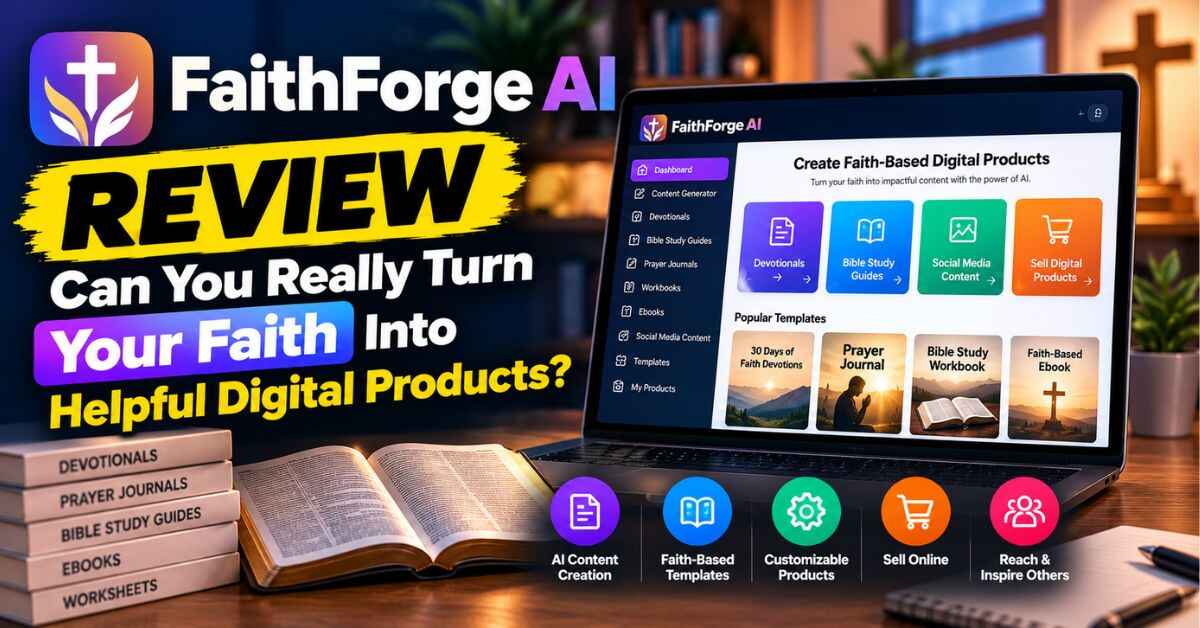
FaithForge AI Review 2026: Can You Really Turn Your Faith Into Helpful Digital Products?
Maybe you’ve sat down on a quiet evening with your Bible open and thought, “I should write this down. Somebody else could use this.” Then the blank page stared back, and twenty minutes later you were scrolling your phone instead. If that’s you, this FaithForge AI review is worth a few minutes of your time. I went through the whole sales page, every feature, every claim and the fine print, and I’ll tell you what it does, what it doesn’t, and who it might actually suit.
I’ll be upfront about one thing: I’m not going to promise you riches. The product’s own page doesn’t either, which is one of the reasons I kept reading.
The Idea Is Beautiful. The Process Usually Isn’t.
Most believers I know carry around more material than they realize. Years of Sunday school lessons. Notes scribbled in the margins of a study Bible. A prayer that got them through a hard season. A way of explaining Scripture that finally made it click for a friend.
It’s real knowledge. But turning it into something other people can use is a different job entirely.
You have to pick a topic. Research it. Write it in a way that holds attention. Check every single verse by hand, because getting a quote wrong feels awful. Then you need a cover, a layout, a place to put it, a way to take payment and a way to let anyone know it exists. And once you’ve done all that for one devotional, you realize a real library means doing it fifty more times.
That’s where most good ideas quietly die. Not because the person lacked faith or talent, but because the work between “I have something to share” and “someone can actually read it” is longer than it looks.
The Usual Options Don’t Feel Great Either
There are really four paths people take, and each has a catch.
Do it all yourself. This is free in money and expensive in time. Every devotional means hours of drafting, formatting and designing, and then you do it again next week.
Buy ready-made content. Some memberships hand you devotionals and graphics for around $27 a month. That saves time, but thousands of other members get the exact same material. It isn’t yours, and it doesn’t sound like you.
Stitch together separate tools. One for writing, one for graphics, one for the website, one for the store. Before long you’re moving files between tabs and paying a handful of monthly fees, and what started as a desire to encourage people has become a tech project.
Hire people. Writers, designers, a developer for the site. It works, but the cost climbs quickly, and every new piece means another round of waiting.
None of that is wrong. It’s just a lot, especially if you’re doing this alongside a job, a family and a church schedule. Which is why so many people never start.
So What Is FaithForge AI?
FaithForge AI is a web-based platform built specifically for faith content. Not a generic chatbot with a cross stuck on the homepage, but a set of tools designed around devotionals, prayers, Bible studies, sermons, Christian books and similar resources, plus the website and store you need to put them in front of people.
You log in from a browser, so there’s nothing to install. You choose what you want to make, tell it a few details, and it produces a draft you can read, edit and approve before anything goes live.
Here’s what’s inside, going by the sales page:
- Ten separate creators covering devotionals, sermons, Bible studies, prayers, Christian books, quotes, Bible verse posts, reels scripts, ministry newsletters and sales copy
- A scripture graphics studio that turns a verse into a finished image
- A spoken-word tool that turns your written devotionals or prayers into natural-sounding audio
- A no-code website builder with free subdomains
- A digital product store connected to your own Stripe or PayPal account
- An Amazon affiliate faith store
- A scheduler so you can line up a month of daily devotionals and let them publish on their own
- 200+ templates for occasions like Easter, Christmas, Lent, weddings and funerals
- A done-for-you library of ready-made resources to start with
- A commercial license, plus a church services license if you want to create content for congregations
That’s a long list, so let me explain what actually matters in practice.
How It Works, Without the Hype
The process has three steps.
First, you choose. Pick a topic, a scripture or an occasion. Say you want a devotional about overcoming fear, or a set of prayers for people going through grief. You also tell it your church tradition and the tone you want.
Second, you click create. The page says a first draft usually shows up in under a minute. You read it, change whatever you like, add your own story if you want to, and approve it.
Third, you publish. Send it to your FaithForge website, list it in your store, export it as a document, or prepare it for places like Amazon or Etsy.
That’s it. The marketing line is that if you can send a text message, you can use it. I wouldn’t promise it’ll feel effortless for every person, but the flow is simple enough that I believe it. See what’s inside FaithForge AI
The Benefits That Actually Matter
Instead of repeating the whole feature list, here are the parts I think make the biggest difference.
The Scripture Is Looked Up, Not Guessed
This was the first thing I wanted to check, because it’s where AI tools usually go wrong. According to the page, every verse in your content is pulled from the Bible text itself, in the New Living Translation, rather than being generated from memory. Anyone who has seen a chatbot confidently “quote” a verse that doesn’t exist will understand why this matters. You still read every page before it goes out, and nothing publishes without your approval, but not having to verify each reference by hand is a real relief.
One thing to note: it’s NLT. If you prefer another translation, that’s worth keeping in mind.
It Follows Your Tradition
You can set Catholic, Baptist, Pentecostal, Methodist, non-denominational and others, and the content is meant to follow that. Generic faith content that doesn’t match what you believe is a headache to fix, so starting closer to the mark saves editing time.
You Don’t Start From Zero
There are 200+ templates and a done-for-you library on day one. If you’ve ever stared at an empty document wondering what to make first, having a shelf already stocked is a gentler way in. And when someone you know loses a loved one, having the right words waiting is a small mercy.
It Handles the Parts Most People Hate
Writing is only half the battle. The website, the store, the checkout and the scheduling are the pieces that usually make people quit. Having those under one roof means you aren’t paying for five tools or learning five interfaces.
You Keep Your Own Money
The page says buyers pay into your own Stripe, PayPal or bank account, and the platform doesn’t touch your money. You also get commercial rights, so you can sell what you create.
You Can Stay Behind the Scenes
No camera, no voice recording, no building a following with your face. You can even publish under a pen name. For anyone who feels shy about putting their name on this, that removes a big barrier.
One Payment, No Subscription
The price is a one-time $17 during the launch, with lifetime access and no monthly fees. The page says the regular price is $97 and that the price can go back up after the launch window.
Where Could This Actually Help? (Real-World Examples)
Let me make this concrete, because features only mean something when you can picture them.
The longtime Sunday school teacher. She has thirty years of lessons in her head and a shoebox full of notes. She’d love to turn them into a devotional series but doesn’t have the time or confidence to write it all out. Here, she could pick a theme, set her tradition, generate drafts, rewrite them in her own voice, and schedule a month of daily devotionals in one afternoon.
The volunteer who runs the church newsletter. Every week there’s another bulletin, another prayer list, another study handout. A tool that gives you a solid first draft means you spend your energy on the personal touches instead of the blank page.
The small-time creator who wants a side income. Maybe you already share verse posts or encouragement online. With the graphics studio, reels scripts and a store, you could turn that into small digital products, like prayer journals or printables, that people can buy.
The person offering services to churches. The church services license lets you create content for congregations as a paid service, and the page mentions a client dashboard, package templates and contracts. A lot of small churches have nobody to make bulletins and devotionals, so this is a real gap.
The grandparent building a legacy. The page tells a story about a grandfather writing devotional books in his own voice for his grandchildren. Whether or not you ever sell a copy, there’s something lovely about leaving that behind.
The curious beginner. Not everyone is trying to earn. Some people just want to create meaningful resources for their family or small group and see what’s possible.
About the Money (Let’s Be Honest)
The sales page itself is fairly direct here, which I appreciated. It says outright that it isn’t going to promise you’ll get rich overnight, that some devotionals will sell nothing at all, and that a realistic average for one piece of content is around $50 a month. It then shows a table where more assets add up to more income, and labels those as portfolio calculations, not promises.
I like that framing. It’s closer to how digital products really behave. A single devotional rarely changes your life, but a growing library can compound over time, if you keep creating, learn what people respond to and put real effort into getting it seen.
Now, here’s where I’d add my own caution. The page also has a line in the FAQ saying there’s “absolutely no way” your content won’t sell because it gets published to Amazon and Etsy. I wouldn’t take that literally. Being listed somewhere isn’t the same as being bought, and nobody can guarantee sales. The honest version is the one earlier on the page: results depend on your effort, your topics and your market. Also read: NEURA AI Review 2026: Is One Dashboard Really Worth Seven AI Subscriptions?
FaithForge AI Review: Things to Think About Before You Buy
You deserve the balanced view, so here it is.
Amazon is crowded with AI-written religious books. The page actually admits this. It cites one analysis that flagged 63% of 2,034 religious books on Amazon as AI-written, and notes that Amazon now asks publishers to disclose AI-generated content and limits self-publishers to three new titles a day. That means this isn’t a land-grab where you click a button and cash in. What will set your work apart is the part the software can’t do for you: your review, your edits, your own experience and your honesty about how it was made.
Be open about using AI. I’d say so plainly. Something like, “Software helped with the drafting, and I checked every word.” Faith readers tend to respect honesty a lot more than polish, and platform rules increasingly ask for it.
A machine can’t pray for you. The page says this itself, and I agree. The tool can draft, format and look up verses. The faith, the choice of subject and the final approval are yours. Treat the output as a first draft and put your heart into the editing.
The bonuses are a different kind of product. The four extras (CashAI, TraffixAI, Zyntri and Xyro) are aimed at ClickBank promotion and free traffic, and their descriptions include big daily-income claims. I’d treat them as optional extras and keep your expectations modest. The main value here is the faith content platform.
The usual earnings caveat applies. The testimonials and any income figures aren’t typical, as the page’s own disclaimer says. Whatever you earn will depend on how much you create, how well you serve your audience and how you get it seen.
The positive side of all this is that the risk is low. It’s $17, there’s a 30-day money-back guarantee, and the page lists the owner’s name (Peter Onwe) and a support email, which is more than a lot of launches bother to do. If it doesn’t suit you, you can ask for your money back.
Who FaithForge AI Is Probably Good For
- Believers with ideas and experience who get stuck at the blank page
- Church volunteers and ministry leaders who need steady content
- Christian creators who want a simpler way to keep producing
- People who’d like to offer content services to local churches
- Anyone who wants to test a small faith-based digital product business without a big investment
- Anyone tired of paying separate monthly fees for writing, design and website tools
Who Might Want to Skip It
- If you want a guaranteed income with no effort, no tool will give you that
- If you’re not comfortable using AI-assisted drafts for faith content, this isn’t for you, and that’s a fair line to draw
- If you want deep customization of every word, you’ll be editing a lot, and you may prefer writing from scratch
- If you only need a single devotional, doing it by hand might be easier
So, Is It Worth It?
Here’s how I’d think about it. A freelance writer might charge anywhere from $50 to $150 for one devotional piece, and a basic website setup can cost a few hundred dollars. FaithForge AI bundles drafting, graphics, audio, a website, a store and scheduling for $17, with a refund window if it doesn’t work out. Even if you only use half of it, the math is hard to argue with.
But the real question isn’t price. It’s whether you’ll actually use it. A tool only helps if you sit down with it. So my suggestion is simple: don’t plan a whole business yet. Pick one topic that matters to you, maybe the scripture that got you through your hardest year. Generate a draft. Read it, change it, make it sound like you. In an hour you’ll know whether this fits the way you work. Take a look at FaithForge AI and try your first devotional
The page says the $17 price is a launch offer and can return to $97, so if you’re even a little curious, it makes sense to check where things stand today.
Quick FAQ
Do I need to be a writer or a tech person? No. You choose a topic and click through the steps, then review the result.
Is there a monthly fee? The page lists a one-time $17 payment for lifetime access.
Can I choose my denomination? Yes. Catholic, Baptist, Pentecostal, Methodist, non-denominational and others are listed.
Can I use a pen name? Yes, the page says you can publish under a pen name and don’t need to show your face.
Can I sell what I create? Commercial rights are included, and payments go to your own Stripe or PayPal account.
What if it’s not for me? There’s a 30-day money-back guarantee.
Final Thoughts
I’ve read a lot of launch pages, and plenty of them lean hard on pressure. What stood out here is that this one slows down to talk about the questions most believers actually have: Is it wrong to make money from faith? Can I trust AI with something this important? Will the scripture be accurate? Those are fair questions, and the answers on the page are more thoughtful than I expected.
Whether FaithForge AI is right for you comes down to a simple thing. Do you have something to share, and has the work between the idea and the finished product been the thing holding you back? If so, this is a low-cost, low-risk way to find out.
Curious to see it for yourself? You can look at everything inside and check the current offer here: See what’s inside FaithForge AI
Quick note: this post contains affiliate links. If you click one and decide to buy, I may earn a small commission at no extra cost to you. It helps me keep writing these reviews. I only recommend things I think are worth a look, and I’d always rather you buy something that helps you than something that doesn’t. Please do your own research, and remember that results depend on your own effort.