AutoCinema AI Review 2026: Turn One Sentence Into a Full Season of Short Drama
You’ve probably done this.
You open TikTok or Reels for “just a minute.” A woman is being thrown out of a family mansion. Thirty seconds later, you learn she’s the secret owner of the company. The episode ends right as the door opens. And you tap to the next one before you’ve even decided to.
That’s the pull of short vertical drama, and it’s the reason I took a close look at this AutoCinema AI review topic. It’s a new tool that says it can turn one sentence into a whole season of these episodes, with the same faces and voices all the way through. I’ll walk you through what it does, who it’s for, where the limits are and whether it’s worth a look at the launch price.
Let’s start with why this format is so hard to make.
The Problem With Making Short Drama
Short dramas look easy because each episode is only a minute or so. But a single series isn’t three videos. It’s often 20, 30, even 50 episodes, and each one needs the same cast, the same look and a story that actually builds.
Here’s what making one the traditional way involves:
- Writing dozens of short scripts, each with a hook and a cliffhanger
- Casting actors, and paying them for every shoot day
- Locations, cameras, lighting, sound
- Editing every episode, adding music and captions
- Doing it all again and again, on a schedule
That’s a budget most creators will never have. And that’s why you see so few independent creators making real series.
So people turned to AI video tools. And that’s where the second problem shows up.
Why AI Clips Don’t Become a Series
Most AI video tools can make a nice clip. A few seconds of something cool looking. Maybe a whole video if you’re patient.
But a drama needs the same person to look like the same person in episode 1 and in episode 20. And that’s where regular AI tools tend to fall apart. The face shifts a little. The hair changes. The voice sounds different. The lighting jumps.
For a one-off video, nobody minds. For a story, it breaks the spell. Viewers stop believing in the character, and once they stop believing, they stop watching.
On top of that, creators who try to build a series by hand with several separate tools often report spending days per episode on generating, fixing and editing. That’s how an exciting idea turns into a half-finished project on a hard drive.
If any of this sounds familiar, you’re not alone. It’s one of the most common reasons good story ideas never get finished.
So What Is AutoCinema AI?
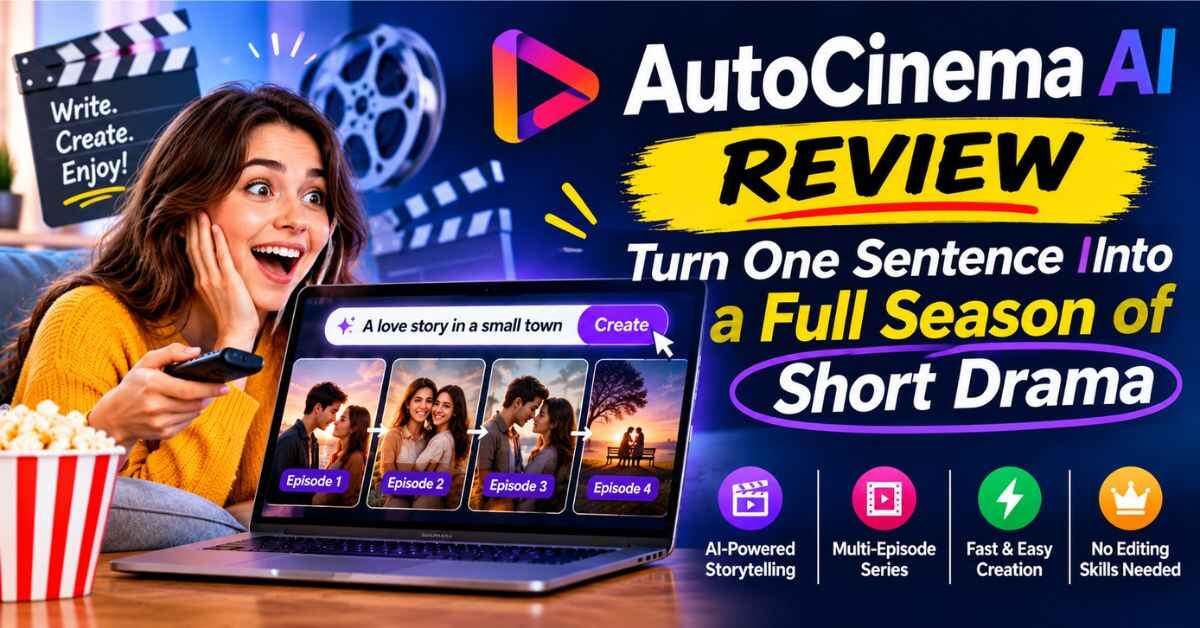
AutoCinema AI is a browser-based AI studio built to turn a single story idea into a connected, multi-episode drama. You don’t download anything. You open it, type your idea, choose how many episodes you want, and the studio handles the production steps.
According to the creators, here’s what it takes care of:
- Plans the whole season with episode plots, twists and cliffhangers
- Creates the cast and locks their faces, looks and voices across episodes
- Writes the scripts and dialogue and breaks scenes into shots
- Generates the visuals as cinematic scenes
- Adds voices, music and sound effects
- Adds captions, plus titles and thumbnails
- Delivers finished episodes in vertical or widescreen format
It’s sold as a one-time payment, listed at $14.95 on the sales page, with a commercial license and a 30-day money-back guarantee. There’s no monthly subscription for the app, according to the page.
That one-time part matters to me. If you’ve ever added up the monthly bills for a video tool, a voice tool, an image tool and an editor, you know how fast it climbs.
👉 Want to see what a finished episode actually looks like? Watch the AutoCinema AI demo here
AutoCinema AI Review: How It Works, Step by Step
I like products that are easy to explain, and this one is. Here’s the flow as the sales page describes it.
Step 1: Open it in your browser.
No downloads, no installs and no complicated setup.
Step 2: Describe your season.
You type one idea. The example on the page is a billionaire who falls for a poor girl who’s secretly plotting revenge against his family. You pick the number of episodes and let it go.
Step 3: The AI plans the story.
It maps out the whole season, including the big twists and the cliffhangers. It decides where the story should build, where it should shock people and where it should end.
Step 4: It creates your cast.
Main characters, villains and supporting roles, each with a consistent look.
Step 5: Scripts and storyboards.
It writes the dialogue and breaks each scene into shots.
Step 6: Scenes, voices and music.
It generates the visuals, adds character voices, a soundtrack, sound effects and captions.
Step 7: Review and publish.
You get connected episodes that are ready to review and upload to short-form platforms. And if something isn’t right, you can edit a script, swap a voice or regenerate a scene without starting over.
The page says episodes usually run around 60 to 90 seconds, which is the length this style tends to work best at.
That’s the whole routine. One idea in, finished episodes out.
The Features That Matter Most
A long feature list is easy to scroll past, so here are the ones I think make a real difference.
Character consistency.
This is the headline. You define the cast once, and the tool is built to keep faces, voices and personalities steady from the first episode to the last. For a story-driven series, this is the thing that separates a real drama from a pile of random clips.
A planned season arc.
Instead of making one episode at a time and hoping it connects, the studio plans the whole season first. The page describes a typical shape: a strong opening, a twist partway through, rising stakes, a betrayal, a climax and a final episode that leaves a door open. When the plan is built in from the start, later episodes can pay off earlier ones.
Hooks and cliffhangers.
Short drama lives or dies in the first few seconds and the last few. The tool is built around opening in the middle of the conflict and ending on a question that makes you want the next episode.
Editable scenes.
You can fine-tune dialogue, pacing and scenes. Don’t like an episode? Fix it without redoing everything.
Voices, music and captions in one place.
No jumping between five tools. Expressive voices, soundtracks and sound effects are included, plus captions for people who watch with the sound off, which is a lot of us.
Any genre.
Romance, revenge, billionaire drama, mystery, horror, fantasy, sci-fi, comedy and more. You also pick the visual style, from realistic to stylized to anime.
Vertical and widescreen.
Make vertical episodes for TikTok, Reels and Shorts, or widescreen for YouTube.
Languages.
The page says you can generate versions in different languages from the same season. Test the languages you care about before you rely on it.
Titles and thumbnails.
It creates dramatic titles, thumbnails and descriptions, so you’re not starting from scratch on packaging.
Commercial license.
You can use what you create for YouTube, social media, marketing and client projects, according to the page.
Why Short Drama Is Worth Paying Attention To
Here’s why this whole category has people talking.
Short vertical drama is built for the way we use our phones. Episodes are quick. The stories are simple to follow and packed with emotion: secret identities, betrayals, forbidden love, family secrets, revenge finally served. And every episode ends in a way that makes the next one feel necessary.
Viewers don’t have to commit to anything. They just keep tapping.
For creators, there’s another reason the format is interesting. A series gives people a reason to come back. A random clip gets watched and forgotten. A story with characters people care about gets followed. That’s the difference between a one-hit video and an audience.
I’ll add one honest note here. Platforms are getting more careful about repetitive, mass-produced content, and most of them ask you to label AI-generated videos when you upload. The page itself mentions this and describes it as a quick checkbox. So the creators who do best with tools like this are the ones who bring real ideas, real characters and a real point of view, not just volume.
👉 Curious how a full season gets planned from a single sentence? See the AutoCinema AI walkthrough here
Who AutoCinema AI Is a Good Fit For
Let me paint a few pictures, because different people will use this very differently.
The storyteller with no budget.
You’ve got stories in your head, maybe even written down, and no way to film them. This lets you turn them into watchable episodes.
The faceless creator.
You’d like to build a channel without showing your face or recording your voice. Every character is voiced by the system, so you can publish under a channel name.
The writer or author.
If you write romance, thrillers or fantasy, you could turn a plot into a short episodic teaser series and show people what your story feels like.
The short-form creator who wants a series.
Maybe you’ve been posting random AI clips. A connected story with returning characters is a more engaging format.
The freelancer or small agency.
A commercial license means you could create short drama clips or promotional story videos for clients. Check the license terms and make sure the output fits what the client needs.
The curious beginner.
You don’t need video or editing experience. If you can type an idea, you can start. Also read: VidZonic AI Review 2026: Turn One Sentence Into an Animated 3D Story Video
A Few Ways People Could Use It
These are examples, not promises of results.
A revenge drama series.
An overlooked daughter builds a secret business and returns years later. A classic arc that fits short episodes perfectly.
A billionaire romance with a hidden identity.
A favorite on short-drama platforms, built on secrets, reveals and big emotional moments.
A supernatural mystery.
A haunted house, a cursed object, a puzzle that unfolds over episodes. These stories are built for cliffhangers.
A short season to test an idea.
The page itself suggests starting small, with maybe 10 to 20 episodes, to see what your audience responds to, then expanding what works. That’s smart advice for anyone.
A multi-language version.
Create the same season in a second language to reach another audience.
A trailer for a bigger project.
Use a short episode or trailer to test interest in a story before you invest more time in it.
None of these require a camera, a cast or an editing crew.
What About Making Money With It?
I’ll be careful here, because this is where a lot of reviews get carried away.
The sales page talks about the ways creators can monetize short drama, including creator programs on platforms like YouTube, brand deals, affiliate offers and licensing to drama apps. It also shows example earnings from sample creators. But the page’s own fine print says those figures are illustrations of what’s possible and not promises of earnings, and that results depend on your content, audience, effort and competition.
I’d treat it the same way. AutoCinema AI is a production tool. It can save you huge amounts of time and cost. It can’t guarantee views, subscribers or income. Platforms have their own rules, thresholds and ways of rewarding content, and no software changes that.
What the tool does is remove the biggest wall between you and a finished series. What you build from there depends on your story, your consistency and how well you understand your audience.
Pricing and the Guarantee
The sales page lists AutoCinema AI at $14.95 as a one-time payment, with instant access and a full commercial license. The creators say this is a launch price and that it will go up later, so if you’re interested, check the current price on the official page.
There’s also a 30-day money-back guarantee. The page says you can request a refund if the season doesn’t generate the way you expected, if the character consistency or episode quality doesn’t meet your standards, or if you simply decide it isn’t a fit.
That window is long enough to try a real test. Make a short season, look at the characters, listen to the voices, and decide for yourself. I’d always read the refund policy on the site before buying, so you know exactly how it works.
👉 Want to check the current price and what’s included? Take a look at the official AutoCinema AI page here
A Simple Way to Test It
If you decide to try it, here’s the approach I’d take.
- Start with one clear idea. A strong, simple hook beats a complicated plot. “A woman returns to the family that rejected her, with a secret” is plenty.
- Make a short first season. Ten episodes is enough to see how it performs.
- Look closely at the cast. Are the faces and voices staying consistent from episode to episode? That’s the main promise, so test it first.
- Check the opening and the ending of each episode. Do they hook you? Would you tap the next one?
- Edit what you don’t like. Try changing a line of dialogue and regenerating a scene, so you know how much control you have.
- Label your AI content. When you upload, follow each platform’s rules.
- Use the guarantee if you need it. If it doesn’t deliver for you, you’ve got 30 days.
That way, your decision rests on your own results.
The Honest Pros and Cons
A review is only useful if it tells you the trade-offs, so here’s how I see it.
What I like:
- Turns one idea into a planned, multi-episode season
- Built around keeping characters consistent, which is the hard part of AI series
- Scripts, visuals, voices, music, captions and thumbnails in one place
- Vertical and widescreen formats, and a choice of genres and styles
- Scenes and dialogue are editable
- Beginner-friendly, and it runs in your browser
- A one-time payment, a commercial license and a 30-day guarantee
What to keep in mind:
- AI video quality varies, so review every episode before you publish
- Character consistency is the big promise, so test it on your own story first
- The page says the price will rise after launch
- Income isn’t guaranteed, and the page’s own disclaimer says so
- Platforms have rules about AI labels and repetitive content
- A great story and steady posting still matter more than any tool
None of those are dealbreakers. They’re just the realistic side of using any AI tool.
So, Is AutoCinema AI Worth a Look?
Let me wrap up the way I’d talk to a friend.
If you’ve got stories you want to tell and the cost, the crew and the editing have always stood in your way, AutoCinema AI is worth a serious look. It tackles the exact problem that holds most AI series back, which is keeping characters and story together over many episodes, and it packages the whole production process into one simple flow for a small one-time price.
It won’t write your success for you. You still need good ideas, a bit of taste and some persistence. But as a way to go from “I have a story” to “I have a connected season I can actually publish,” it’s one of the more interesting tools I’ve come across lately.
And since you’ve got 30 days to try it, the risk is low. At the very least, watch the demo and see how it handles a season. If a story idea pops into your head while you’re watching, that tells you something.
👉 Ready to see what your first season could look like? Check out AutoCinema AI here, look at the current launch offer, and try your first story idea.
Quick note: This post contains an affiliate link. If you buy through it, I may earn a small commission at no extra cost to you. I only share products I think are worth a look, and I’ve tried to be honest about the good and the not-so-good. This review is based on the information the creators have published, so I’d encourage you to test the product yourself during the guarantee period. I’m not promising any views, sales or income, because results depend on your own ideas and effort. Please read the official page, the terms and the refund policy before you buy.