
BookRival AI Review 2026: Features, Pricing, Pros & Cons (Worth It?)
Picture this. You spend three weeks writing a Kindle book on a topic that felt right. You pay for a cover, tidy up the formatting, hit publish, and then… nothing. No sales, no reviews, just silence. If that sounds familiar, this BookRival AI review is going to be useful to you.
BookRival AI is a web app that flips the usual self-publishing process around. Instead of guessing a topic and hoping, it starts with books that are already selling on Amazon, shows you where those books are weak, and then helps you build an original book designed to compete with them. You don’t write a chapter or design a cover yourself.
In this review I’ll cover what BookRival AI is, how it works step by step, what you get, what it costs, where I think you should be careful, and who it really suits. I went through the full sales page and the launch details, so you get the useful parts without the hype.
BookRival AI Review: Quick Overview
- Product: BookRival AI
- Creator: Basil Chukwuemeka
- Type: Web-based AI app for Amazon KDP book research, writing, covers and publishing prep
- Launch date: Tuesday, November 24, 2026 at 10 AM EST
- Launch price: $17 one-time (the page says it moves to $297 after launch)
- Monthly limits included: 15 scouts, 5 books and 10 Opportunity Reports
- Guarantee: 30-day money-back
- Skill level: Beginner-friendly, no writing or design skills needed
- Installation: None, you log in from your browser
- Launch gift: The first 250 buyers also get a reseller license
What Is BookRival AI?
BookRival AI is a self-publishing assistant built specifically for Amazon KDP (Kindle Direct Publishing). It’s not just a keyword tool and it’s not a book generator that spits out text and wishes you luck. It’s a full flow: find a winner, study it, build a better book, create covers, write your listing and export the files.
The idea behind it is simple. Books that are already selling on Amazon are proof that readers want that topic right now. So instead of publishing in the dark, you start from a real bestseller, use it as a benchmark, and build something better.
The sales page is clear about one thing, and I appreciate that: the bestseller is a benchmark, never a source. BookRival doesn’t copy it. Every book it builds is meant to be original, and an originality check compares your manuscript against the rival before you export.
The page also states who it’s for and who it isn’t. It’s aimed at opportunity seekers, stuck publishers, beginners and freelancers. It says it’s not for people who want to flood Amazon with low-quality clones. That honesty is a good sign.
How Does BookRival AI Work?
The sales page describes three simple steps. Here’s how it plays out in practice.
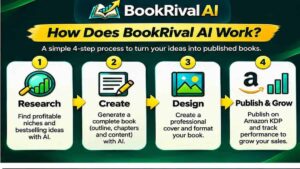
Step 1: Getting Started
You log in to the web app and open the Dashboard. There’s nothing to install. From there you open Bestseller Scout, which finds Amazon books that are already selling. You can search by interest, type a keyword, paste a link to a specific book, or just click “Find winners for me” and let the tool choose.
You get a ranked list of books, and each one has a Rival Score. That’s a single number that combines demand, competition, momentum and how much room there is to beat the book. It gives beginners something concrete to act on, which beats staring at a spreadsheet.
Step 2: Setting Up the Product
Next you pick a winner and open the Competitor Blueprint. The tool reads the book’s listing and its reader reviews, then shows you what the book does well, where readers are disappointed, and what gaps you could fill. It also suggests an angle, a length and a price to aim for.
This is the part I find most interesting. Reading hundreds of Amazon reviews by hand is slow and tedious, and it’s where good book ideas usually hide. Having it summarized into strengths to match, weaknesses to beat and gaps to fill saves a lot of time.
Step 3: Using the Main Features
Now the building starts. AI Book Builder creates your manuscript from the Blueprint: a brief, an editable outline, chapters, then an edit pass. Cover Designer gives you three Kindle-ready front covers. Listing Optimizer writes your title, subtitle, description, seven keywords, categories and price. Finally, Export & Publish gives you EPUB and PDF files and a step-by-step KDP checklist.
Important: BookRival doesn’t publish for you. You upload the finished book to KDP yourself, guided by the checklist. That’s actually a good thing, because it keeps you in control of your own account.
👉 Curious what the head-to-head demo looks like?
The sales page includes a start-to-finish example of scouting a winner, spotting its weak points and building a better book. Take a look at the BookRival AI demo here and see whether the workflow feels right for you.
BookRival AI Features and Benefits
The app has 10 core tools. These are the three I’d put the most weight on.
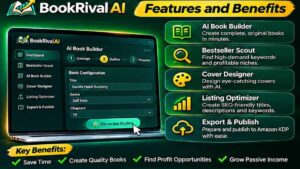
Feature 1: Bestseller Scout and the Rival Score
This is where BookRival earns its name. Most KDP tools hand you a keyword and leave you to work out the rest. Bestseller Scout starts from actual books that are selling and ranks them with a Rival Score.
The benefit is that you stop guessing. If you’ve ever picked a topic based on a gut feeling and then watched it flop, you’ll see why starting from proof feels different. You also get a Saved Winners shortlist, so you can compare options before committing to anything.
Feature 2: Competitor Blueprint and the AI Book Builder
The Blueprint tells you why a book sells and where it’s weak. The AI Book Builder then uses that information to write an original manuscript built around what readers actually asked for.
I like that you review and approve each stage. You can edit the outline before chapters are written, and there’s an edit pass afterwards. That matters, because AI writing is always better with a human steering it. The built-in originality check is also reassuring, though I’d still read your finished book carefully before you publish.
Feature 3: Cover Designer, Listing Optimizer and KDP Safety Checks
A great book with a weak cover or a vague listing struggles to sell. The Cover Designer gives you three options, and you can compare them at thumbnail size right beside the rival’s cover. That’s smart, because most readers meet your book as a tiny image in search results.
The Listing Optimizer writes your title, subtitle, description, seven keywords, categories and a suggested price, ready to paste into KDP. And the Export & Publish step includes safety checks: the AI-disclosure step, the three-books-a-day limit, and spelling and formatting checks. For a beginner worried about breaking Amazon’s rules, that guidance helps.
Who Is BookRival AI Best For?
I think it’s a good fit for:
- Beginners who want to try Kindle publishing without writing or design skills
- Stuck publishers who keep guessing topics and getting no sales
- Side-hustlers looking for a faster way to research and build books
- Freelancers and small agencies who want to produce books for clients or themselves
- Non-technical people who prefer a simple dashboard to a pile of separate tools
- Anyone building a low-cost digital publishing habit on a small budget
It’s probably not for you if you want guaranteed income, if you want to mass-produce low-quality books, or if you don’t plan to review and improve what the AI writes. Amazon cares about quality, and so do readers.
BookRival AI Pros and Cons
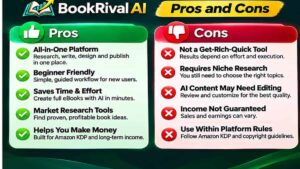
Pros
- Starts from books already selling, which is smarter than guessing
- Rival Score gives you one clear number to act on
- Competitor Blueprint turns reader reviews into a clear plan
- Covers a full workflow: research, writing, covers, listing and export
- Three covers compared at thumbnail size beside the rival
- Built-in originality check and KDP safety steps
- Very low launch price ($17 one-time)
- Web-based, with no installation needed
- 30-day money-back guarantee
Cons
- Monthly limits apply (15 scouts, 5 books, 10 reports), which is fair, but worth knowing
- The $17 price is a launch price, and the page says it rises to $297 afterwards
- AI-written books need your review and editing to be genuinely good
- It doesn’t upload to KDP for you, so you handle the publishing steps
- Amazon’s AI policies can change, so keep an eye on KDP’s current rules
- There’s no guarantee of sales or income
- The sales page uses big “value” numbers, such as $11,258+, that I’d treat as marketing
BookRival AI Pricing and OTOs
Front end: BookRival AI at $17 one-time. You get all 10 core tools, with monthly limits of 15 scouts, 5 books and 10 Opportunity Reports. The page says there are no monthly fees. It also shows a crossed-out “regular price” of $297 and says the price goes up to $297 when the launch window closes.
Free gift: The first 250 buyers also get a reseller license, which the page values at $1,997. I wouldn’t treat that number as a real-world price, and the offer may no longer be available by the time you read this.
OTOs: The launch details say the funnel has an order bump and eight upgrades, ranging from $17 up to $297, with downsells on three of them. One of the upgrades is aimed at agency use. The exact contents and prices of each upgrade aren’t spelled out on the pages I reviewed, so check each one carefully at checkout.
My advice: start with the front end. At $17, it’s a low-risk way to see whether the workflow suits you. Hold off on upgrades until you’ve actually built and published a book and know what you’d use more of.
🔥 Wondering if the $17 launch price is still open?
The page says the price jumps to $297 when the launch ends. Check the current BookRival AI price and what’s included before it changes.
BookRival AI Bonuses
The sales page lists three fast-action bonuses, valued at $111 in total:
- Bonus #1, Rival Score Cheat Sheet: A short guide to reading a Rival Score and picking your first winner
- Bonus #2, KDP Upload Walkthrough: A follow-along guide to the KDP upload steps, including the AI-disclosure screen
- Bonus #3, Thumbnail Test Guide: How to judge a cover at thumbnail size, the way readers see it on Amazon
These are small, practical extras, and they match the main product well. If you’ve never uploaded a book to KDP, the walkthrough could save you a lot of confusion. The values are the seller’s estimates, not market prices.
My BookRival AI Evaluation
Here’s my honest scorecard:
- Ease of use: 9/10. One dashboard and a clear “find, plan, build, publish” flow.
- Value for money: 9/10. Seventeen dollars for ten tools is very low, even with monthly limits.
- Beginner friendliness: 9/10. No writing or design skills needed, and the KDP checklist helps.
- Income potential: 6/10. Starting from proven demand helps, but sales depend on your niche, your editing and your promotion.
- Transparency: 8/10. The page is upfront about monthly limits, that it doesn’t auto-publish, and that results vary.
Overall, I’d give it 8 out of 10.
Here’s what I like most. The “start from proof” idea is a sensible answer to the problem that sinks most first-time authors: nobody wanted the book. And the page doesn’t oversell. It says plainly that it can’t promise sales, that results vary, and that BookRival isn’t for people who want to churn out clones. In this corner of the internet, that’s refreshing.
If I were using it, I’d treat the AI draft as a strong first draft and spend real time editing. I’d add my own examples and tone, and I’d check the finished book against Amazon’s current rules. The tool does the heavy lifting. Your judgement makes the book good.
One more note on timing. The page points out that fresh-start topics like fitness, money, productivity and habits tend to rise every January. That’s a reasonable seasonal angle, though the page itself is careful to say that rising demand isn’t a promise of sales.
BookRival AI vs. Alternatives
Doing it all yourself. This is free, but it’s slow. Researching a niche, reading reviews, writing, designing a cover and writing a listing can take weeks per book, and you still won’t know if it’ll sell.
Paid KDP keyword and research tools. These help you find keywords and see market data, but they usually stop at research. You still have to write, design and format everything yourself.
Hiring freelancers. Ghostwriters, cover designers and editors can produce great work. But the page estimates $700 to $4,000+ per book before you know if anyone wants it, and that cost adds up fast.
General AI chatbots. A chatbot can draft chapters, but it doesn’t scout Amazon winners, score them, read competitor reviews or hand you a KDP checklist. You’d be gluing the workflow together yourself.
BookRival’s pitch is that it combines research, writing, covers, listing and export in one place for one low payment. If you’d like to compare other options, browse our independent software reviews and our AI Tools section. Related reads include our BookBloom AI review, our Ai Long eBook Creator review, our Prepper Book Builder review and our Nook Tales Creator review. You can also explore our Digital Products category.
Is BookRival AI Legit?
From what I can see, yes. It’s a real web app from a named creator, with a clear sales page, a launch plan, a refund policy, a privacy policy, terms and a support link. The features are described in detail, and the workflow matches what AI tools in this space can realistically do.
What “legit” doesn’t mean is guaranteed sales. The page says so itself: “We can’t promise sales or income,” and results depend on your niche, your effort and the market. The “$11,258+ value” and the testimonials are marketing, and I’d read them that way.
It’s also worth being realistic about Amazon. KDP requires you to disclose AI-generated content and limits how many titles you can publish per day. BookRival builds those steps into its checklist, but the final responsibility for following Amazon’s rules is yours.
BookRival AI Refund Policy
BookRival AI is covered by a 30-day money-back guarantee. If it doesn’t do what’s promised, you message the support team within 30 days and the page says they’ll refund your payment, with no awkward questions.
That’s long enough to run a proper test. Don’t just click around the dashboard. Run a scout, build a Blueprint, generate a manuscript and look at the covers and listing. That’s the only way to know if the output is good enough for you. There’s also a separate refund policy page linked from the site if you want to read the exact terms first.
Frequently Asked Questions
Do I need to be a writer or technical?
No. The tool scouts, plans and writes, and you review and approve. If you can type an interest or click “Find winners for me,” you can use it.
Is it just copying bestsellers?
No. The bestseller is used as a benchmark, and the books are built to be original. An originality check compares your manuscript to the rival before export.
Will Amazon ban me?
BookRival includes an AI-disclosure step, the three-books-a-day limit and quality checks. Still, nobody can speak for Amazon’s decisions, so follow KDP’s current rules.
Does it publish to Amazon automatically?
No. You upload your finished EPUB or PDF to KDP yourself, using the step-by-step checklist.
Is it really a one-time payment?
Yes, $17 one-time with no monthly fee. Your account includes 15 scouts, 5 books and 10 Opportunity Reports each month.
Why are there monthly limits?
The page explains that AI writing and Amazon data cost money every time they run, so fair monthly limits keep the price low.
Can I expect to earn money?
The page can’t promise sales or income. Results vary with your niche, effort and the market.
Do I need to install anything?
No. It’s a web app that runs in your browser.
When does it launch?
Carts open Tuesday, November 24, 2026 at 10 AM EST.
What if I don’t like it?
You have 30 days to ask for a refund.
Final Verdict: Is BookRival AI Worth Buying?
If you’ve ever wanted to publish on Kindle but didn’t know what to write, BookRival AI is one of the most sensible approaches I’ve seen. It starts from proof instead of a hunch, shows you where the winners are weak, and helps you build a better book with covers, a listing and export files. For $17 one-time, the price makes it an easy thing to try.
It won’t make sales on its own. You still need to review the book, add your own value, upload to KDP and promote it. The page says it can’t guarantee income, and I’d take that seriously.
My recommendation is simple. Grab it at the launch price, run a real scout in a niche you understand, build one book, and judge it on that result. With a 30-day refund window behind you, there’s little to lose.
🚀 Ready to stop guessing and start from the winners?
The launch price is the lowest this will be. Get BookRival AI at the launch price here and run your first scout today.
Affiliate disclaimer: This post contains affiliate links. If you buy through them, I may earn a small commission at no extra cost to you. It doesn’t change my opinion, and I only recommend tools I think are worth a look. Please do your own research before you buy, because results vary from person to person and nothing here is a promise of income.