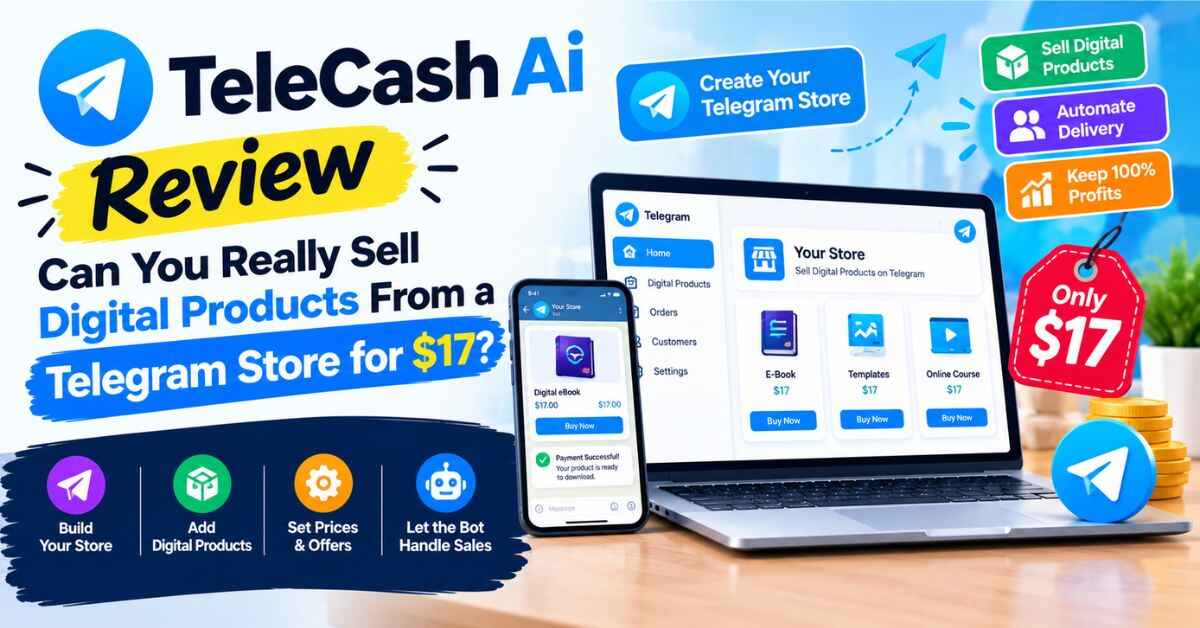
TeleCash Ai Review: Can You Really Sell Digital Products From a Telegram Store for $17?
Telegram has become a place where millions of people hang out, join groups, follow channels and, increasingly, buy things. So when a sales page showed up promising a ready-made “Telegram store” with products already loaded, a bot that takes orders, and payments sent straight to your PayPal or Stripe, I wanted to know if it was real. That’s why I’m writing this TeleCash Ai Review.
I read the page carefully, compared the numbers against each other, and checked which claims actually hold together. The idea is interesting. Some of the details are not, and I’ll show you exactly where, so you can decide with your eyes open.
Why Starting an Online Business Feels So Hard
Let’s start with why a product like this gets attention in the first place.
Most people who want to earn money online hit the same wall, and it usually comes in a few layers.
First, you need something to sell. You can create your own product, but that takes weeks. Writing an ebook, designing a planner, recording a course. Most people never finish. Or you can promote someone else’s product as an affiliate, but then you still need a place to send people and a reason for them to trust you.
Second, you need a store. A website means a domain, hosting, a design, a checkout page and a way to take payments. Each of those is its own little project, and each one has a way of going wrong at 11 PM when you just want to get live.
Third, you need people. A store with no visitors is just a very quiet room. Traffic is the part that costs time or money, and it’s the part that trips up almost everyone.
Add those three together and it’s no wonder so many beginners quit after a few weeks. The tools are scattered, the steps are unclear, and every guru online seems to say something different.
So when someone says, “Skip the product creation, skip the website, skip the hosting, just use your phone and a Telegram account,” it sounds like a relief. That’s the pitch behind TeleCash Ai.
What TeleCash Ai Says It Is
According to the sales page, TeleCash Ai is a Telegram-based store system. Here’s what it says you get:
- A pre-loaded store with ready-made digital products, like ebooks, planners, checklists, guides, video courses, templates and graphics
- A Telegram bot that takes orders and delivers the files automatically
- Payments sent directly to your own PayPal or Stripe account
- An AI tool that can generate your own ebooks, planners or prompt packs, with covers
- A shareable web page link for your store
- The ability to run multiple stores under one login
- Coupons, order bumps and upsells
- One-click messages to past buyers
- Basic analytics, including where your sales come from and a live sales view
- Affiliate offers from ClickBank, JVZoo or Amazon that you can sell alongside your own products
- A commercial license so you can set up stores for other people
The page says you only need a phone and a Telegram account. Nothing to install, no website, no hosting, no domain.
The workflow, as described, is short. You log in, connect your bot, pick your products, connect PayPal or Stripe, and share your link. The page puts the whole thing at about ten minutes, though it also says “three easy clicks” and “under 60 seconds” in other places. I’d read those as “it’s meant to be quick,” not as a stopwatch promise. Notably, the page doesn’t explain how the Telegram bot actually gets created or what setup that involves, so “no tech needed” is something to test yourself.
Want to see what the dashboard and a finished Telegram store actually look like? You can take a look at the TeleCash Ai demo on the official page. Watching how a store is built is the quickest way to judge whether the idea works for you.
TeleCash Ai Review: A Closer Look at the Features
Here’s how I’d group the features, with my thoughts on each.
The Pre-Loaded Product Library
This is the biggest draw. Instead of making a product, you pick from ready-made ones. For a total beginner, that removes a huge barrier.
But here’s the thing I’d check first. The page never shows a sample of any product. No page counts, no cover samples, no preview of a course. It also doesn’t say who made these products or what rights you have to sell them. Are they original? Are they private label content? Can you resell them freely? The page doesn’t say. Product quality and licensing are the foundation of the whole offer, so I’d want clear answers before building a store on top of them.
The AI Product Generator
The tool says it can generate your own ebooks, planners or prompt packs with covers. That could be handy for creating something with your own name on it. The page doesn’t mention limits, quality or ownership of what the AI produces, so test it before depending on it.
The Telegram Bot Storefront
Customers chat with your bot, place an order, pay, and get their files delivered automatically, any time of day. For digital products, that’s a smart setup. People are already in Telegram, so there’s no need to send them to a separate website.
Payments
Money goes to your own PayPal or Stripe, according to the page. That’s reassuring, since you’re not waiting on a middleman to pay you out. The page doesn’t say which countries or currencies are supported, so check that works for you and your customers.
Affiliate Offers
You can add offers from ClickBank, JVZoo or Amazon next to your own products. That’s a nice extra, but remember that affiliate income comes from a commission the merchant pays you, not from “keeping 100% of every sale.” The page mentions both ideas in different places, and they’re not the same thing. Also check each program’s rules about where you’re allowed to promote.
Store Tools
Order bumps, upsells, coupons, one-click messages to past buyers, and analytics by source (a group, a reel or a post). If it all works as described, that’s a decent set of tools for a small store. Being able to see which post brought a sale is genuinely useful.
The Commercial License
The page says it lets you set up stores for clients and charge your own fees. The page calls the license “usually sold separately” and “included only when you act now.” It doesn’t say how long it lasts, whether it covers the bundled products and bonuses, or what the limits are. Read the actual terms before you promise a client anything.
Who Could Actually Use TeleCash Ai
Rather than say “it’s for everyone,” here are the people I can see getting something out of it.
The complete beginner. You’ve got no product, no website and no budget, and you want to learn how selling online works. A simple Telegram store is a low-pressure way to practice.
The group or channel admin. If you already run a Telegram, WhatsApp or Facebook group with an engaged audience, a store gives you something to offer them. This is the strongest fit, because you already have people to show it to.
The coach or creator. If you’ve got followers who trust you, you could sell planners, guides or templates without building a site.
The affiliate marketer. Another place to promote offers, with a bot handling the delivery side.
The freelancer or small agency. The commercial license is aimed at you. You could offer to set up Telegram stores for local businesses. The page doesn’t give pricing guidance or proof that clients want this, so test the idea with a couple of people first.
The small local business. A shop that wants to sell downloadable guides or vouchers through Telegram might find it a simple option.
Here’s the honest bit that matters for every one of these. The tool gives you a store. It doesn’t give you customers. Telegram is a big platform, with the page citing numbers like over a billion monthly users, but those are Telegram’s numbers, not TeleCash Ai’s results. Having a store on a big platform isn’t the same as being seen on it.
If one of those sounds like you, the best way to know whether it fits is to see it running. Here’s the official TeleCash Ai page with the demo and the full list of what’s included. While you watch, ask yourself one thing: do I already have an audience I could show this to?
The Price: Read This Part Slowly
I always check the money first, and with TeleCash Ai, this is where things get confusing.
The headline offer is $17, one time, marked “today only.” There’s also a coupon code, TELECASH3, for $3 off, which would bring it to about $14, although the page never states the final total.
But the page also shows a crossed-out “real price” in different forms. In some places it’s $199 a month. In the pricing box, it’s $197 a month. After launch, the page says it moves to “a monthly plan” without giving the monthly number clearly. Those figures don’t match each other, and none of them is explained.
My read: the high monthly numbers are probably sales anchors designed to make $17 look tiny, which is a common trick. But there’s a real question underneath. The page says “full access, for life” in places and says the product “moves to a monthly plan” in others. If you pay $17 now, do you keep access without monthly fees? The page doesn’t clearly say. Before you pay, find out exactly what you’re agreeing to.
Then there’s urgency. The top countdown timer showed about 15 minutes, while the bottom one showed zeros. The page says the price “goes up every few hours” in some spots, and ties it to Black Friday in others, but never gives a date. I wouldn’t let any of that rush you.
The Upsell
There’s a “Business Booster Pack” at $9.97, which the page says includes priority support, “dedicated 24/7 support” and faster servers. The page claims 98% of customers add it, which can’t be verified. It’s optional. I’d skip it at first and only add it if you run into problems that actually need it.
The Bonuses
The page lists five main bonuses (Content Catalyst, Campaign Banner Studio, Global Sales Blueprint, SketchFlow Assets and VideoForge Studio), plus two “fast action” bonuses for the first 48 buyers. The bonuses are described in very general terms.
Here’s why I’d ignore the dollar values. The same bonuses carry different values in different sections. One is listed at $497 in one place and $997 in another. The page’s total of “$11,970+” doesn’t match its own line items, which add up to around $6,000. In other words, the numbers don’t agree with each other, so they can’t tell you anything useful. Judge the bonuses by whether you’d use them, not by the price tag.
The Guarantee
There’s a 30-day money-back guarantee, described as “no questions asked.” But the page gives no contact method, no process and no timeline. It just says to “send us a message.” I couldn’t find a company name, address or support channel either. Before buying, make sure you know exactly how to reach someone and request a refund. Also read: BizInGPT Review 2026: Can You Really Build ChatGPT Plugins for Local Businesses Without Writing Code?
The Honest Part: What Worries Me About This Page
I’d rather tell you now than have you find out later, so here’s a plain list of what stood out.
The income claims have no backing. The page says things like “start making up to $434 a day” and shows testimonials with earnings. There’s no explanation of how those figures were reached or what a typical buyer might see. The only disclaimer (“results are not typical and depend on your effort, product and promotion”) sits at the bottom of the testimonials, away from the big headlines. Treat the earnings talk as marketing, not as a forecast.
The testimonials don’t line up. Several people appear twice, once in a case study and once in a testimonial, and their results differ. One person is credited with $2,318+ in sales in one place and “5 new clients” in another. Another is credited with $4,840+ in 30 days in one spot and “$145 on Day 1” in another. The outcomes mix revenue, engagement, conversion and hours saved, so they can’t be compared. And a set of five-star reviews from six UK users uses cautious phrases like “could be” and “worth exploring,” which sounds more like first impressions than results. I wouldn’t lean on any of it.
The success stories aren’t about this product. The page tells stories of creators who sold planners and digital products on other platforms, with impressive sales numbers. The page itself says none of them used TeleCash Ai. They show that selling digital products can work in general, not that this tool works.
The product library is a black box. No samples, no source and no licensing details. If those products turn out to be low quality or widely shared, your store won’t stand out.
It depends on one platform. Everything runs through Telegram. The page doesn’t talk about Telegram’s own rules for bots, selling or messaging, and rules can change. Don’t put your entire income in one place you don’t control.
Basic business information is missing. No company name, no terms of service, no privacy policy and no contact details beyond a support link. For something that connects to your payment account, I’d want those.
The page looks unfinished in places. I noticed a placeholder reading “$[X] to $[X],” a headline cut off mid-word, a line of raw code, a Step 3 that repeats Step 2 and the same pricing block repeated around ten times. It’s also inconsistent about whether this is a pre-launch product with “beta users” or a finished one. None of that proves the tool is bad, but it suggests the page was assembled quickly.
It won’t create traffic. This is the part no tool solves. You’ll still need to bring people to your store through groups, posts, reels or ads.
None of this means TeleCash Ai can’t work. It means the page asks you to take a lot on faith, and the price you’d pay to test it, though small, still deserves a careful look.
A Sensible Way to Test It
If I were trying this, I’d keep it small and protect myself.
Before paying, I’d save the sales page and the offer details, so I know exactly what was promised. I’d find a working way to contact support and request a refund, and note it down.
I’d skip the add-on and buy only the main offer, then check right away whether the access terms and the monthly-plan question are clear inside the account.
Then I’d open the product library and look at the actual products. Read a sample ebook. Look at a planner. Ask myself honestly if I’d pay for it, and whether it’s good enough to put in front of my own audience.
I’d check the license terms before selling anything, especially whether I’m allowed to resell each product and the AI-generated ones.
Next I’d set up one small store and share it with a small group of real people, not strangers, to see whether anyone actually buys. Real feedback beats any testimonial.
And I’d use the 30-day guarantee as a genuine testing window. If the products or the setup don’t match what the page showed, I’d ask for a refund right away.
Picture two people who see this page on the same day. One buys it, spends an evening testing the products, and asks a few friends in a group to look at the store. The other keeps scrolling. A month later, one of them knows whether this idea works for their audience. The tool was the same. The difference was testing it.
Quick Questions
Do I need a website? The page says no. Everything runs through a Telegram bot and a shareable store link.
How much does it cost? The page shows $17 one time, with a $3 coupon (TELECASH3). It also mentions much higher monthly prices elsewhere, so confirm what you’re paying and whether any monthly fee applies later.
Where does the money go? To your own PayPal or Stripe account, according to the page.
Are the products mine to sell? The page doesn’t clearly say who owns them or what rights you get. Check the license terms.
Can I use it for clients? The page says a commercial license is included, but doesn’t define it. Read the terms first.
Is there a refund? There’s a 30-day guarantee, but no contact method or process is given on the page.
Will it get me sales? The tool gives you a store, not customers. The page itself says results depend on your effort, product and promotion.
Final Verdict: Is TeleCash Ai Worth It?
I’ll be straight with you. I can’t give this an easy yes.
The idea behind it is appealing. A ready-made store inside an app people already use, with automatic delivery and payments to your own account, is a neat package for a beginner. At $17 or so, the cost of testing it is small, and the 30-day guarantee gives you a safety net.
But the sales page leaves too many questions open. The prices don’t agree with each other. The income examples don’t hold together. The product library isn’t shown. The license isn’t explained. And there’s no company information or refund process to lean on. Those are exactly the things you’d want clear before building anything on top of a product.
If you’re curious and careful, a small, low-cost test within the refund window is a reasonable way to find out for yourself. If you’re hoping for $400 a day with no effort, I’d keep your expectations very low.
Whatever you decide, confirm the real price, get the refund steps in writing, read the license, and look at the products before you promise anything to anyone.
If you’ve read this far, you’re probably the kind of person who checks before buying, and that’s exactly the right habit. Take a look at the demo, the current price and the details I mentioned, and see if it still feels worth testing. Visit the official TeleCash Ai page here. The offer may change or end, and the 30-day guarantee gives you room to test it on your own terms.
A quick note: this post has affiliate links. If you click one and buy, I may earn a small commission at no extra cost to you. It helps me keep writing reviews like this. I try to be upfront about the good and the not-so-good, and the opinions here are mine. Please do your own research, read the terms on the official page, and decide what’s right for you. Results vary, and nothing here is a promise of income.