Marblism for Affiliate Marketers (2026): A Practical Workflow, Honest Limits and the Partner Program Explained
If you earn money from affiliate marketing, you already know the part nobody mentions in the sales pages. The commissions are the easy bit. The hard bit is everything around them: the research, the writing, the posting, the emails, the follow-ups, and that nagging feeling you should be publishing more. So I wanted to take a proper look at Marblism for affiliate marketers.
Can a team of AI employees really lighten that load? Where does it help, where could it hurt you, and what should you know about Google, FTC rules and the affiliate program’s own terms? One thing before we start, because it matters in this niche. I’m a Marblism affiliate too, so I earn a commission if you buy through my links. I’ll still show you the real numbers and the real risks. A post about affiliate marketing that isn’t honest about affiliate marketing isn’t worth your time.
The Problem: Affiliate Marketing Is a Treadmill
Picture a normal week.
Monday, you pick a keyword and check out the competition. Tuesday, you write a review, and it takes four hours because you actually bother to verify the facts. Wednesday, you format it, add images, drop in your links and hit publish. Thursday, you realize you haven’t posted on social media in nine days, so you throw something together at the last minute. Friday, your inbox has three partner emails, a question from a reader and a network asking about your traffic. Then the weekend comes and you’re behind again.
None of it is hard. It’s just never-ending. One great article won’t pay your bills. Affiliate income usually comes from a whole library of useful content that keeps getting found, shared and updated, which means a steady stream of articles, posts and emails, month after month.
And there’s a trap on that treadmill. The faster you run, the more tempting the shortcuts look. AI makes it incredibly easy to turn out fifty “reviews” in a weekend. Then Google’s spam systems notice, or your readers do, and the site you spent a year building drops like a stone.
That risk is real. Google says AI-written content isn’t against its rules on its own. What it goes after is something it calls scaled content abuse, which means mass-producing pages mainly to game rankings instead of helping people. In May 2026 it also made clear those spam rules apply to AI-generated answers in search, and the list includes thin affiliation, which is exactly what a pile of low-effort affiliate pages looks like. A spam update that started in late September 2026 lists scaled content abuse as one of the policies in scope.
So the real challenge isn’t just making more content. It’s making more without wrecking your rankings, your credibility or your readers’ trust.
The Solution: A Team for the Repetitive Parts
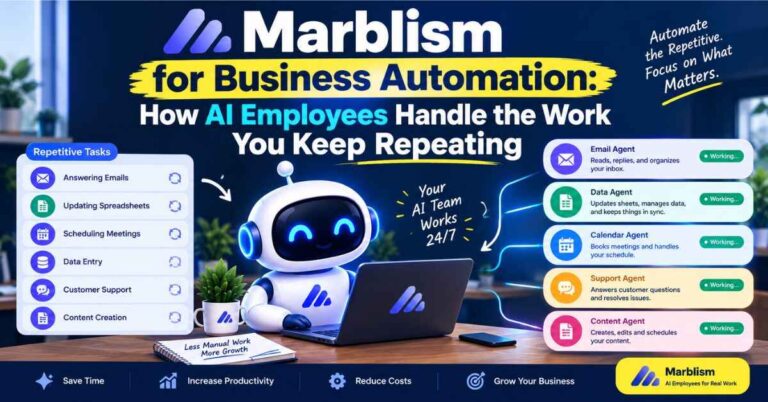
Marblism gives you seven AI employees, and each one has a single job. Eva handles your inbox and calendar. Sonny runs your social media. Stan does outreach. Penny writes SEO content. Rachel answers your phone. Walter builds websites. Linda reviews contracts. They plug into the tools you already use, and they check in with you before anything important goes out.
The pricing is simple. It’s $24 a month on the yearly plan or $44 a month if you pay monthly. That covers all seven employees, unlimited businesses, unlimited team members and 50 hours of AI work a month, with a 7-day money-back guarantee.
For an affiliate, “unlimited businesses” is the part to notice. If you run more than one site or brand, each one can have its own employees and settings under the same plan.
Want to see the team before you read on? Here’s the official Marblism page. Looking costs nothing.
Marblism for Affiliate Marketers: A Practical Workflow
Let’s walk through your week again, this time with the employees in it. I’ll tell you which jobs I’d hand over happily and which ones I’d keep.
Penny: Your Research Partner and First-Draft Writer
Penny finds keywords you have a real shot at ranking for, writes SEO articles, tracks rankings, and can publish straight to WordPress, Webflow, Shopify or Wix on a schedule. You can also set it so every draft lands in front of you for approval first.
Here’s how I’d use her. Think of Penny as the person who does the slow, boring groundwork, not as a publish button. Independent reviewers say her drafts are well structured but still read like AI until a person edits them, and one reviewer found a few broken links. In affiliate content, that gap matters more than anything. Your reader is deciding whether to trust you with a purchase, and that trust comes from things only you can add: what you tested, what surprised you, what annoyed you, what you’d do differently.
So let Penny handle the keywords, the outline and a solid draft. Spend your own time on the part readers and Google actually reward: first-hand experience, honest pros and cons, original examples, screenshots and up-to-date pricing.
Sonny: Getting the Word Out While You Write
Publishing is only half the job. Someone has to share the thing. Sonny posts to Instagram, LinkedIn, X and Facebook, can send one post to several platforms at once, handles Pinterest and Threads too, and since September he can make short videos, including ones that use a clone of your voice and your own picture. Pinterest alone drives a lot of affiliate traffic in some niches.
You can let him post on his own or send each post to you first. I’d keep approval switched on, because every post that mentions a product needs to follow disclosure rules.
Eva: Your Inbox, Partner Emails and Paperwork
Eva sorts your inbox into groups like To reply, FYI and Marketing, drafts replies in your voice, books meetings and joins your calls to take notes. Since spring she can also create and edit Word documents, PowerPoint decks and PDFs in your brand voice. If you deal with affiliate managers, sponsors or readers all day, that’s a lot of small stuff you can stop doing by hand.
She also can’t send emails for you. She writes the draft and you press send. For emails that involve money or promises, I like that.
Since August she can also react to events in connected apps. Marblism’s own examples include a new lead in a CRM triggering a drafted welcome email. If you track campaigns in something like Airtable, that’s worth playing with.
Walter: Quick Niche Sites and Landing Pages
Walter builds a website from a prompt, lets you edit it by chatting and connects your own domain. If you’re testing a new niche, it’s a fast way to get a clean site up. One warning, though. A stack of thin, near-identical niche sites is exactly what Google’s spam rules were written for. Build fewer sites and make each one properly useful.
Stan: Outreach, With Care
Stan finds leads, writes personalized messages and runs follow-ups by email and LinkedIn. For an affiliate, the sensible use is business outreach, like pitching brands on partnerships, sponsorships or guest posts. The danger is spam. Cold email is covered by laws like CAN-SPAM and GDPR, and that responsibility is yours, not Marblism’s. Keep volumes small, personalize everything and never use bought lists. Marblism’s own partner terms also ban unsolicited spam and purchased-list emails.
Linda and Rachel
Linda drafts contracts and flags risky clauses, so she can give you a plain-English first read on sponsor or freelancer agreements. She isn’t a lawyer. Rachel answers phones, which most affiliates won’t need unless they also run a service business or a lead-generation operation. I’d leave her off at first.
The Brain: Where Your Voice and Rules Live
One feature ties it all together. The Brain is Marblism’s shared knowledge area, where you store your tone of voice, your product details and your style rules. The more precise it is, the less rewriting you do. I’d put your affiliate disclosure wording in there, along with a list of claims you will never make.
How to Use It Without Hurting Your Site
Here’s the approach I’d follow.
Start with quality, not volume. A handful of deeply useful reviews beats fifty thin ones every time. Google’s own guidance says AI can help with research and structure. The trouble starts when you mass-produce pages that add nothing for the reader.
Then add what AI can’t. Screenshots from your own testing. Real numbers. Your actual opinion. A comparison table you built from the official pricing pages. That’s the difference between a review and a rewrite.
Keep a human in the loop. Read and edit every draft before it goes live. It’s also your protection against mistakes like a wrong price or a feature that no longer exists.
Be upfront about your affiliate links. Put a plain-language disclosure near the top of any post that contains them, not buried in the footer. It builds trust, and it keeps you on the right side of FTC rules and every affiliate program’s terms.
Check facts against official pages, especially in AI, where prices and features change quickly. And update your best posts regularly, because refreshing a top article often does more than publishing five new ones.
Last, don’t use AI to fake experience. If your post is based on research rather than hands-on use, say so. Readers respect that far more than a made-up “I tested this for 30 days.”
The Other Side: Marblism’s Partner Program
Since you’re an affiliate, you’re probably curious about the program itself. Here’s what Marblism’s own pages say.
You start as an Ambassador, earning 30% lifetime commission. After 10 conversions you move up to Growth at 40%, and after 50 you reach Strategic, also at 40%, with a bigger discount for your customers and some extra perks. “Lifetime” means you earn on every payment a referred customer makes while they stay subscribed. Commissions stop if they cancel and restart if they come back.
Referred customers get 10% off their plan at the first two tiers and 25% off at Strategic. Payouts are monthly, NET30, through Stripe Connect and your Dub dashboard, with a $50 minimum. There’s no exclusivity, so you can promote other products too. There’s also a partner-to-partner program called the Marblism Collective, which pays 15% to 25% of what a partner you referred earns. Marblism Review 2026: Pricing, Honest Pros and Cons, and Who Should Actually Use It
The Honest Math
Marblism’s earnings calculator assumes a $50 average plan, which works out to $20 a month per referral at 40%. But the real plans are $24 a month yearly or $44 monthly. My rough math, after the customer’s discount, puts a new Ambassador somewhere around $6 to $16 a month per referral, depending on the plan and tier. So treat the calculator as a best case.
Also remember that commissions can be reversed if an order is refunded, canceled or charged back, and Marblism has a 7-day money-back guarantee. The partner page highlights one coach who reports more than $3,000 in commissions in her first month. That’s real for her, but I’d read it as the top of the range, not the average.
Could a few referrals pay for your own subscription? Possibly. Is that a reason to buy? No. Buy it because it helps your workflow, and treat the commissions as a bonus.
The Rules You Need to Know
This is the part many affiliates skip, and it can cost them their commissions. Marblism’s partner terms say:
- You can’t publish coupon codes on blogs, YouTube descriptions, newsletters or coupon sites. Use your partner link for public content.
- You can’t bid on Marblism’s brand name in ads, and direct-linking your partner link in paid ads needs written approval.
- You must clearly disclose affiliate links and follow FTC rules, and you can’t use cloaked or deceptive redirects.
- No spam, fake urgency or unrealistic promises.
- The terms also say you can’t build pages meant to rank for Marblism’s brand keywords or review and comparison pages that imitate official pages, though original, value-driven content is welcome. If your plan includes review-style content, email partners@marblism.com and ask how they see it before you publish. Getting an answer in writing is cheap. Losing commissions isn’t.
Read the full terms yourself before you apply, because they can change.
What It Costs Compared to the Alternatives
A freelance writer who knows your niche can cost hundreds or even thousands of dollars a month. A virtual assistant for inbox and admin work often runs well over a thousand. Marblism’s yearly plan is $288 for the whole year, with all seven employees included.
That doesn’t mean AI replaces a great writer. It means the repetitive layers (research, drafts, scheduling, posting, inbox sorting) can be handled for a small fixed cost, so your money and time go to the parts that need you.
One detail about the 50 hours. They’re shared across all the employees, and only advanced actions use them. Chatting and quick tasks don’t. They reset monthly, and you can buy top-ups. Marblism doesn’t publish a simple price list per action, and third-party conversions don’t agree with each other. So test your real workload in the first week. Long articles and video are the jobs worth watching.
The Honest Downsides
It isn’t set-and-forget. Independent reviewers estimate 10 to 45 minutes a day of checking and approving, plus a few days of tone adjusting. For affiliate content I’d budget more, because editing is where the value comes from.
Penny’s drafts still need a human. Reviewers say they read like AI until edited, and she can’t replace first-hand experience. The hours can also run out, and some users have complained about that, especially with video. Stan gets the most mixed reviews, and email-law compliance is on you.
Support is a mixed bag too. Many reviewers praise the human team, but Marblism has said its around-the-clock support is an AI bot and its people work business hours. And read the billing carefully. There’s no free trial, only a 7-day money-back guarantee, and yearly is $240 cheaper than monthly.
Finally, the program rules are strict. Break them and commissions can be withheld or reversed.
Who Marblism Fits (and Who Should Skip It)
It could suit you if you’re a solo affiliate or small content team who wants help with the repetitive parts of publishing and distribution. It could also suit marketers who run several sites or brands and want one plan to cover them, or creators who spend half their day on inbox and partner emails. And it only works if you’re willing to edit and fact-check everything before it goes live.
You might skip it if you plan to mass-publish unedited AI articles, which is risky with Google and with readers. Skip it too if you want something completely hands-off, or you don’t want to spend any time reviewing.
How I’d Start
If I were trying it for an affiliate site, I’d keep it simple.
Start with two employees: Penny for research and drafts, Sonny for distribution, plus Eva if your inbox is a mess. Fill the Brain with your voice, your niche, your disclosure wording and your list of things you’ll never claim. Turn approval on for everything and watch for two weeks. Edit like an editor, adding first-hand details and checking facts and links. Keep an eye on how fast the 50 hours drop. Use the 7-day refund window to test your most important task and decide with real results. And read the partner terms before you promote anything.
If it works, add more. If it doesn’t, you’ve lost a week, not a year.
When you’re ready, you can start with Marblism here and test your first employee.
The Bottom Line
Here’s where I land on Marblism for affiliate marketers.
It can take real weight off the repetitive side of affiliate work: research, first drafts, scheduling, posting, inbox and admin. The price is low, setup is quick and the 7-day guarantee keeps the risk small. But it only pays off if you stay the editor. Google’s spam rules, FTC guidelines and your readers’ trust all point the same way. Use AI to save time on the grunt work, then spend that time making your content more honest, more original and more useful.
The best way to find out is to try it on one slice of your workflow. Take a look at Marblism and pick the first employee you’d put to work. It might give you some hours back, and those hours are best spent on the work only you can do.
Quick FAQ
Is Marblism good for affiliate marketers? It can help with research, first drafts, scheduling, social posting and inbox work, as long as you review and improve everything. It isn’t a way to mass-publish unedited content.
Does Google penalize AI content? Google says AI content isn’t against its guidelines by itself. But mass-producing pages mainly to manipulate rankings is a spam violation, and thin affiliate pages are covered too.
How much does the Marblism partner program pay? Partners start at 30% lifetime commission and move to 40% after 10 conversions, according to Marblism. Payments are monthly, with a $50 minimum.
Can I share a coupon code on my blog? No. Marblism’s terms don’t allow public coupon codes. Use your partner link instead.
How much does Marblism cost? $24 a month on the yearly plan or $44 a month if you pay monthly, with all seven employees and 50 hours of AI work included.
Affiliate disclosure: Some links in this post are affiliate links. If you click one and decide to buy, I may earn a small commission at no extra cost to you. I only recommend things I think can genuinely help, and I’ve tried to be honest about the downsides too. Thanks for supporting the blog.