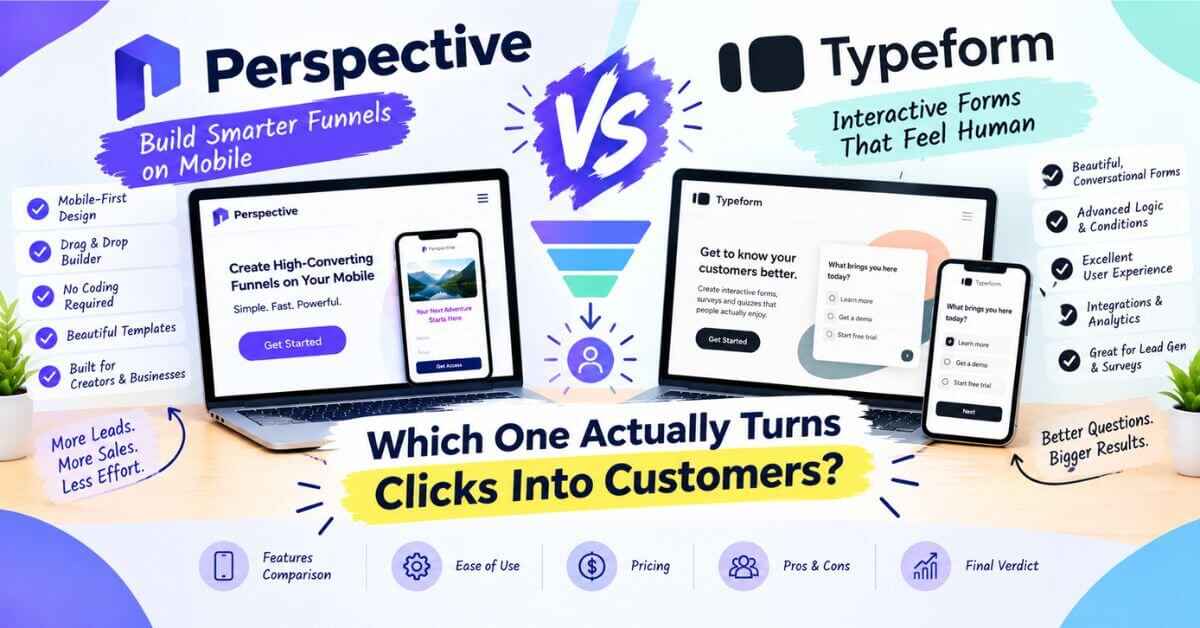
Perspective vs Typeform: Which One Actually Turns Clicks Into Customers?
If you’ve been stuck on Perspective vs Typeform, I’d guess you started with a simple thought: “I want something that feels friendlier than a boring form.” Fair enough. Both tools show questions one at a time, both look clean on a phone, and both can make a visitor feel like they’re in a conversation instead of filling out paperwork. So on the surface they look like twins.
They aren’t. One was built mainly to collect answers. The other was built to turn visitors into leads, bookings, and customers. That difference sounds small, but it changes what you end up paying for, how much work you do after someone submits, and whether your marketing actually moves forward. In this post I’ll walk you through both, give Typeform its fair credit, and show you why I think Perspective is the smarter pick for most small businesses, coaches, and freelancers.
A Pretty Form Is Not a Marketing System
Let me tell you about a mistake that’s easy to make.
You decide your contact form is outdated. It’s one of those long, gray boxes with six fields and a “Submit” button that looks like it was designed in 2009. People aren’t filling it out. So you look around and find a tool that shows one question at a time, with smooth animations and big friendly buttons. You build a form with it, and honestly, it looks fantastic.
You publish it. People start answering. For a few days, you feel like a genius.
Then reality shows up.
The answers land in an inbox or a spreadsheet. Nobody gets a confirmation. You forget to reply to someone for two days. You can’t tell which questions make people quit halfway, because that kind of insight sits on a higher plan. You hit a limit on how many responses you can collect that month, and the form quietly stops accepting new ones right in the middle of your best campaign. Or you realize you’re paying for a nice-looking form and then paying again for email, for a contact list, for scheduling, for tracking.
A beautiful form is a start. But a form only collects. What your business actually needs is a path: from “I saw your post” to “I’m booked, I’m confirmed, and I’m in your system.”
That’s the gap between a form tool and a funnel tool. And it’s the most useful lens for judging Perspective vs Typeform.
What Is Perspective?
Perspective is a funnel builder from a German company called Perspective Software GmbH. A funnel is a short, guided path that takes someone from “I tapped your link” to “I booked a call,” “I joined your list,” “I applied for the job,” or “I bought.”
Visitors move through short screens, one question or one idea at a time. They tap an answer, the next screen slides in, and they keep going. It feels like an app because it’s built mobile-first. The phone version comes first, and desktop comes second.
The company says you can build a funnel in about 30 minutes without design or coding skills, that more than 8,000 businesses use it, and that it holds a 4.9 rating on G2 and 4.8 on OMR. Those are their own numbers, so treat them as a starting point and read the public reviews yourself.
What makes it more than a form is everything wrapped around the funnel. In one account you get email messaging (plus WhatsApp on higher plans), a metrics dashboard, a built-in contact manager, an appointment block for booking calls, a payment step, an AI funnel builder, workspaces for clients, and integrations with the tools you probably already use.
What Is Typeform?
Typeform is one of the best-known names in online forms and surveys. It popularized the “one question at a time” look, and it’s great at making questions feel conversational and friendly. People use it for surveys, quizzes, feedback, registrations, and simple lead capture.
Reviewers consistently describe it as a tool that collects responses beautifully. It’s easy to start with, it looks polished, and it connects to a lot of other apps. For many people, it’s the first tool they reach for when they want something better than a standard web form.
Where it gets more complicated is how it’s priced and what’s included, which I’ll get to in a moment. Also read: Perspective Review 2026: Features, Pros, Cons, and Honest Verdict
Perspective vs Typeform: The Short Version
If you only read one section, read this one.
- Typeform is a polished form and survey builder. It’s excellent at collecting answers in a friendly, conversational way.
- Perspective is a mobile-first funnel builder that collects answers and also handles what comes next: follow-up messages, a contact manager, booking, payments, metrics on where people drop off, and training to help you get results.
So if you need a beautiful survey, a quiz, or a feedback form, Typeform is a solid choice. If you want to turn traffic into leads and booked calls, and you’d like one tool to handle most of the journey, Perspective is the better fit.
Let me walk through the areas that matter in real use.
Round 1: How Each One Is Built to Be Used
Typeform’s core strength is the question-by-question experience. You build a form, choose your question types, set logic if you need it, and share it. It’s quick, and the end result looks clean.
Perspective works with funnel blocks: a headline, a multiple-choice question, a testimonial slider, a date and time picker, a countdown, a file upload, a payment step. You drop them in, edit the words, and move on. That means a Perspective funnel can include more than questions. It can include social proof, a video, an offer, a booking calendar, and a thank-you screen, all in one flow.
There are also 29 premium funnel templates and more than 70 section templates built around real goals: booking calls, running quizzes, webinar signups, freebies, applications, and simple sales. So you rarely start from a blank page. An AI funnel builder gives you a first draft, an AI brand profile picks up your look and tone, and you can rewrite, simplify, or translate copy into 20+ languages. You stay in control and can edit everything by hand afterward.
My take: Typeform is built around questions. Perspective is built around outcomes, which is what most businesses actually care about.
Curious how a funnel feels compared with a form?
It’s one of those things you get faster by trying than by reading. Open a free trial, pick a template, and click through it on your phone like a stranger would. It takes about ten minutes.
👉 Try a Perspective funnel on your own phone
Round 2: What Happens After Someone Submits
This is the round that decides it for me.
With Perspective, a confirmation email can go out seconds after someone submits. You can set up messages that trigger when a lead’s status changes, connect your own sender address, and on higher plans build email sequences, even by typing a prompt and letting AI draft them. The Expand plan adds WhatsApp messaging, which matters a lot if your audience lives in WhatsApp more than in their inbox.
Leads land in a built-in contact manager. You can view them as a list or on a Kanban board with stages like New, Intro Call, and Closed. Drag someone to the next column, add a task, jot a note. It isn’t a giant CRM, and it doesn’t pretend to be. But it means you’re not exporting a spreadsheet every Friday and wondering who you forgot to answer.
The dashboard also shows conversion rate over time, page-to-page conversion (so you can see exactly which screen loses people), button clicks, device split, busiest times of day, and top answers. From the Grow plan up, you can A/B test your first page.
Typeform is mostly about collecting the response. Follow-up usually happens through integrations with other tools, and some of the deeper analysis, such as drop-off and conversion tracking, shows up on higher-priced plans, according to recent reviews. Typeform has been adding contact and automation features through add-ons, so check its current feature list. But the general approach is the same: it’s one piece of your stack, and you connect the rest.
That’s fine if you already have a CRM, an email tool, and a scheduler running smoothly. If you don’t, Perspective saves you from building that stack yourself.
I’ll be fair in the other direction, too. One reviewer who compared Perspective with other builders said its advanced email automation could still improve. If you need very complex, branching email logic, you may want a dedicated email platform alongside it, and Perspective connects with ActiveCampaign, Brevo, HubSpot, GoHighLevel, and others.
My take: If you want the follow-up, lead tracking, and funnel metrics in the same place as your questions, Perspective has the clear edge.
Round 3: Pricing (The Part That Surprises People)
Let’s talk money, because this is where the two tools feel most different. Prices change, so please confirm both on the live pricing pages. This is what I found.
Typeform prices mainly by how many responses you collect each month, according to several 2026 pricing guides:
- Free: around 10 responses a month in total, with Typeform branding.
- Basic: roughly $28 to $39 a month for 100 responses and one user.
- Plus: roughly $56 to $79 a month for 1,000 responses and three users. This is the lowest tier that removes Typeform branding.
- Business: roughly $91 to $129 a month for 10,000 responses and five users, where conversion and drop-off tracking appear.
The lower figure is the annual-billing price and the higher figure is month-to-month. Typeform has also said it tests pricing, so what you see may differ. The detail that catches people is that these response allowances are shared across all your forms, and guides report that once you reach the monthly cap, the form stops collecting new responses until you upgrade or the month resets. If a campaign takes off, that can be an expensive surprise.
Perspective has four plans, with about 20% off if you pay yearly:
- Base: around €47 a month billed yearly (about €59 monthly). It includes 2 live funnels, 40 AI credits, and 100 generated leads.
- Grow: around €147 a month yearly (about €184 monthly). It includes 10 live funnels, 150 AI credits, 500 leads, A/B testing, and branding removal.
- Expand: around €297 a month yearly (about €369 monthly). It includes 20 live funnels, 500 AI credits, 1,000 leads, and WhatsApp messaging.
- Scale: custom, for larger organizations.
A “generated lead” counts whenever someone leaves their email or phone number. Visitors who just look around and leave don’t use up your allowance. And if you go over your limit, you aren’t cut off. Extra leads cost a flat €0.25 each, billed at the end of the cycle, so a successful campaign never switches off your funnel.
Here’s how I’d read that. On paper, Typeform’s entry price looks lower, but the 100-response cap on Basic gets used up fast, and removing branding or tracking drop-off pushes you up the ladder. Perspective’s entry plan costs more on the sticker but includes email, a contact manager, booking, metrics, and training, so you aren’t adding separate tools around the form. When you add up what you’d otherwise need to pay for, the picture often flips.
My take: If all you need is a survey, Typeform’s free or entry plan can do it. If you need an actual lead-to-customer system, Perspective usually costs less than the stack of tools you’d assemble around a form.
Round 4: The Phone Experience
Perspective’s own site points out that 98.5% of Facebook users access the platform on mobile, citing Meta’s report. If your traffic comes from social media or ads, most of your visitors are tapping on small screens.
Typeform looks great on phones, and that’s a big part of why people love it. This round is close. The difference is that Perspective designs the whole funnel around phone behavior: big tap targets, one clear action per screen, nothing hiding below the fold, plus a dashboard that shows how your device split performs. A reviewer on its site said it’s built for mobile and feels like an app, and another who compared it with older funnel tools said it did mobile optimization and ease of use the best.
My take: Both look good on a phone. Perspective builds its entire flow, not just its questions, around mobile visitors.
Round 5: Learning and Support
Software is only worth what you can get out of it, and training is what separates a tool you use from a tool you pay for and abandon.
Perspective includes a free academy with step-by-step video lessons, a weekly live training where the team helps with ads and funnels, a crash course, and a community on Skool. The trial includes 30+ courses. Live chat support runs Monday to Friday, roughly 10:00 to 17:00. The team is in Germany, so check how that fits your time zone, with email for the rest.
Typeform has a solid help center and a lot of tutorials, since so many people use it. It’s easy enough to learn that most people don’t need much training for simple forms. But it won’t teach you how to build a lead-generating funnel, because that’s not what it’s designed for.
My take: For learning how to get actual marketing results, Perspective gives you more to lean on.
Wondering whether a funnel beats a form for your business?
The quickest way to find out is to rebuild one of your existing forms as a Perspective funnel and compare. If the follow-up and booking features feel like a relief, you’ll know within an hour. A free trial lets you test it without paying anything up front.
👉 Rebuild one form as a funnel and see the difference
Real-Life Scenarios: Which Tool Wins?
Let’s make this concrete. These are illustrative situations, not customer stories, but they show how the choice tends to play out.
The customer survey. Imagine a small shop that wants honest feedback after each purchase. A friendly, simple survey is all it needs, and there’s no booking, payment, or follow-up sequence involved. Typeform is a natural fit here, and it’s great at this.
The coach with a link-in-bio. Picture a business coach whose Instagram link goes to a plain “Book a call” button, and half the people who tap it never schedule. With a Perspective funnel, those visitors answer three easy questions (what’s your goal, what’s in your way, when do you want to start), then pick a time right inside the funnel. A confirmation email goes out immediately, the lead appears on her contact board, and she walks into the call knowing who she’s talking to. A plain form wouldn’t do the booking, the confirmation, and the tracking in one place.
The local clinic. A dental practice runs a Facebook ad for new patients. A short funnel asks “What are you looking for?” and “When works for you?” then sends a confirmation automatically. It feels like texting a friend instead of filling in a form, and the staff don’t need to maintain a pile of connected tools.
The small hiring team. One story featured on Perspective’s site describes skipping the resume at the first step and using an application funnel instead. Most people viewing a job ad on their phone won’t upload a CV right then, so you make step one easy, qualify them with a few questions, and ask for more later. The creator claims up to 70% more applications this way. That’s one person’s result, not a promise, but the logic holds up.
The course creator building a list. Instead of a “subscribe to my newsletter” box, a quiz like “Which type of learner are you?” delivers a freebie matched to each answer, followed by an automatic email. People who take a quiz tend to be more engaged than people who just drop in an email. A form can collect the quiz answers. A funnel can also welcome them, track them, and move them forward.
The freelancer growing into a small agency. Someone who built one funnel for one client now has five. Separate workspaces keep each client organized, and on higher plans branding can be removed so everything looks like theirs. One user on the site said they started running ads and had a new client within days.
The pattern is easy to see. When the goal is gathering opinions, a form tool is perfect. When the goal is turning visitors into paying customers, a funnel tool wins.
Why I Lean Toward Perspective for Most People
Here’s my honest reasoning.
Most coaches, consultants, local businesses, and small teams aren’t trying to run surveys. They’re trying to grow. They need people to say “yes, I’ll book,” “yes, I’ll sign up,” or “yes, I’ll buy,” and they need to follow up before the excitement fades.
Perspective makes the funnel itself excellent, with short tap-through screens, templates, AI drafts, and a phone-first design. Then it gives you just enough follow-up, metrics, and contact management to act on the leads, without making you assemble extra tools or pay for response caps that shut you off at the worst moment.
It also keeps the doors open. It connects with Zapier, Make, webhooks, and tools like ActiveCampaign, Brevo, HubSpot, and GoHighLevel, so if you outgrow part of it, you aren’t trapped. And because plans are flexible, you can start small and upgrade when your results tell you to.
Add live training and a friendly community, and for a phone-first lead-gen business, it’s an easy recommendation.
What Perspective Won’t Do (The Honest Part)
A comparison that only praises one side isn’t worth much, so here’s the other half.
Perspective probably isn’t right for you if you only need a free, simple survey or feedback form, if you want a huge library of survey-specific question types for research, or if very advanced multi-step email automation is your main need. It’s a funnel and lead tool, not a research survey platform.
Live chat support runs on weekday daytime hours in German time, so if you’re far from that time zone, you’ll sometimes lean on email. And as with any tool, a funnel builder can’t rescue a weak offer. You still need to know your audience and write clearly.
I’d rather you hear that now than discover it three weeks into a subscription.
The Free Trial Settles the Debate
You don’t have to take my word, or anyone’s, for any of this.
Perspective offers a 14-day free trial on any plan, with access to the templates and 30+ courses. They send a reminder on day 7, and if you cancel from your account settings before the trial ends, you won’t be charged. Some invite links offer a longer trial, up to 30 days, but that depends on the link and the offer at the time, so check the signup screen. Typeform also has a free plan, so you can test both side by side.
Here’s how I’d run a fair test:
- Pick one real goal, like booked calls or email signups.
- Build the same thing in both tools and time yourself.
- Open both on your phone and click through as a stranger would.
- Send a test lead through each and see what happens next. Who gets a confirmation? Where does the lead go?
- Ask yourself which setup you’d rather live with six months from now.
Whichever tool left you feeling less frustrated and more excited is probably your answer. Your gut is more reliable than you’d think after a hands-on test.
My Bottom Line
When people ask me about Perspective vs Typeform, I don’t say Typeform is bad. It’s a great tool for collecting answers, and it earned its reputation.
But if your goal is to turn visitors into leads, bookings, and customers, a form alone leaves too much of the work on your plate. Perspective gives you the funnel, the follow-up, the lead tracking, and the training in one place. It feels like an app to your visitors, and it keeps going after the “Submit” button.
Try it, build one funnel, and compare it with whatever else is on your shortlist. That’s the only comparison that really counts.
Ready to go beyond the form?
You’ve done the reading. The next best step is a small experiment: pick a template, edit it with your own words, and watch your first test lead come through. That’ll tell you more than another ten comparison tabs.
👉 Start your free Perspective trial and build your first funnel
Somewhere out there, someone scrolling on their phone would happily book with you, join your list, or buy from you if the path were just a little easier. Making that path easy is what this tool is for.
Quick disclosure: some links in this post are affiliate links. If you sign up through one, I may earn a small commission at no extra cost to you. I only recommend tools I think are genuinely useful, and my opinions are my own. Prices, features, and trial terms can change, so please double-check everything on each tool’s official website before you decide.