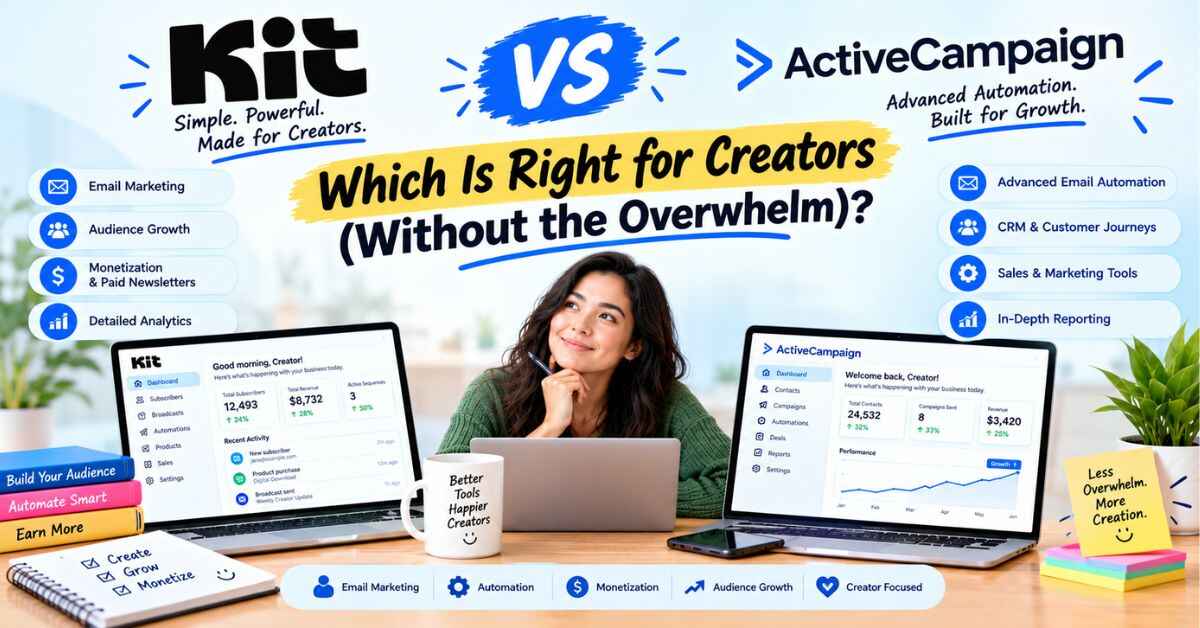
Kit vs ActiveCampaign: Which Is Right for Creators (Without the Overwhelm)?
Some tools feel like a bicycle. Others feel like a cargo plane. In the Kit vs ActiveCampaign debate, you’re basically deciding which one you need. ActiveCampaign is the cargo plane: powerful, packed with features, and built for teams running complex marketing and sales. Kit is more like a very good bike for someone who just wants to get somewhere, which in this case means building an audience and earning from it. Neither is wrong. But using a cargo plane to deliver a pizza gets expensive, confusing and slow.
So I’ll go through what each one does well, where each falls short, and who should pick which. I’ll also be upfront about where ActiveCampaign genuinely wins, because it does, and pretending otherwise would waste your time.
Kit is the email platform that used to be called ConvertKit. If you write, teach, coach, podcast or sell digital products, this should save you a few hours of tab-hopping.
The Problem With Tools That Are Too Powerful
Here’s a story I hear from creators all the time, and I bet you’ll recognize it.
You decide it’s finally time to take email seriously. You do your research. Everyone says the big, powerful platform is the “professional” choice, so you sign up. You open the dashboard. There are automations, goals, lead scoring, pipelines, conditional content, predictive sending. It looks impressive.
And it’s completely overwhelming.
You wanted to send a welcome email and a short follow-up. Instead you’re watching tutorial videos about “business goals” and wondering what a “custom object” is. A week goes by. Then two. The list sits there. You’ve paid for a tool that could run a sales department, and you’re using about four percent of it.
Meanwhile your audience is still living on platforms that can change the rules overnight. The reach you worked so hard for could drop tomorrow, and you still don’t have a way to talk to people directly.
That’s the real cost of picking too much tool. It isn’t only the monthly fee. It’s the weeks you lose, the confidence you lose, and the list you never build. A simpler tool you actually use beats a powerful one you don’t.
But let’s not swing too far the other way. Some people really do need the powerful option. So let’s look at both properly.
Kit vs ActiveCampaign: What Each One Is Built For
The easiest way to understand the difference is to look at who each tool was designed around.
ActiveCampaign is a marketing and sales automation platform. It’s built for businesses and teams that want deep automation, CRM features and lots of connections across their tools. It has a free trial, but no free plan listed on its pricing page.
Kit is built for creators who want to build a business around their audience. Kit’s own pitch is that ActiveCampaign targets B2B sales teams and enterprise users, while Kit targets creators and entrepreneurs, and that Kit’s automations don’t need a dedicated marketing team. That’s Kit describing the difference, so take it with a grain of salt, but it does match how people tend to use the two.
According to Kit, more than 550,000 creator business owners use it. Its site shows names like Pat Flynn, Tim Ferriss, James Clear, Ali Abdaal and Mark Manson. That doesn’t prove it’s right for you, but it shows people with real audiences trust it with their lists.
Now let’s look at the things that actually decide it.
Round 1: Pricing and Free Plans
Let’s start with money, since that’s what everyone wants to know.
ActiveCampaign (from its pricing page):
- No free plan is listed. There’s a 14-day free trial with no credit card required.
- Four plans: Starter, Plus, Pro and Enterprise, priced by number of contacts and billed yearly.
- Starter includes multi-step automation, 250+ email templates and 1 user. Plus adds landing pages and cross-channel marketing. Pro adds predictive sending, conditional content, attribution and 3 users. Enterprise adds things like SSO, HIPAA support and a dedicated account team.
- CRM add-ons (Pipelines and Sales Engagement) are available on Plus and above, and SMS and WhatsApp are add-ons too. Their prices weren’t listed.
- The page showed placeholders instead of dollar amounts for me, so I can’t quote prices. Check the live page or get a quote.
Kit (from its pricing page, at 1,000 subscribers):
- Free: up to 10,000 subscribers, with unlimited forms, landing pages and email broadcasts, plus the ability to sell digital products and subscriptions. It does not include visual automations or integrations.
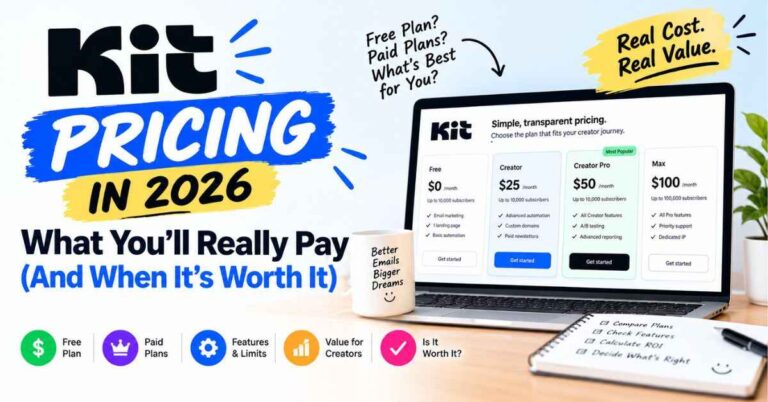
- Creator: about $33 a month when billed yearly. This adds unlimited automations and sequences, integrations, Kit MCP, two users, SMS and more.
- Pro: about $66 a month billed yearly, with a limited-time 25% first-year offer. This adds Subscriber Signals, the Growth Concierge team, deeper analytics and more.
- 14-day free trial of paid plans, and Kit says no credit card is needed.
A few honest takeaways.
Kit has a real free plan. ActiveCampaign, from what I could see, doesn’t. If you want to start building a list at zero cost, that’s a clear difference.
Kit also says it charges only for active subscribers, and describes ActiveCampaign as charging for non-subscribed and unsubscribed contacts too. That’s Kit’s claim about ActiveCampaign, so check ActiveCampaign’s current billing rules before you rely on it.
Since I can’t show you ActiveCampaign’s prices, the best move is to use both companies’ pricing calculators at your own list size and compare the real numbers.
Pricing pages only tell part of the story. If you’d like to see what you’d actually pay at your own list size, you can check Kit’s current plans here and try the paid features free for 14 days. Kit says no credit card is needed to start.
Round 2: Automations (Power vs Simplicity)
This is where the two tools feel most different.
Think about what you want to happen when someone joins your list. A warm welcome email goes out right away. A couple of days later they get your best free resource. A few days after that, a short story about why you do this work. Later, a gentle mention of something you sell.
Both tools can do that. The question is how much you want to think about it.
ActiveCampaign goes deep. According to Kit’s comparison page, it has 900+ automation templates, compared with Kit’s 25+. That’s a lot of ready-made starting points, and if you run complex funnels with lots of branches, that depth is a real plus. It also lists 1,000+ native integrations, against Kit’s 100+.
Kit keeps it simpler. You build your journey like a flowchart. Someone signs up, gets this email, waits two days, gets that one. You can split people into paths based on what they click, so someone who loves your productivity tips doesn’t get the same emails as someone who joined for fitness content. Kit also says it has built-in connections with creator tools like Thinkific, Calendly and Typeform. And Kit’s pitch is that you can do all this without a marketing team.
If you run a business with a sales team, multiple products, lots of tools and complex logic, ActiveCampaign’s depth may be worth the learning curve. If you’re a solo creator who wants a welcome sequence, a launch sequence and a few paths for different readers, Kit gives you what you need without the cockpit.
For abandoned-cart emails, ActiveCampaign supports Shopify, WooCommerce and BigCommerce, while Kit lists Shopify and Fourthwall. So for a store-focused business, ActiveCampaign may fit better.
Round 3: Making Money From Your Audience
This is the part that matters most for conversion, so let’s slow down.
Kit is built around earning from your list. You can sell digital products, paid newsletters and subscriptions right from the platform, and it also offers newsletter sponsorships (listed as beta) and paid recommendations. The listed fee for selling is 0.6% plus normal card processing. Because every sale connects to a subscriber, you can see who bought, follow up with something that fits them and avoid sending the same pitch to everyone.
ActiveCampaign is more focused on marketing and sales automation. It offers CRM add-ons for sales pipelines, and Kit’s comparison says it syncs purchase data from Shopify, Square and WooCommerce. I couldn’t confirm whether ActiveCampaign lets you sell digital products or paid newsletters directly, so I won’t claim either way. If selling inside your email tool matters to you, check ActiveCampaign’s current features.
The practical difference: Kit treats selling as a core part of the product, with commerce, sponsorships and subscriber data tied together. If you’re an ebook seller, a course creator, a coach or an artist selling digital goods, that setup is a natural fit. If you’re running a sales team with a real pipeline and deals, ActiveCampaign’s CRM tools are built for that.
Round 4: Knowing Your Subscribers
Both tools help you understand who’s on your list. They go about it differently.
Kit lists subscriber scoring, subscriber journey and purchase history, and source tracking. On the Pro plan, Subscriber Signals goes further, showing audience details like demographics and social followings and building a sponsor-ready report in one click. Kit’s comparison says this tells you who your subscribers are, while describing ActiveCampaign as tracking what they do. That’s Kit’s framing, so test it yourself.
ActiveCampaign’s Pro plan includes attribution and conversion tracking, advanced segmentation and predictive sending. For a marketing team that lives in dashboards, that’s powerful stuff.
For a creator, the question is simpler: can I see who’s engaged and send them the right thing? Both can. Kit just tries to make that easier to read.
Round 5: Email Design, Deliverability and Testing
A few smaller things that add up.
On templates, ActiveCampaign lists 250+ email templates on its Starter plan, and Kit’s comparison page lists 100+ for ActiveCampaign versus Kit’s 40+. Either way, ActiveCampaign has more to browse. If you love picking from a big library of designs, that’s a plus for them.
On testing, Kit covers subject lines and email content. Kit says ActiveCampaign tests subject lines from automations only.
On deliverability, Kit says creators on its platform see about a 99.8% delivery rate and roughly 40% average open rates. Kit lists ActiveCampaign’s rate as “not shared.” Those are Kit’s numbers, so use them as a rough guide. Your results depend on your list and how good your emails are, and ActiveCampaign is a well-established platform.
And Kit lists unlimited email sends, while ActiveCampaign’s plans include a set number of sends per month based on your contacts, such as 10,000 on Starter at 1,000 contacts.
Round 6: Support and Switching
Here’s where a lot of creators quietly decide.
ActiveCampaign gives Starter and Plus basic email and chat support, and Pro and Enterprise priority support, plus onboarding and migration help on those higher tiers. Its page also advertises free migration and onboarding with no setup costs.
Kit offers 24/7 email and chat support on Creator and Pro, plus Kit University, a blog with how-to guides, creator stories and a library of email templates. You can hire a Kit Expert for hands-on help, and Pro users get an email strategist and a deliverability specialist.
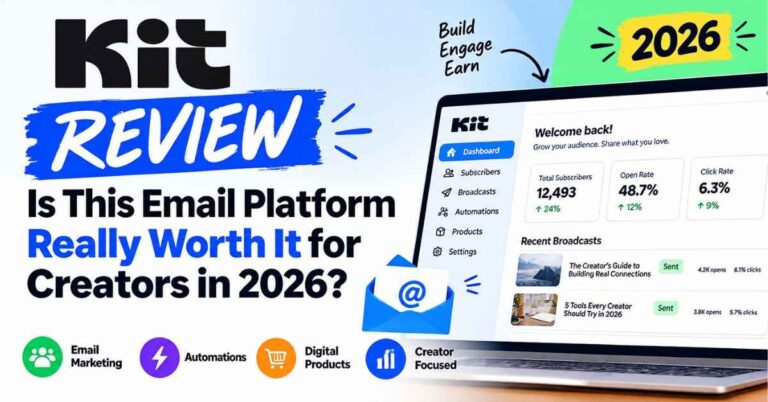
On switching, Kit advertises free migration. Their team moves your subscribers, tags, segments, automations and forms, then checks that every active subscriber made it. They say your part takes about an hour. Kit describes ActiveCampaign’s migration support as limited, though ActiveCampaign says it offers free migration, so both are making a case here. Ask each one exactly what they’ll move for you. Also read: Kit Review: Is This Email Platform Really Worth It for Creators in 2026?
Where ActiveCampaign Has the Edge (I Said I’d Be Honest)
I wouldn’t trust a comparison that says one tool wins everything, so here’s what I’d give ActiveCampaign credit for.
Depth of automation. 900+ automation templates and very flexible logic.
Integrations. 1,000+ native integrations versus Kit’s 100+. If you rely on a long chain of different tools, that matters.
CRM and sales tools. Pipelines, sales engagement and deeper tracking, if you run a real sales process.
E-commerce coverage. Support for Shopify, WooCommerce and BigCommerce cart abandonment.
Templates. A larger library of email designs.
For some businesses, that’s the deciding factor. If you have a team, a sales process or a complex stack of tools, ActiveCampaign is a sensible choice.
Where Kit Has the Edge
And here’s why a lot of creators land on Kit anyway.
A real free plan. Up to 10,000 subscribers, with unlimited forms, landing pages and broadcasts.
Simplicity. You can set up a welcome sequence in an afternoon without learning a new vocabulary.
Built around earning as a creator. Digital products, paid newsletters, subscriptions, sponsorships and paid recommendations, all tied to the same subscriber data.
Recommendations. A creator-to-creator growth feature. Kit says creators who use it grow their lists about twice as fast. I’d treat that as a best case, because results depend on your niche and setup.
Free migration and creator-focused support. A team that understands creator businesses, plus lots of learning material.
Unlimited sends. Kit lists unlimited email sends.
And one more thing. Kit has also added Kit MCP, which lets you connect an AI assistant like Claude, ChatGPT or Gemini to your account and ask things like “which email got the most clicks last month?” You can then have it tag subscribers or draft a follow-up. Kit says nothing happens until you approve it, which is how it should work.
If you’ve been leaning toward the simpler route and want to feel it for yourself, the easiest move is to try it. You can start with Kit’s free plan and see how it feels. No pressure to upgrade. Set up a signup form, send yourself a test email, and see if it fits how you work.
Which One Should You Pick? A Simple Guide
Here’s how I’d decide, depending on who you are.
You’re a solo creator, writer, coach or podcaster. Kit is built for you. Start free and add automations when you’re ready.
You want to sell digital products, courses or a paid newsletter. Kit’s setup around selling is built for that.
You run a business with a sales team and a real pipeline. ActiveCampaign’s CRM and automation depth are worth a serious look.
You rely on lots of different tools. Check whether Kit connects with the ones you use. ActiveCampaign’s integration library is far bigger.
You run an online store with heavy e-commerce needs. ActiveCampaign supports more store platforms for cart abandonment.
You’re moving from another tool. Look at who will help you migrate. Both companies advertise free migration, so ask what exactly they’ll handle.
How Different Creators Could Use Kit
These are examples of how people in these roles typically use a tool like Kit. They’re not income claims.
The creator with followers and no list. Say you run a motivational page on Instagram. You post daily, people love it, but there’s nothing beyond the feed. With Kit, you could write a short free guide on building a morning routine and put it on a landing page linked in your bio. Anyone who signs up gets the guide, then a week of follow-ups: your best posts, a bit of your story, and later an offer like a paid workbook. Same audience, but now you have a direct line to them.
The blogger whose readers disappear. Someone finds your article, gets their answer and never returns. Add a Kit form offering a related checklist, and now you have their email. Each new post gives them a reason to come back.
The coach who’s out of hours. A free mini-course delivered through automated emails warms people up before they ever speak to you. The ones who are ready come to you. The rest stay on the list and keep getting useful content.
The podcaster or YouTuber. Offer a bonus episode or show notes in exchange for an email, then send a short weekly note. Kit even mentions turning YouTube videos into a weekly newsletter, which is a smart way to reuse content you already made.
My Final Kit vs ActiveCampaign Verdict
So, who wins?
If you want one sentence: ActiveCampaign is the stronger pick for businesses that need deep automation, CRM and lots of integrations, and Kit is the better fit for creators who want to build and earn from their audience without the overwhelm.
Both are good tools. But if you want a real free plan, automations that are easy to set up, more ways to earn from your own products, a growth feature like Recommendations and a team that handles your migration, Kit is the one I’d lean toward for most solo creators. It won’t grow your list by magic, and it isn’t built to run a sales department. What it does is remove a lot of the friction between you and a direct line to people who care about your work.
You don’t have to commit today. Try the free plan or the trial, set up a simple signup page, and see how it feels. Worst case, you learn something about your audience. Best case, a year from now you’ve got a list of people who chose to hear from you, and you’re glad you started.
Your audience is out there right now, scrolling, watching, listening. The real question is whether you’ll have a way to reach them next month if the algorithm shifts again. Take a look at Kit and see if it’s the right fit for you. It takes a few minutes to get started, and you can decide for yourself after that.
Quick Questions About Kit vs ActiveCampaign
Is Kit better than ActiveCampaign? It depends on what you’re doing. ActiveCampaign suits businesses that need deep automation, CRM and lots of integrations. Kit suits creators who want simpler automations and more ways to earn from their audience.
Which has a free plan? Kit has a free plan for up to 10,000 subscribers, though it doesn’t include automations. ActiveCampaign lists a 14-day free trial but no free plan on its pricing page.
Which is cheaper? I couldn’t see ActiveCampaign’s dollar prices on its page. Use each company’s pricing calculator at your own list size and compare the real numbers.
Which is easier to learn? Kit describes itself as simpler and built for creators. ActiveCampaign is more powerful, which usually means a steeper learning curve. Try both trials to see how each feels to you.
Can I move my list to Kit? Yes. Kit advertises free migration, with its team handling subscribers, tags, segments, automations and forms.
Can I sell products through Kit? Yes. Digital products, paid newsletters and subscriptions, with a listed fee of 0.6% plus card processing.
Is Kit the same as ConvertKit? Yes. ConvertKit was renamed Kit in 2024.
A Quick Note About Links
Some links in this post are affiliate links. If you click one and sign up for Kit, I may earn a small commission, at no extra cost to you. I only recommend things I think can genuinely help the people reading, and I’ve tried to be upfront about where ActiveCampaign is the better choice. Either way, thanks for reading.