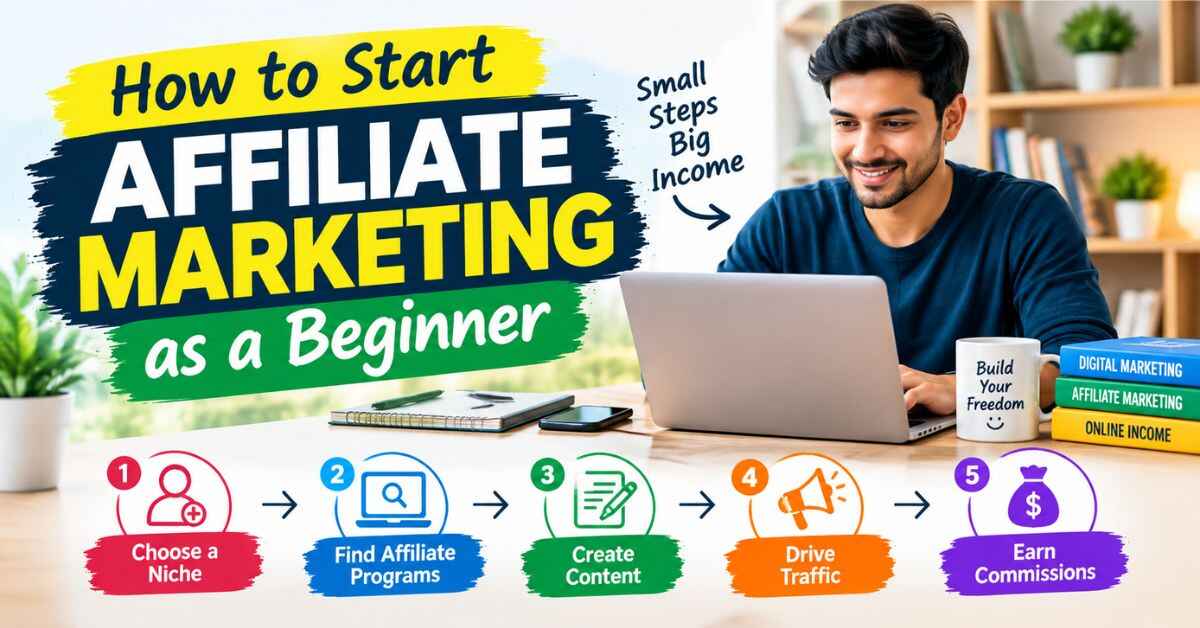
How to Start Affiliate Marketing as a Beginner (Without Wasting Your First 3 Months)
Here’s how it usually goes. You get fired up, sign up for a couple of affiliate programs, grab your links, drop them somewhere, and wait. A week later, nothing. Two weeks later, still nothing. So you decide it doesn’t work, or that the whole thing is a racket, or that you’re just not built for it.
I get why people land there. A lot of what’s online around this topic is exaggerated. But most beginners also skip the dull middle bit, the part where you make something people actually want to read. Nobody mentions that part in the ads.
So this is my take on how to start affiliate marketing as a beginner, in the order I’d do it if I were starting fresh. No promise that you’ll quit your job by spring. Just what to do, roughly how long it takes, and where people tend to go wrong early.
It’s a long one. Get a drink first.
What you’re actually doing
You recommend something. Someone buys it through your link. The company sends you a slice of the sale.
That’s all it is. You don’t make the product, you don’t ship it, and you don’t field angry emails when it arrives late. The company deals with that. You’re the person who says “hey, this one’s good, here’s why,” and your job is to be believable when you say it.
Think of the last time a friend raved about some app or gadget and you went and bought it. Now picture your friend getting a small thank-you every time that happened. Same idea. It just happens through blogs and videos and posts instead of over dinner.
Behind the scenes it’s pretty simple too. You get a unique link. When someone clicks it, a little cookie in their browser tells the company you sent them. If they buy within a set window, the sale is yours. Most programs pay out monthly once you’ve crossed a minimum.
What you earn per sale depends entirely on what you promote. Some physical products pay a few percent. A lot of software and digital products pay far more. Then there are the pricier programs people call high-ticket, where one sale can pay a few hundred dollars. I’ll get to those further down, because they come with a few strings.
Will it work if you’re starting from nothing?
It can. Though I’d be lying if I said it was quick.
Affiliate marketing isn’t passive at the beginning. You put in the work first, and the money, if it comes, comes later. For the first stretch you’ll probably be spending a lot more hours than you earn dollars. That’s normal, and it doesn’t mean you’re doing it wrong. Some people get a first commission within a month or two. Plenty take longer. It comes down to how much time you give it, how clear your topic is, and whether anyone can find what you make.
The good news is how cheap it is to try. No stock to buy, no office, no big upfront bill. A laptop and some stubbornness will take you a long way.
The thing that hurts most people is impatience. If someone promises fast, effortless money, they’re nearly always selling something, and nine times out of ten it’s a course.
How to Start Affiliate Marketing as a Beginner: Pick a topic you can live with
First decision: what are you going to talk about? People call this your niche, but it’s really just the subject you’ll be writing or filming about for the next year or so.
Choose something you already know a little about, or something you’re genuinely curious about. This matters more than it sounds. By month four, if you’re bored, you’ll stop. Simple as that.
It helps if people actually spend money in that area. Fitness, personal finance, tech, home projects, pets, online business, they all have buyers. A subject nobody pays for is a hard place to earn, however good your work is.
And try to go narrow. “Fitness” is a packed room. “Home workouts for busy parents” feels like it was written for one particular person, and when a reader lands on your page and thinks “that’s me,” you’ve done something most sites never manage.
Choose one place to publish
You need a home base. Somewhere people can find you, and where you decide what goes up.
A blog or small website is slow to start but pays off, because a good post can bring in visitors for years. YouTube works well if you’re fine talking to a camera, or even just recording your screen while you explain something. Video builds trust quickly. Social platforms like Instagram, TikTok, Pinterest and Facebook groups can bring attention fast, but you’re using someone else’s space and they can change the rules whenever they like.
Down the line you’ll want an email list as well, since people on a list are far more likely to act on a recommendation than someone scrolling past. That’s a second step, though, not a first one.
If I could give a beginner one bit of advice here, it’d be to pick a single platform and stick with it for three months at least. Being everywhere at once is a good way to burn out with nothing to show.
Be picky about what you promote
This is where beginners get greedy. They go straight for the biggest commission without asking whether the product is any good, and it tends to come back on them.
Before you put your name next to something, ask yourself a few plain questions. Would I tell a friend to buy this? Is there a real company behind it, with a proper website, contact details and a refund policy I can actually read? What are users saying on sites that aren’t selling it? How does the commission work, and how long does the tracking window last? And do the claims sound sensible, or a bit too good to be true?
If a product makes wild income promises and you’d have to repeat them to your readers, remember that those words end up with your name on them.
To find programs, the big affiliate networks list thousands of products in one place. Plenty of companies also run their own, which you can usually find by searching the company name plus “affiliate program.”
Start small. Two or three is plenty. Learn them well enough to say who each one suits, and just as importantly, who it doesn’t.
Make something useful
Most beginners rush past this, and it’s pretty much the whole game.
Nobody clicks an affiliate link because it’s there. They click because something you wrote or filmed helped them decide. So think about what a person needs to hear right before they hit “buy.”
An honest review is the classic. What it is, who it’s for, what it costs, what you liked, what annoyed you. That last part, the annoyances, is what makes people trust the rest.
Comparison posts do well because the reader is nearly there and just needs help choosing between two things. How-to guides work because you’re teaching, and the product turns up as part of the answer instead of a pitch. A “best for beginners” roundup can work too, as long as you’ve actually chosen the items carefully and haven’t just listed whatever pays best.
One habit to start on day one: say when a link is an affiliate link. It’s the right thing to do, in lots of countries it’s the law, and readers tend to respect you for it. It costs you almost nothing and earns a fair bit of goodwill.
Getting people to see it
Good content that nobody finds earns nothing, so you need some way to bring in visitors.
The slow, free way is search. You write about things people are already searching for, and you post steadily on social. It takes patience. A blog post can sit there for months before it starts to rank. Once it does, it can keep working long after you’ve forgotten about it.
The fast way is paid ads. They can work, but they’re also a quick way to lose money while you’re still learning the ropes. As a beginner I’d lean on the free route first, and if you do try ads, only put in a small test amount you’re fully okay losing.
My simple view of search: find questions real people are asking, answer them clearly, and try to be more useful than whatever’s already out there. No tricks needed. Just be helpful.
Check your numbers now and then
After a few weeks of publishing, have a look at your stats. Most affiliate dashboards show clicks, sales and earnings. You’re hunting for patterns. Which pieces get clicked most? Which products get plenty of clicks but no sales, which could mean the offer doesn’t suit your readers? What topics seem to get people talking?
Then do more of what’s working and let the rest go. It sounds obvious, yet loads of beginners never look. They just keep posting and hoping.
A gentle first month
If you’d like something concrete, here’s one way to spend the first 30 days.
Week one, settle on your topic and your main platform and get it set up. Write one sentence about who you’re trying to help.
Week two, research. Find two or three affiliate programs that fit, read their terms, and sign up. Look at what others in your space are publishing and see what’s missing.
Week three, start putting things out. Aim for three to five pieces, with at least one real review and one how-to, and a clear disclosure on each.
Week four, share what you’ve made and watch what happens. Ask for honest feedback if you can. Look at whatever little data you have and plan next month.
It isn’t glamorous. But it’s a real foundation, and plenty of people never get further than “I’ve been meaning to try that.”
Do you have to pay for training?
No, not necessarily.
Everything in this guide can be learned for free. There are endless tutorials, forums and free courses, and the affiliate networks teach the basics themselves. If you’re patient and good at working things out alone, that route is fine.
What you give up is time and direction. Going solo means more trial and error, and nobody nearby to say “you’ve gone down a dead end.” Some people would rather pay for structure, coaching or a ready-made setup so they can skip some of the guessing.
If that sounds like you, a program like the Millionaire Partner System is one of the options people end up looking at. It’s built around promoting higher-priced offers, and it comes with coaching and a done-for-you setup. It isn’t cheap, and the marketing makes some very big income claims that its own fine print says aren’t typical. I went through the cost, the refund questions and who it really suits in my full breakdown: Millionaire Partner System Review 2026: Legit Way to Earn Online or Just Another Hype Machine?
(Internal link to the pillar post. Keep it in the middle of the article, where it reads as a natural next step.)
Whichever way you go, free or paid, only put in money you could stand to lose. That goes for anything online.
A few traps to avoid early on
I’ll give this its own post, but a few are worth a mention now.
Don’t promote anything you haven’t properly looked into. Your credibility is the only real asset you’ve got here. Don’t switch methods every time something shiny shows up in your feed; choose one approach and give it time. Don’t expect fast money. Don’t hide the fact that you earn from your links. And please don’t give up in month two, because that’s often right before things start to move.
Questions beginners always ask
Do I need money to start? Not much. Free tools and platforms will get you going. Things like a domain name or hosting come later, and they can stay cheap.
Do I need my own website? No. You can begin on YouTube or social media. A site just gives you more control later on.
How long until I earn something? It varies a lot. Some people see a first commission in weeks, others in a few months. Anyone who gives you an exact date is guessing.
Can I do this with a full-time job? Yes, lots of people do. An hour or two most days adds up faster than you’d think.
Do I need to be techy? Not really. If you can send an email and follow a tutorial, you can start.
So, where does that leave you?
Affiliate marketing isn’t magic, and it isn’t a scam either. It’s a skill, and like most skills it rewards the people who start small, keep turning up, and look after their readers.
Pick a topic. Choose one platform. Find a couple of products you’d honestly recommend. Make something useful. See how it’s doing. Then go again.
If you’d like to see how a structured, coaching-based approach works before you decide your own path, you can watch the free training and make up your own mind:
👉 Watch the free Millionaire Partner System training here
You don’t have to join anything to get going, mind you. Just picking your topic and writing your first honest review puts you ahead of everyone who’s still “thinking about it.”
If you’ve got questions, or you’re just getting started, leave a comment. I read every one.
(Optional: if you have a real moment from your own journey, such as a first commission, a flop, or something you wish you’d known, add two or three lines near the intro. It’ll do more for the human feel than any edit.)
Affiliate Disclosure
Just so you know, some links in this post are affiliate links. If you click one and buy something, I may earn a small commission, at no extra cost to you. I only point you toward things I think are worth a look, and I try to be upfront about the downsides too. This isn’t financial advice, and results differ from person to person, so please do your own research and only spend what you can afford.