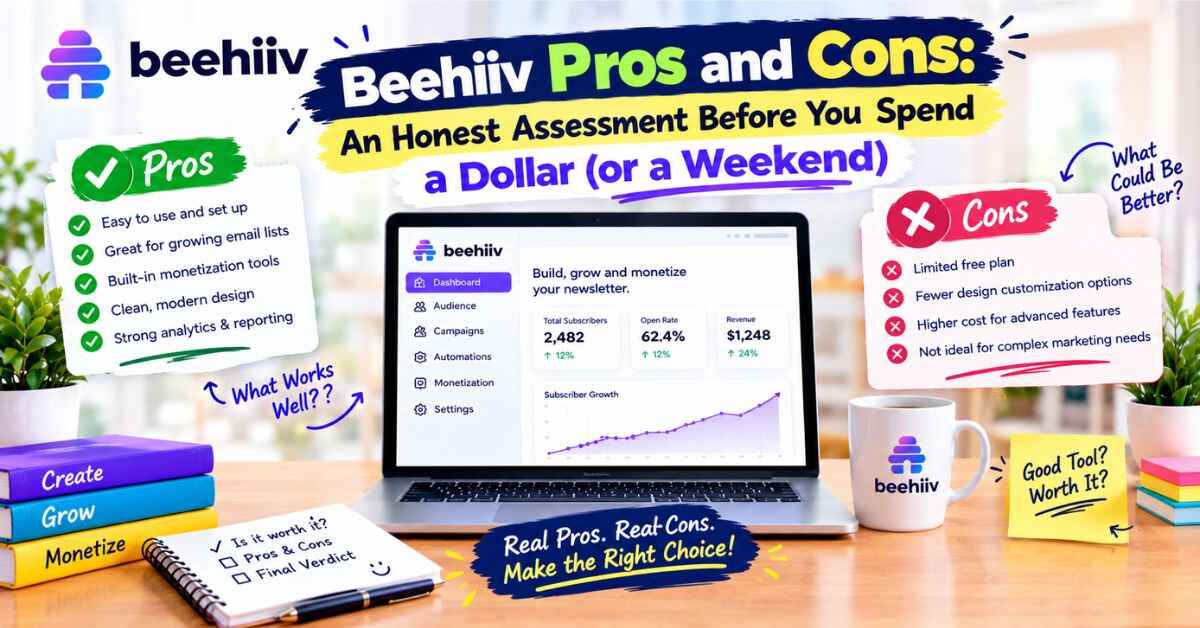
Beehiiv Pros and Cons: An Honest Assessment Before You Spend a Dollar (or a Weekend)
Every review says it’s honest. Very few actually are. So let me promise something smaller and more useful: in this Beehiiv Pros and Cons: An Honest Assessment, I’ll tell you what genuinely works, what genuinely bugs people, and who I’d point toward it or away from it. No gushing, no scare tactics.
I’ll also tell you something up front. I think beehiiv is a strong choice for a lot of people building newsletters. But “strong” isn’t “perfect,” and it certainly isn’t “right for everyone.” There are real drawbacks, one of them very recent, and you should hear them before you sign up, not after.
Grab a coffee. Let’s go through it properly.
Why Honest Reviews Are So Hard to Find
Let me describe how most product reviews work, because it explains why you’ve probably felt a little skeptical lately.
Someone writes a post about a tool. They list a bunch of features in the order the company’s website lists them. They say it’s “powerful” and “easy to use.” They add a “cons” section with one or two items that aren’t really cons: “It has so many features it can feel overwhelming!” Then they drop a link and call it a day.
You read it, you sign up, and three weeks later you find out the thing you needed was behind a higher plan. Or the price changed. Or the tool just doesn’t work the way you imagined.
And now you’re out time and trust.
That’s why I want to do this differently. A review is only useful if it tells you what to expect when things aren’t perfect. So in this post, the cons get as much attention as the pros. If you walk away thinking “okay, that’s a fair picture,” I’ve done my job.
What beehiiv Is, in Plain Words
Before the good and bad, a quick recap.
beehiiv is a newsletter platform where you write, publish, grow, and earn from an email list in one place. Its free plan covers up to 2,500 subscribers with unlimited sends, a newsletter website, templates, and landing pages. Paid plans are now called Lite and Pro, priced by subscriber tier, with custom pricing for large publishers. The platform changed its plans and prices on October 1, 2026, so older articles may show outdated names and numbers.
On paid plans, beehiiv takes 0% of your subscription revenue, though normal payment processing fees still apply. It also offers an ad network, referral and recommendation tools, and analytics focused on growth.
That’s the product. Now let’s weigh it. Also read: Beehiiv Review 2026: An Honest Look at the Newsletter Platform Everyone Keeps Talking About
Beehiiv Pros and Cons: An Honest Assessment
Here’s the full picture, pros first, then cons, in plain language.
Pro #1: It’s built around growth, not just sending
This is the biggest one for me. Many email tools stop at “write and send.” beehiiv builds in:
- A referral program, where readers earn rewards for inviting friends
- Recommendations, where newsletters promote each other and swap readers
- Boosts, where you can pay to be promoted to relevant readers or earn by recommending others
- Landing pages and signup forms you can share anywhere
- A newsletter website that can bring in search traffic over time
Writing is usually the easy part. Getting readers is the hard part. Having tools for that built in saves you from stitching together extra software.
Pro #2: The free plan has real room
2,500 subscribers, unlimited email sends, a newsletter website, templates, and landing pages. For someone starting out, that’s months or even a year of runway. According to beehiiv’s own announcement, podcasts, community tools, and digital products can also be tried on the free plan, with a 0% platform fee on digital products. (Plan details differ slightly between sources, so confirm on the pricing page.)
Pro #3: Several ways to earn
- Paid subscriptions, with a 0% take from beehiiv on paid plans
- The ad network, which matches your newsletter with brands
- Direct sponsorships, which you can sell yourself
- Digital products
- Boosts, where you earn by recommending other newsletters
Compared with a platform that takes a percentage of subscription revenue, beehiiv’s flat plan pricing can leave you with more as you grow.
Pro #4: A writing-first editor
You type like you’re in a normal document. You can add images, buttons, polls, and sections without touching code. Every issue also becomes a page on your site, so it doubles as a blog.
Pro #5: Useful analytics
You can see where subscribers come from, which posts bring readers, which links get clicked, and how your list changes over time. That means you can do more of what works instead of guessing.
Pro #6: One place for most things
Website, email, landing pages, growth tools, monetization, and analytics, all under one account. For many people, that means fewer logins and fewer bills.
Con #1: Some of the best features cost money
This one matters. According to beehiiv’s plan details, automations, paid subscriptions, ad monetization, polls, and A/B testing start at Lite. Branding removal, advanced analytics, and priority support are on Pro. If you’re counting on a welcome email series or paid tiers from day one, the free plan won’t cover it.
Con #2: The prices went up
beehiiv changed its pricing on October 1, 2026, and some creators weren’t happy about it. Reports at the time quoted creators who had joined beehiiv specifically to avoid Substack’s 10% cut and were reconsidering after the increase. For a list of around 10,000 subscribers, beehiiv’s own page showed roughly $119 a month for Lite and $199 for Pro with yearly billing, while press coverage quoted about $139 and $239, which looks like monthly billing. For small publishers who don’t charge readers and rely on ads, that can feel heavy.
Existing customers aren’t hit right away: they keep their current rate until their first renewal on or after November 1, 2026.
Con #3: The free plan caps at 2,500 subscribers
Other platforms offer more free capacity. Kit’s free plan, for instance, covers up to 10,000 subscribers, though with fewer features. If you’re collecting emails at scale without much monetization, you’ll hit beehiiv’s ceiling sooner.
Con #4: Design freedom is limited
You get clean templates, branding options, and a custom domain, and the top plan lets you remove beehiiv branding. But if you want a distinctive, code-level customized site, a platform like Ghost gives you much more control.
Con #5: Complex automations are lighter
For welcome series and simple triggers, beehiiv is plenty. If your business depends on branching funnels, detailed customer journeys, and heavy tagging, tools like Kit or Mailchimp go further.
Con #6: Ad income varies a lot
The ad network is a nice option, but earnings depend heavily on your niche, audience size, and engagement. Some creators say rates haven’t matched their hopes. Treat any “average earnings” number as a rough idea, not a promise.
Con #7: There’s a learning curve
It’s friendly, but there’s more to explore than with the simplest tools. Give yourself a weekend to click around before you judge it.
Con #8: The tools don’t do the work for you
Referrals and recommendations help, but they won’t build an audience on their own. You still have to write things people want to read and share them.
So, Do the Pros Outweigh the Cons?
That depends entirely on who you are. Here’s how I’d weigh it.
For most writers, creators, bloggers, and niche publishers who want to grow and earn, the pros outweigh the cons. The growth tools and earning options are exactly what you need, and the free plan lets you test without risk.
For small publishers who aren’t earning and don’t plan to, the cons weigh heavier. Paid plans can feel expensive, and a free option elsewhere might serve you better.
For people who need deep design control or complex funnels, the cons are bigger. Ghost, Kit, or Mailchimp may fit more naturally.
The honest answer isn’t “yes” or “no.” It’s “it depends, and here’s what it depends on.”
Who Should Use beehiiv
Let me be specific.
Writers and independent publishers. If your newsletter is the product, this is built for you.
Creators who want to own their audience. If you’re tired of depending on algorithms, a newsletter gives you a direct line.
Bloggers adding an email list. Every issue becomes a web page, and signup forms and landing pages make list-building easy.
Coaches, consultants, and educators. A newsletter builds trust before anyone hires or buys.
Niche publishers and affiliates. A list gives you a steadier asset than search traffic. Used honestly, with clear disclosure, it can become your most reliable channel. Check beehiiv’s content policies and each program’s email rules before sending.
Beginners. The free plan lowers the risk of trying.
If that sounds like you, beehiiv is an easy place to open a free account, set up a basic page, and see how the editor feels.
Who Should Probably Choose Something Else
Trust matters more than a quick sale, so here’s who I’d point elsewhere.
- Anyone who wants the simplest possible start. Substack may feel calmer.
- Publishers who want deep design control and ownership. Look at Ghost.
- Course creators who live on funnels. Kit is built for that.
- Online store owners. Mailchimp’s integrations fit better.
- People who can’t justify a monthly cost. Stay on a free plan somewhere until it makes sense.
A Fair Comparison With the Main Alternatives
A quick look so you can compare.
Substack: Free to start, takes 10% of subscription revenue, has a built-in reader network and app, and is the easiest to begin. Fewer growth and automation tools, limited design control.
Ghost: Open source, strong on design and ownership, says it takes 0% of your earnings. Reported starting prices are roughly $15 to $18 a month for about 1,000 members, with a 14-day free trial, though sources vary. Fewer built-in growth tools, more setup, and members include free subscribers.
Kit (formerly ConvertKit): Strong on visual automations and product sales, free plan up to 10,000 subscribers with limits, with reports putting paid plans at around $39 and $79 a month at 1,000 subscribers on monthly billing. Transaction fees apply on product sales.
Mailchimp: Strong on campaigns and store integrations, but its free plan was cut in January 2026 to around 250 contacts with a small monthly send limit, and costs climb with your list.
None of these is “better” overall. They fit different situations.
Real-Life Style Scenarios
Let me put some faces on the pros and cons.
The writer who loves it. Hana writes a weekly essay about slow living. She uses the free plan, loves the editor, and sets up a referral program once she hits a few hundred readers. The growth tools do exactly what she hoped. She doesn’t pay until she wants a welcome series.
The creator who upgrades at the right time. Arif reaches 2,400 subscribers and plans a paid tier. He upgrades to Lite for paid subscriptions and automations. He knows exactly why he’s paying, so the cost feels fair.
The publisher who’s frustrated. Marcus has 8,000 subscribers, doesn’t charge readers, and earns a small amount from ads. After the price change, the paid plan feels steep for his income. He compares costs and considers a cheaper alternative. That’s a legitimate conclusion.
The designer. Omar wants a site that looks like a real magazine. beehiiv’s templates are clean but not unlimited. He moves to Ghost for full control.
The funnel builder. Samira sells courses through a seven-email sequence. beehiiv’s automations feel light for her needs, and Kit fits better.
Different people, different results. That’s why a one-line verdict never tells the whole story.
How to Test beehiiv Without Regret
If you want to try it, here’s a low-risk way.
- Start on the free plan. There’s no reason to pay before you’ve tested.
- Spend one weekend. Set up a page, write a short issue, build a simple landing page.
- Send a real issue to a small group, even ten people.
- Look at the numbers after a couple of weeks: opens, clicks, and where subscribers come from.
- Check which paid feature you actually need. If nothing is missing, stay free.
- Use the pricing slider with your expected list size before you upgrade.
- Decide with real experience, not with a review. That includes this one.
My Honest Take
Here’s where I land.
beehiiv is a strong, well-rounded platform for people who want to grow and earn from a newsletter without stitching together a lot of tools. The pros are real: built-in growth tools, a roomy free plan, several ways to earn, a friendly editor, and useful analytics. The cons are real too: some features sit behind paid plans, prices rose recently, the free plan has a ceiling, and design and automation depth are more limited than some alternatives.
If you’re a writer, creator, blogger, or niche publisher who wants an audience you own, I think it’s worth trying, and the free plan makes trying it cheap. If you want maximum design freedom, complex funnels, or a big free list with no plans to earn, look at the alternatives first.
That’s the honest verdict. Not “buy it now,” just “here’s how to decide.”
Quick Questions People Ask
Is beehiiv worth it?
For most newsletter writers and creators who want growth tools and income options, yes. For small publishers who aren’t earning, paid plans can feel expensive.
What’s the biggest pro?
Built-in growth tools: referrals, recommendations, and Boosts.
What’s the biggest con?
Some key features need a paid plan, and prices rose in October 2026.
Is beehiiv free?
Yes, there’s a free plan for up to 2,500 subscribers with unlimited sends, a newsletter website, templates, and landing pages.
Can I make money with beehiiv?
Through paid subscriptions, the ad network, sponsorships, and digital products. Results depend on your audience and niche.
Is it hard to learn?
Not really, but there’s more to explore than the simplest tools.
Can I switch away later?
Yes. All major platforms let you export your subscribers. Plan to rebuild automations and design.
Final Thoughts
If I could leave you with one idea, it’s this: don’t choose a platform because a review told you to. Choose it because it matches how you want to work, and test it before you commit.
beehiiv has real strengths and real limits. Now you know both.
If you think it might fit, beehiiv is a low-pressure place to start. Open the free plan, write a short test issue, and explore the growth tools. If it doesn’t fit, you’ve lost an hour. If it does, you may have just found a home for your newsletter.
I hope this look at beehiiv’s pros and cons gave you an honest picture.
Affiliate Disclaimer
Quick heads-up: some links in this post are affiliate links. If you sign up through them, I may earn a small commission at no extra cost to you. It helps me keep writing posts like this. I only share things I think are worth your time, and my opinions are my own. Features and prices change often, so please check beehiiv’s website for the latest details before you decide.