Who Should Use beehiiv? Benefits, Drawbacks, and Alternatives
Who should use beehiiv? That’s the question I’d ask before signing up for any platform, and it’s a better question than “is it good?” Because a tool can be excellent and still be wrong for you. A great hammer is a terrible way to cut a sandwich.
So in this guide, I’ll cover the benefits, the drawbacks, and the alternatives, and I’ll try to be specific about who gets real value from beehiiv and who would be happier somewhere else. I’m not trying to talk you into anything. If beehiiv fits, you’ll see it. If it doesn’t, I’ll point you toward something that might.
Grab a coffee. Let’s figure this out properly.
The Problem With “Which Platform Is Best?”
If you’ve searched for a newsletter tool, you’ve seen the same pattern. Every article ranks platforms from “best” to “worst,” as if there were one correct answer for everyone.
There isn’t.
A solo writer who wants to send one weekly letter has completely different needs from an online store owner running abandoned cart emails. A journalist who cares about design has different needs from a coach who wants to sell a course. A creator with 50 followers has different needs from a publisher with 50,000.
When you choose based on “best overall,” you’re really choosing based on someone else’s situation. And the result is a familiar story: months later, you’re frustrated with a tool that looked great in a review but doesn’t fit how you actually work.
That frustration is expensive. Not just in money, but in momentum. Moving a list, rebuilding automations, and telling your readers “we’re switching platforms” is nobody’s idea of fun. So it’s worth getting the match right the first time.
What beehiiv Is, in Plain Words
beehiiv is a newsletter platform where you write, publish, grow, and earn from an email list in one place. Its free plan covers up to 2,500 subscribers, with unlimited email sends, a newsletter website, templates, and landing pages. Paid plans are now called Lite and Pro, priced by subscriber tier, with custom pricing for large publishers. It changed plans and prices on October 1, 2026, so older articles may show outdated names and numbers.
On paid plans, beehiiv takes 0% of your subscription revenue, though normal payment processing fees apply. It also offers an ad network, referral and recommendation tools, and analytics focused on growth.
In short: it’s built for people who want their newsletter to grow and earn, with the tools included instead of bolted on.
The Benefits: What beehiiv Does Well
Let’s start with the good stuff.
1. It’s built around growth
Most email tools help you send. beehiiv also helps you get found. It includes:
- A referral program, where readers earn rewards for inviting friends
- Recommendations, where newsletters promote each other and swap readers
- Boosts, where you can pay to be promoted to relevant readers or earn by recommending others
- Landing pages and signup forms you can share anywhere
- A newsletter website that can bring in search traffic over time
If you’ve ever felt like writing was the easy part and growing was the hard part, these tools are the biggest reason to look at beehiiv.
2. It gives you several ways to earn
- Paid subscriptions, with a 0% take from beehiiv on paid plans
- The ad network, which matches your newsletter with brands
- Direct sponsorships, which you can sell yourself
- Digital products, which beehiiv says carry no platform fee
- Boosts, where you earn by recommending other newsletters
A fair warning: ad earnings depend on your niche, audience, and engagement, and some creators say rates haven’t matched their hopes. Treat any “average earnings” number as a rough idea, not a promise.
3. The free plan has real room
2,500 subscribers with unlimited sends and a newsletter website is a lot of runway for a new publication. You can learn, publish, and grow without paying.
4. The editor is writing-first
You type like you’re in a normal document, add images, buttons, and sections, and send. Every issue also becomes a page on your site. It’s friendly for people who don’t want to wrestle with design.
5. The analytics are useful
You can see where subscribers come from, which posts bring readers, which links get clicked, and how your list grows. That helps you do more of what works.
The Drawbacks: What beehiiv Doesn’t Do So Well
I said I’d be honest, so here’s the other side.
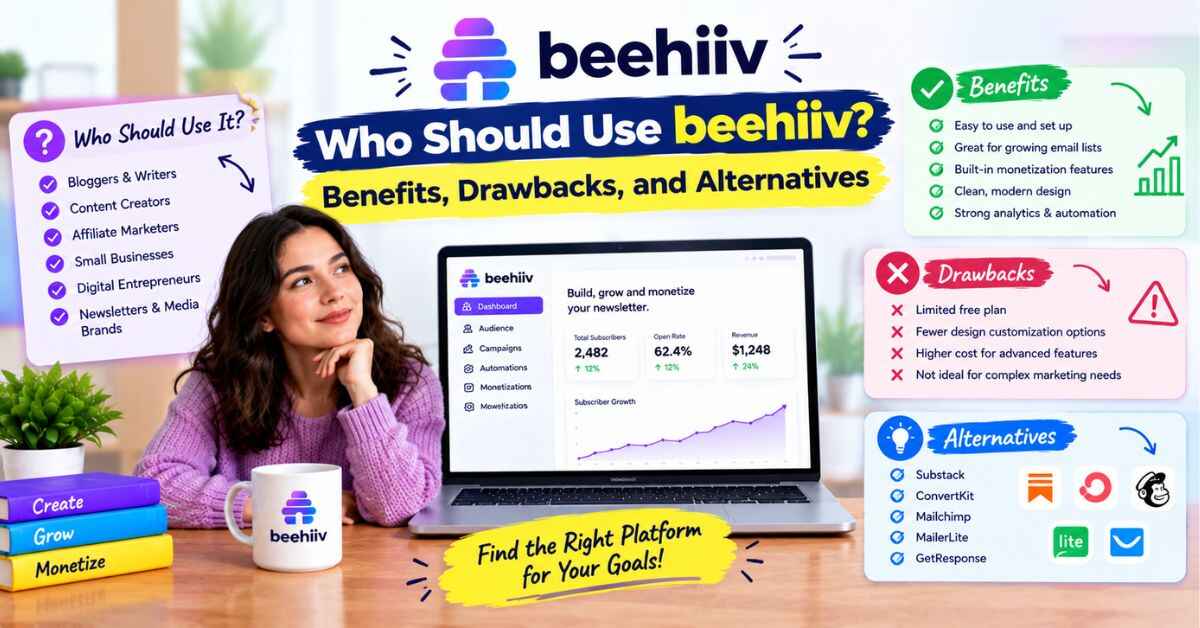
Some key features need a paid plan. According to beehiiv’s plan details, automations, paid subscriptions, ad monetization, polls, and A/B testing start at Lite. Branding removal and advanced analytics are on Pro.
The free plan caps at 2,500 subscribers. Other platforms offer more free capacity, though often with fewer features.
Prices rose in October 2026. Some creators weren’t happy about it, especially smaller publishers who don’t charge their readers. If you aren’t earning from your newsletter yet, paid plans can feel heavy.
Design freedom is limited. You get clean templates and branding options, but not the deep customization of something like Ghost.
Complex automations are lighter. If your business depends on branching funnels and detailed customer journeys, tools like Kit or Mailchimp go further.
Ad income varies a lot. What works for one publisher may not work for you.
There’s a learning curve. It’s friendly, but there’s more to explore than the simplest tools. Give yourself a weekend.
Growth still takes work. The tools help, but they won’t build an audience for you.
None of these are dealbreakers if you know them going in. They’re trade-offs.
Who Should Use beehiiv?
Now the heart of it. Here’s who I think gets real value.
Writers and independent publishers
If your newsletter is the product, beehiiv is built for you. The editor, the website, the growth tools, and the earning options all line up with that goal.
Creators who want to own their audience
If you make videos, designs, podcasts, or social content and you’re tired of depending on algorithms, a newsletter gives you a direct line. beehiiv’s landing pages make it easy to move followers onto your list.
Bloggers adding an email list
Every issue becomes a web page, so your email content can keep working in search. The signup forms and landing pages help you collect emails from readers already visiting your site.
Coaches, consultants, and educators
A newsletter is a good way to share ideas, build trust, and let people get to know you before they hire or buy.
Affiliate marketers and niche publishers
A list gives you a steadier asset than search traffic alone. Used honestly, with clear disclosure and recommendations you believe in, it can become your most reliable channel. Check beehiiv’s current content policies and each affiliate program’s email rules before sending.
Small teams and multi-newsletter publishers
Higher plans add more seats, guest authors, and publications, which helps if you work with others.
Beginners who want a low-risk start
The free plan lets you test the whole idea without spending a cent.
If you recognize yourself in any of those, is an easy way to open a free account, build a basic page, and see how the editor feels.
Who Should Probably Skip beehiiv
Trust matters more than a quick sale, so here’s who I’d point elsewhere.
People who just want the simplest possible start. If settings make you anxious, Substack may be a calmer place to begin.
Publishers who want deep design control. If you want a distinctive site and full ownership, Ghost is stronger.
Course creators who live on funnels. If your business is built on multi-step email sequences leading to product sales, Kit’s automations are more mature.
Online store owners. If you need e-commerce integrations and cart emails, Mailchimp fits better.
People who can’t justify a monthly cost. If you aren’t earning yet and your list will pass 2,500 soon, compare costs carefully before committing.
Anyone who needs a huge free list. If you’re collecting emails at scale without much monetization, a platform with a larger free tier may suit you.
Choosing the right tool beats choosing the popular one every time.
The Alternatives, Briefly
Let me walk through the main options so you can compare fairly.
Substack
Free to start, with a 10% cut of subscription revenue plus payment processing fees when you begin charging. It has its own app and reader network, and it’s known for being the easiest to start. The trade-offs: limited design control, fewer growth and automation tools, and that 10% cut as paying readers grow. Some creators moved to beehiiv specifically to avoid that cut.
Ghost
An open-source publishing platform run by a non-profit foundation. You can self-host it or use Ghost(Pro). Ghost says it takes 0% of your earnings. Reported starting prices are roughly $15 to $18 a month for about 1,000 members on the lowest plan, around $29 for the middle plan, and around $199 for the top published plan, with a 14-day free trial, though sources vary. Members include free subscribers, so costs can climb as your free list grows. It’s best for design freedom and ownership, with fewer built-in growth tools.
Kit (formerly ConvertKit)
Built for creators who sell products, with strong visual automations and tagging. Its free Newsletter plan covers up to 10,000 subscribers, though with limits, and paid plans have risen in price this year, with reports putting Creator around $39 and Pro around $79 a month at 1,000 subscribers on monthly billing. There’s also a transaction fee when you sell products. Best for funnels, less focused on publishing.
Mailchimp
One of the oldest email marketing tools, strong on campaigns, automations, and store integrations. Its free plan was cut in January 2026 to around 250 contacts with a small monthly send limit, and costs climb with your list, with unsubscribed contacts possibly counting toward your limit. Best for stores and marketing, not built around newsletter growth.
Others to look at
MailerLite and Buttondown also come up often. I haven’t compared them in depth here, so check their current features and pricing yourself if the four above don’t fit.
A Quick Side-by-Side
| beehiiv | Substack | Ghost | Kit | Mailchimp | |
|---|---|---|---|---|---|
| Best for | Growth and income | Simple writing | Design and control | Funnels and products | Stores and marketing |
| Free plan | Up to 2,500 subs | Free until you charge | Trial / self-host | Up to 10,000 (limited) | Small (about 250) |
| Cut of subscriptions | 0% on paid plans | 10% | 0% | Fee on product sales | Not the focus |
| Growth tools | Strong | Network and app | Mostly DIY | Moderate | Basic |
| Ad network | Built in | Not the focus | None | Sponsor network on some plans | None |
Treat it as a map, not a rulebook. Plans and fees change. Also read: Beehiiv Review 2026: An Honest Look at the Newsletter Platform Everyone Keeps Talking About
What It Costs When You Grow
Since cost shapes the decision, let me be clear about the paid side.
Lite adds paid subscriptions (0% take from beehiiv), ad monetization, automations, polls, A/B testing, longer analytics, and more room for guest authors and publications.
Pro adds branding removal, webinars and coaching tools, advanced analytics, and priority support.
For a list of around 10,000 subscribers, beehiiv’s own page showed roughly $119 a month for Lite and $199 for Pro with yearly billing, while press coverage quoted about $139 and $239, which looks like monthly billing. Paying yearly can earn up to two months free, according to beehiiv. Existing customers keep their current price until their first renewal on or after November 1, 2026.
Use the pricing page slider with your own list size, because numbers change. My advice: stay on Free until a specific feature clearly pays for itself.
Real-Life Style Scenarios
Let me put some faces on this.
The independent writer. Hana writes a weekly essay about slow living. She wants a clean editor, a site for her archive, and eventually a paid tier. beehiiv fits.
The design-focused publisher. Omar covers regional business news and wants a site that looks like a real outlet. Ghost fits him better.
The course creator. Samira teaches photography and runs a seven-email nurture sequence into a course. Kit’s automations suit her.
The shop owner. Tomás sells handmade candles and sends cart reminders. Mailchimp’s integrations make sense.
The ready-to-earn creator. Lina has a growing list, sponsors asking about rates, and plans for referrals and a paid tier. beehiiv’s tools line up with all of that.
The beginner. Li has 80 followers and a big idea. He uses beehiiv’s free plan, or Substack, as a low-risk test.
Different people, different winners. That’s the honest truth.
How to Decide in Five Minutes
If you’re still unsure, ask yourself these questions.
1. How will I make money?
Subscriptions, ads, sponsors: lean beehiiv or Substack. Product funnels: Kit. A store: Mailchimp. Custom memberships: Ghost.
2. How important is design?
Very: Ghost. Clean and good enough: beehiiv or Substack.
3. How much setup am I comfortable with?
Little: Substack or beehiiv. Some: Kit or Mailchimp. A lot, and I enjoy it: self-hosted Ghost.
4. How will I grow?
If you want growth tools built in, beehiiv. If you prefer a built-in reader network, Substack. If you’ll handle growth yourself, Ghost.
5. What’s my budget today and a year from now?
Compare real numbers at your expected list size.
Your answers usually point to one or two clear candidates.
My Honest Take
Here’s where I land.
beehiiv is a strong choice for people who want to grow and earn from a newsletter without stitching together a pile of tools. The free plan is roomy, the growth tools are built in, and the earning options are real. It’s especially good for writers, creators, bloggers, and niche publishers who treat their newsletter as an actual project.
It isn’t for everyone. If you want the simplest start, Substack may feel better. If you want design control, Ghost is stronger. If you run funnels or a store, Kit or Mailchimp may fit your business more naturally. And if you’re a small publisher who isn’t earning yet, paid plans can feel expensive after the October 2026 price change.
So my advice is simple: start on the free plan, use it for a few weeks, and watch how it feels. You’ll learn more in an hour of real use than from any review.
Quick Questions People Ask
Who should use beehiiv?
Writers, creators, bloggers, coaches, and niche publishers who want growth tools and several ways to earn built in.
Who shouldn’t use beehiiv?
People who want maximum design control, complex funnel automations, or e-commerce marketing, and those who can’t justify paid plans yet.
Is beehiiv free?
Yes, there’s a free plan for up to 2,500 subscribers with unlimited sends, a newsletter website, templates, and landing pages. Some features need a paid plan.
What’s the best alternative to beehiiv?
It depends. Substack for simplicity, Ghost for design and ownership, Kit for funnels, Mailchimp for stores.
Can I switch later?
Yes. All of these let you export your subscribers, and beehiiv has import tools. Plan to rebuild automations and design.
Is beehiiv good for beginners?
Yes. The editor is friendly, and the free plan lowers the risk. There’s more to explore than the simplest tools, so give yourself a weekend.
Final Thoughts
If you remember one thing, make it this: the best platform is the one that matches how you actually want to work. Not the one with the longest feature list, and not the one your favorite creator uses.
beehiiv is a strong match for a lot of people, and a poor match for some. Now you know which is which.
If you think it might be you, beehiiv is a low-pressure place to start. Open the free plan, write a short test issue, and explore the growth tools. If it doesn’t fit, you’ve lost an hour. If it does, you may have just found a home for your newsletter.
I hope this guide to who should use beehiiv, with its benefits, drawbacks, and alternatives, helped you decide.
Affiliate Disclaimer
Quick heads-up: some links in this post are affiliate links. If you sign up through them, I may earn a small commission at no extra cost to you. It helps me keep writing posts like this. I only share things I think are worth your time, and my opinions are my own. Features and prices change often, so please check each platform’s website for the latest details before you decide.