AI Drama Series Review (2026): Make Vertical Dramas Without a Camera, Cast, or Crew
You’ve probably done it without noticing. You’re scrolling late at night, you land on a one-minute clip of a woman in a wedding dress standing in the rain, and somebody is shouting at her. You don’t know who they are. You don’t know why she’s crying. Then the clip cuts off mid-sentence, and your thumb is already tapping the next episode. That’s vertical drama, and it’s the reason I spent a few days looking into this AI Drama Series review topic.
It’s a new app that claims it can take one sentence and turn it into an entire season of that kind of show: scripts, cast, voices, music, captions, thumbnails, everything. No filming, no actors, no editing, and no showing your face. I was skeptical, so I read through everything the creators put out. I’ll tell you what impressed me, what to keep your expectations in check about, and who I think this is really for.
The Thing About Online Video Nobody Talks About
Most people who try to make money with video online get stuck in the same loop.
You make a video, post it, and it gets a few hundred views. The next day you start again from zero, because the person who watched yesterday’s video has no reason to watch today’s. Every upload is a standalone thing, so you’re always starting over.
If you’ve tried AI video tools, it’s probably even more frustrating. The clips look great for about four seconds. Then you try to make a second clip, and the woman in the red coat has a different face. Different hair, different age, different voice. You can’t tell a story with someone who turns into a stranger between scenes.
That’s the real wall for anyone who wants to build something with AI video. It isn’t the picture quality. It’s that nothing connects. You end up with a folder of pretty, unrelated clips that nobody has a reason to follow.
Meanwhile, there’s a whole corner of the internet where people do follow along, and in huge numbers.
The Audience Is Already There
According to the figures on the AI Drama Series sales page, vertical drama is now a market worth roughly $14 billion this year. They also say vertical drama apps were downloaded more than 2.3 billion times in 2025, while traditional streaming app downloads dipped. These are third-party numbers that the creators cite rather than ones I verified myself, so treat them as directional. But the trend matches what you can see just by watching how people use their phones.
One comparison stuck with me. The page says the top vertical drama app gets about 35 minutes of daily watch time per user, which is more than Netflix at around 25. And people don’t watch just one episode. The average binge is supposedly 22 episodes in a sitting.
The part that surprised me is that these viewers pay. In most of these apps the first handful of episodes are free, then there’s a paywall at a cliffhanger, and viewers buy coins to unlock the rest. The page says around 60% of the market’s revenue comes from viewers paying directly rather than from ads.
YouTube has also noticed. Last month’s feature, Shorts Series, lets creators bundle vertical episodes into numbered seasons, so when one episode ends the next one starts automatically. The sales page says YouTube pointed at vertical drama as the reason for building it.
So the audience exists, the platforms exist, and there’s a shelf waiting to be stocked. What’s missing is the shows.
Why So Few People Are Making Them
A normal vertical drama season costs somewhere between $150,000 and $300,000 to produce. You need actors, a crew, cameras, lights, locations, a writer who can turn out fifty to a hundred episodes, and weeks in an edit suite.
That’s the entire reason this market is dominated by big studios. And it’s why the platforms are reportedly so hungry for new titles that some of them now take submissions from outside creators.
Think about that for a second. Huge demand, not enough supply, and a production cost that locks out almost everyone. The gap isn’t about talent or ideas. It’s about money and crew size.
Now imagine you take the crew out of the equation.
That’s the bet behind AI Drama Series.
Curious what a finished episode actually looks like before you decide anything? The sales page has a full, uncut demo you can watch. Take a look at the AI Drama Series demo here.
So What Is AI Drama Series, Exactly?
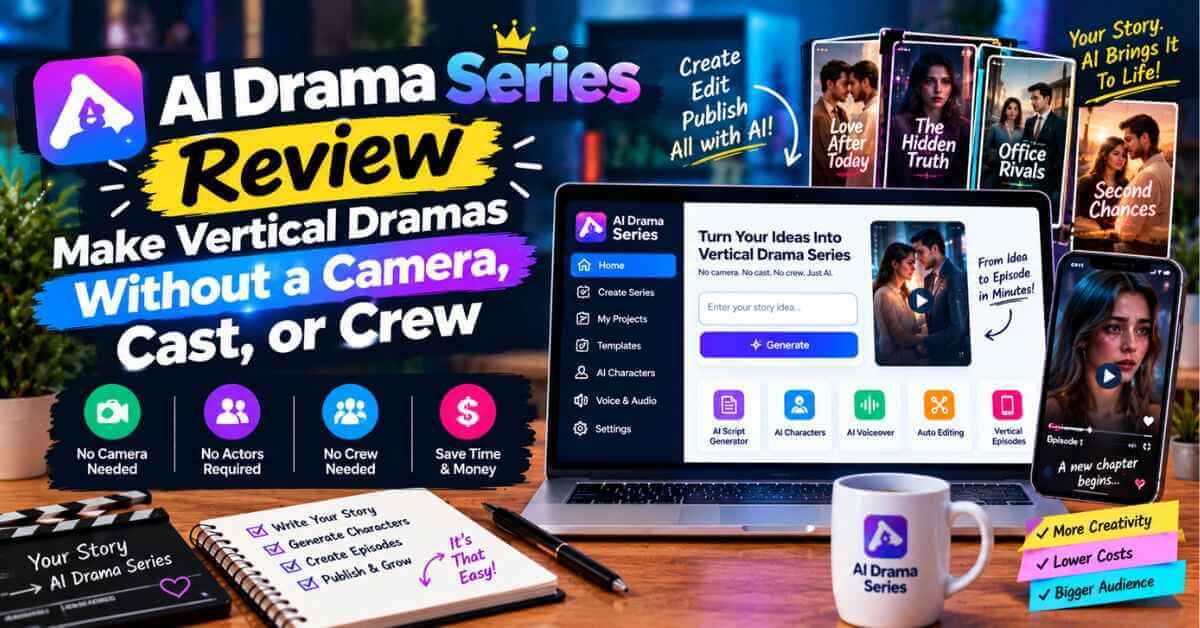
AI Drama Series is a browser-based app. You don’t install anything. You log in, type a one-sentence idea for a drama, pick how many episodes you want, and the app does the rest.
It’s built on top of the current AI video models, Veo 3.1, Kling 4.0 and Seedance 2.5 according to the creators, with a story engine on top that organizes everything into a proper season instead of a pile of clips.
Here’s what the process looks like, step by step.
You type something like: “A woman marries into a wealthy family and discovers on the wedding night that her husband’s first wife never actually died.” The app plans the whole season, including a recurring cast: the bride, the husband, the mother-in-law who knows more than she says, the housekeeper who saw something.
It writes every episode in order, around sixty to ninety seconds each. It casts the characters and locks their faces, voices and wardrobes. Then it shoots the scenes, voices the lines, scores the music, burns in captions, and builds thumbnails, titles and descriptions. When it’s done, you upload to YouTube, TikTok, Facebook or a streaming platform in about two clicks.
That’s the pitch, and honestly it’s what caught my attention. Most AI video tools stop at “here’s a clip.” This one is trying to be the whole studio.
The Feature That Matters Most: Characters Who Don’t Change
If I had to pick one reason this tool stands out, it’s this one.
I mentioned the woman in the red coat who turns into a different woman. That problem kills almost every attempt at an AI-made series. A viewer will forgive a weird hand in a one-off clip. They won’t forgive the lead changing faces between episode three and episode four. The spell breaks and they leave.
AI Drama Series is built around what it calls cast lock. You describe a character once, a tired detective with grey at his temples, say, and that character keeps the same face, voice and clothes from episode one to episode fifty. Even if you add more episodes six months later.
There’s a testimonial on the page that nailed it for me. A video producer said she’d tried making a series with other tools and quit at episode two because her lead kept turning into someone else. I’ve heard that exact complaint from people who’ve tried this on their own, so I believe it.
Does it work perfectly every time? I can’t promise that, and I’d be suspicious of any tool that did. But the fact that it’s the foundation of the product rather than an afterthought is a good sign. Also read: AI VideoSongs Review: Turn One Photo Into a Full Music Video in 3 Clicks (Is It Legit?)
It Plans the Whole Season Before Writing a Line
This is the part I think most people will underestimate.
Any video generator can give you a scene. A season is different. The shows that keep people watching follow a shape. There’s an inciting event in episode one, a first reversal somewhere around episode eight, a gate near episode ten where the paywall sits at the worst possible place to stop, a betrayal around episode twenty-five, then a climax and a loose thread left for season two.
AI Drama Series maps that arc out before it writes anything, so episode thirty pays off something planted in episode four. That’s the difference between a stranger watching one video and a stranger coming back eleven days in a row.
It also writes each episode to a hook-and-cliffhanger pattern. The first five seconds start with conflict already in progress, no sunrise establishing shot. There’s an escalation, then a turn, then it cuts off mid-breath on a question. If you’ve ever binged one of these shows, you know exactly how that feels. It’s annoying and it works.
Writing fifty of those by hand, each cut to the second, is brutal. Having the app do it by default is a real time saver.
The Details That Save You Hours
A few of the practical things I liked, because these are the parts that quietly eat your week if you do them yourself:
Voices that act. Each character gets their own voice with emotion, so lines are whispered, shouted or broken instead of read aloud like a text-to-speech robot.
Music and sound. Score and room sound are matched to the scene and mixed automatically. No hunting for royalty-free tracks.
Burned-in captions. Most people watch on mute, and the captions are styled and timed for you.
Thumbnails, titles and descriptions. A matching set for the whole season, plus listing text for each platform.
Vertical and widescreen. The same season comes out in 9:16 for Shorts, Reels and the drama apps, and in 16:9 for long-form YouTube and streaming. That’s a smart touch, because the page notes long-form YouTube pays a lot more per view than Shorts.
A feature-length cut. The whole season is also compiled into one continuous film, which is the format free streaming platforms take.
Any language and any genre. Revenge, secret billionaire, forbidden romance, family betrayal, small-town mystery, supernatural. You can also release the same season in Spanish, Hindi, Portuguese and more, so one piece of work can reach several audiences.
Full commercial rights. You keep everything you earn, and you can publish under a studio name with no face on screen.
None of these on their own is a miracle. Together, they replace what used to be a team of five or six people.
Want to see the full feature list for yourself? It’s all laid out on the official page. Check out everything AI Drama Series includes here.
A Day in the Life: How You’d Actually Use This
Let me give you some realistic scenarios, because “faceless video business” can sound abstract.
The evening publisher. Say you work a full-time job and you’ve got a couple of hours at night. You pick a genre like billionaire romance, type your idea, generate a twenty-episode season, and spend your evenings uploading and scheduling. The page highlights a retail assistant doing roughly this, releasing three episodes a week around her day job. Whether you’d see the same results is another matter, and I’ll get to that.
The multi-language channel owner. You’ve finished one season in English. Instead of starting over, you release the same season in Spanish, then Portuguese. Each one is its own channel with its own audience, from work you already did. One of the testimonials says their Spanish channel grew bigger than their English one.
The writer who’s tired of pitching. There’s a quote from a screenwriter who spent nine years pitching drama and says the hard part was never the idea, it was getting someone to greenlight forty episodes. She built a season on a Tuesday afternoon and published it herself that week. She also says she still rewrites the odd ending by hand, which I appreciated, because it suggests the output is a strong first draft you can still steer.
The faceless channel builder. If you’ve wanted to start a channel but didn’t want to be on camera, this is a clean fit. Studio name, no face, no voice of your own.
The long-form YouTube person. One of the testimonials mentions using the widescreen compilations more than the vertical cuts, because they earn better on their channel. If you already run a channel, you can compile ten episodes into one video.
Notice what these have in common. None of them need a camera, but all of them need someone to actually publish. Keep that in mind, because I’ll come back to it.
Where the Money Is Supposed to Come From
This is the part people care about, so let me be straight.
The sales page lists a wide range of places a season can earn. YouTube Shorts ad revenue, YouTube long-form, YouTube’s new Shorts Series shelf, Facebook and Instagram payouts, TikTok creator programs, and drama apps like DramaBox and ReelShort that take submissions. There are also streaming services like Tubi, Plex and Roku that pay per hour watched (through an aggregator), and the option of licensing a season to a drama app outright. On top of that you could sell sponsorships or point your audience at affiliate offers.
One example I found interesting is a US furniture retailer that made its own drama series as marketing. The page says it pulled 152 million views and $9 million in attributed sales, and got renewed for a second season. If that’s accurate, it shows how much a story format can do for people who aren’t Hollywood.
Here’s the honest part, which the creators themselves are fairly upfront about in their FAQ. YouTube’s ad program needs 1,000 subscribers and 10 million Shorts views in 90 days before it pays you, so don’t expect ad money in week one. The routes that don’t wait for a threshold are the drama apps, sponsorships and affiliate offers.
The page also shows case studies with numbers like $20,400 in 60 days or $11,400 a month. Those are the creators’ showcase results, and the page says plainly that they aren’t typical and that no earnings are guaranteed. I’d read them as “this is what a good outcome looks like,” not “this is what you’ll make.” Your genre, consistency and effort will change everything.
Still wondering whether this fits what you’re trying to build? Read through the case studies and the full breakdown on the official page. See the AI Drama Series examples here.
Who I Think This Is Really For
After going through everything, here’s my take.
AI Drama Series makes the most sense if:
- You want to publish video without appearing on camera
- You’ve tried AI video before and quit because the characters kept changing
- You’d rather build an audience that comes back than chase one-off views
- You like the idea of supplying a market that seems short on titles
- You’re starting from nothing, with no following, no equipment and no experience
It probably isn’t for you if you only want to make single one-off clips, if you aren’t willing to publish consistently, or if you expect money to show up without releasing episodes. The creators say so themselves, which I respect.
What It Asks of You
This is something I think a lot of reviews skip, so let me say it clearly.
The app handles production. You handle publishing.
That means uploading episodes, keeping a release rhythm, and sticking with a season long enough for people to find it. It’s a few minutes a day, but it’s still a few minutes a day, every day. The page makes this point too: the channels that do well are the ones that publish consistently.
There’s a nice illustration on the page. Two creators start on the same Monday with the same tools and zero followers. One posts a random video every few days. The other publishes a season, one episode a day. The first creator has to invent something new forever. The second finds that every new episode sends viewers back through the earlier ones, and the watch time tells the algorithm to show her work to more people. Same effort, very different compounding.
That idea of a catalogue is what I find most persuasive. A finished season keeps playing without you. Build another in a different genre and you’ve got two. After a few, a quiet month in one genre doesn’t sink your whole channel. Compare that to a creator who starts at zero every morning.
One more honest note: every major platform asks you to tick an AI-disclosure box when you upload. The creators mention this themselves. It takes one click and it keeps your account safe, so do it.
The Price, the Guarantee, and the Extras
Here’s what makes this an easy thing to test. At the time I’m writing this, the launch price is a one-time $17 for lifetime access. The page lists a regular price of $297 and warns it may move to a monthly subscription after launch, so the one-time option isn’t permanent. The page also lists no credits, no caps, no watermarks and no per-second billing.
For comparison, the page points out that clip-only AI video tools often cost $30 to $90 a month and still leave the writing, casting, editing and captions to you. Producing a season the traditional way is reported to run six figures.
There’s also a 30-day money-back guarantee. The idea is you build a season, check that your lead looks the same in episode one and episode twenty, listen to the voices, upload an episode, and if it doesn’t do what the page says, you email for a refund.
There’s an optional $9 add-on called the Episode Launch System, which includes hook formulas, thumbnail and title patterns, and a posting schedule for each platform. I’d treat that as a “nice to have if you want a head start,” not a must. The core product is the season generator.
And if you want to shave a few dollars off, the page mentions a coupon code, AIDRAMA3OFF, for $3 off.
AI Drama Series review: My Honest Take
Here’s where I land.
What I like most is that AI Drama Series is aimed at the right problem. It isn’t trying to make prettier clips. It’s trying to make connected seasons with consistent characters and built-in story structure, which is the thing that’s been missing from AI video.
The price is hard to argue with when there’s a refund window, since the cost of finding out is small. And the format itself, binge-able serialized drama, is one where viewers have already shown they’ll stick around.
What I’d keep in mind: results depend on you publishing regularly, the earnings examples are best-case showcases, and platform payout rules can change. A one-minute AI-made episode still has to earn a viewer’s attention, so choosing a good idea and a genre people already binge will matter more than the tool itself.
But if the idea of releasing a season instead of a random video makes something click for you, this is one of the more interesting ways I’ve seen to try it without a crew or a budget.
If you’re curious, the smartest move is to test it while the refund window protects you. Build one season, check the character consistency, and decide for yourself. Grab AI Drama Series at the launch price here and see what your first episode looks like.
That’s my full AI Drama Series review. If you try it, I’d like to hear which genre you pick. My bet is on revenge, because that hook never gets old.
Quick disclosure: I’m an affiliate for this product, which means if you buy through my link I may earn a small commission at no extra cost to you. I only recommend things I’d be comfortable pointing a friend toward, and I’ve tried to be honest about the good and the not-so-good here. Results vary from person to person, and nothing in this post is a guarantee of income.