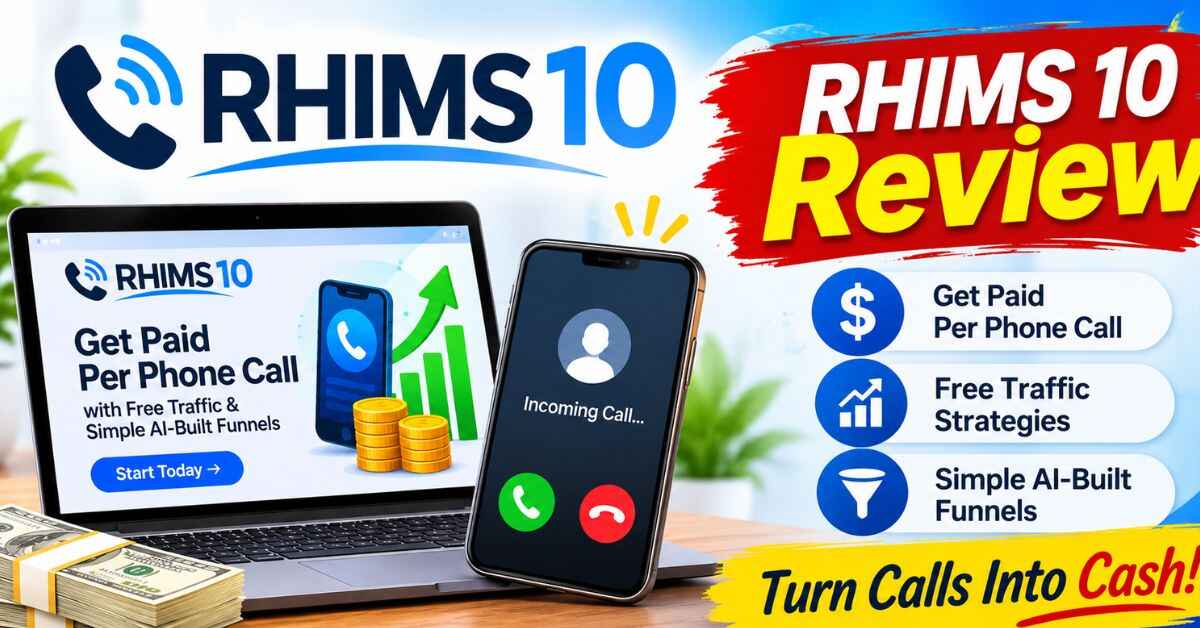
RHIMS 10 Review: Getting Paid Per Phone Call With Free Traffic and Simple AI-Built Funnels
Most affiliate marketing advice comes down to one sentence: get someone to buy something. If they don’t buy, you earn nothing, no matter how much work you put in. This RHIMS 10 review is about a training that works from a different starting point. You get paid when a real person phones a business that wants new customers, and you never talk to the caller.
I went through the details of JayKay Dowdall’s Pay-Per-Call training, the way it’s set up, and the eight bonuses that come with it. I’ll tell you what it is, who it suits, and where you should keep your feet on the ground. I’m not going to promise you a number, because nobody honest can.
A Quick Story About the Usual Way
Picture a friend of mine. I’ll call him Dan. Dan started affiliate marketing about a year ago. He picked a product, grabbed his link, and wrote a few posts. Then he started a small social media page, because everyone told him that’s how it works. He posted for weeks. A few people clicked. Nobody bought.
So he tried a second product, and a third. He made short videos, which he hated doing. He built a tiny email list that mostly ignored him. After four months he was tired, a little embarrassed, and ready to quit.
Dan’s problem wasn’t effort. It was that the whole model asked him to do three hard things at once: attract attention, build trust, and persuade a stranger to spend money. That’s a tall order for anyone, never mind a beginner working evenings.
If that sounds familiar, you’re far from alone.
Why Traditional Affiliate Marketing Wears People Out
Let me spell out the pain points, because they explain why a different model might appeal.
You have to convince people to buy. Even with a great product, you’re asking a stranger to hand over money. Many visitors just leave.
You have to be visible. Most advice says to post on social media, make videos, or build a list. That means showing up daily, which burns people out fast.
You depend on traffic that costs either time or money. Free methods are slow. Paid ads can drain your wallet before you learn what works.
You can do everything right and still earn nothing. A visitor who browses but doesn’t buy pays you nothing.
None of this means affiliate marketing is broken. It means the standard path is hard for a lot of normal people. And when something is hard, people look for a side door.
Enter Pay-Per-Call: A Different Kind of Commission
Pay-Per-Call has been around for a long time, though plenty of marketers have never heard of it.
Here’s the idea in simple terms. Lots of businesses need new customers: plumbers, roofers, insurance agents, car services, law firms, and many more. Some of them are willing to pay for phone calls from people who are ready to talk. They’ll pay for a qualified call even before a sale happens.
As an affiliate, you set up a page for a particular service. Someone who needs that service finds the page and calls the number on it. That call is routed to the business that’s paying for leads. If the call meets the buyer’s requirements, you earn a commission.
The business answers the phone, chats with the customer, and handles the sale. You don’t talk to anyone, you don’t close anything, and you don’t ship a product.
According to the details I reviewed, payouts for qualified calls can run from around $25 to $50, and in some cases past $100. Those are the figures attached to the training, not guarantees, and I’ll come back to why that matters.
What Is RHIMS 10?
RHIMS stands for Really Helpful Internet Marketing Stuff, and RHIMS 10 is the tenth training in JayKay Dowdall’s series. This one is dedicated entirely to Pay-Per-Call affiliate marketing.
What stood out to me is how the training breaks the work into a clear path. Instead of leaving you with a pile of theory, it walks you through three main jobs:
- Finding buyers who pay for calls
- Building what JayKay calls Call Funnels
- Getting free traffic to those funnels
Let me walk through each, because that’s where the value lives.
Job 1: Finding Buyers Who Pay for Calls
Before anything else, you need an offer. In Pay-Per-Call that usually means working through affiliate networks that handle the buyer relationships and the payments.
The training shows you how to spot opportunities worth promoting, and it explains why some niches attract bigger payouts than others. You learn what makes a call valuable in the eyes of a buyer, and why a business will happily pay for the right kind of caller.
That alone is useful. A lot of people lose weeks wondering where to start. Understanding what buyers actually want saves you from guessing.
Job 2: Building Simple Call Funnels With AI
A Call Funnel, as JayKay uses the term, is a focused page that connects someone searching for a service with the business paying for calls. It’s not a big website. It’s a simple, targeted asset.
This is where the AI part comes in. The training includes prompts you can use with tools like ChatGPT, Claude, or DeepSeek to help build these funnels. You aren’t asked to buy expensive funnel software or paid hosting. You use AI tools you may already have, plus free tools to get your pages online.
If the idea of building a page makes you nervous, this is worth noticing. The AI does a lot of the heavy lifting, and the prompts mean you aren’t staring at an empty chat box wondering what to type.
Job 3: Getting Free Traffic
This is the piece that caught my attention most. The page promotes RHIMS 10 as a free traffic system, with no selling, no social media, and no videos.
Instead of pushing you toward Google Ads or Facebook Ads right away, the training shows you how to attract callers using free methods. And the people you’re reaching are already looking for the service. You aren’t creating demand out of thin air. You’re meeting demand that already exists and linking it to a buyer.
From what I could tell, the basic approach is to publish your Call Funnel somewhere that already attracts targeted visitors in your niche, rather than grinding to build an audience from scratch. The description I read also says upkeep is light, around 15 minutes a month.
One more detail worth mentioning: the free traffic approach is aimed at generating calls specifically. It isn’t presented as a trick that works for every part of an online business. I actually like that honesty. A narrow method that does one job well is more believable than a magic button that claims to do everything.
Want to See What’s Inside Before You Decide?
I always say the same thing about training: look at the outline before you spend a cent. The official page lays out the strategy, the funnel idea, and the full bonus list. Reading it takes a few minutes, and you’ll know quickly whether Pay-Per-Call sounds like your kind of thing.
👉 Take a look at RHIMS 10 and see exactly how the Pay-Per-Call method works
Who Is JayKay Dowdall?
It helps to know who’s teaching. JayKay Dowdall is the creator of the RHIMS series, and this is the tenth installment. He has been teaching affiliate and internet marketing for years, and the material I reviewed mentions that he has worked with Pay-Per-Call for a long time, including an earlier Pay-Per-Call course from 2017.
Longevity matters here. Plenty of “new” marketing methods disappear within a year. A model that has been around long enough to have case studies from nearly a decade ago has at least survived some changes in the market. The training also leans on the idea that this is evergreen. People will always need plumbers, insurance, and repairs, no matter which online trend is popular this month. Also read: Pin2Profit AI Review: How to Turn Amazon Products Into Pinterest Pins, Pages and Traffic Without the Grind
The Eight Bonuses
The bonus package is designed around the practical problems people hit when they try something new. Here’s what’s included, in my own words.
1. The Pay-Per-Call Niche Hit List. A researched list of 30 niches, ranked by things like beginner-friendliness, payout potential, competition, and how well they suit free traffic. Handy if choosing a niche feels overwhelming.
2. 10 Call Funnels You Can Copy This Weekend. Ten funnel blueprints that cover the niche, the angle, the offer type, and how the page is laid out. It’s easier to build something when you have an example in front of you.
3. The FREE Traffic Treasure Map. Extra traffic sources and methods to explore, with notes on which suit different niches and which need more hands-on effort.
4. The Call Funnel AI Prompt Vault. Copy-and-paste prompts for niche research, evaluating offers, writing page copy, checking compliance, troubleshooting, and scaling.
5. The Pay-Per-Call Case Files. Breakdowns of real campaigns, including what was done, what happened, and what he’d change today. Seeing real examples beats theory every time.
6. The “Where Are The Callers?” Troubleshooter. A diagnostic guide for when things go quiet. No traffic? Visitors but no calls? Calls but no payouts? It helps you find the weak link instead of changing everything at random.
7. The 15-Minute Monthly Maintenance Plan. A short monthly check of traffic, calls, and payouts, so you can decide whether a funnel needs fixing, scaling, replacing, or leaving alone.
8. The $10 Pay-Per-Call Stack. A rundown of the free and low-cost tools you need, with the goal of keeping your starting cost close to the price of a domain name. It also separates must-haves from nice-to-haves, so you don’t buy a stack of subscriptions before you’ve earned anything.
If I had to pick favorites, I’d say the Niche Hit List and the Troubleshooter are the two that solve the biggest beginner headaches: where do I start, and what do I do when it isn’t working?
What This Might Look Like in Real Life
Let me give you a few examples of the kind of person who could use this. These are illustrations, not promises or testimonials.
The affiliate who’s tired of selling. Sophie has promoted software and courses for two years. She’s good at it, but she’s worn out from writing emails and hoping people buy. Pay-Per-Call gives her a second income stream that doesn’t depend on persuading anyone to purchase a product. She can keep her existing work and add this alongside it.
The complete beginner. Marcus has never made a dollar online. The idea of building a list or filming videos puts him off. A model where he builds a simple page, uses AI to write it, and doesn’t speak to anyone feels more doable. He starts with one niche from the hit list and one funnel blueprint.
The side-project builder. Priya works a full-time job. She doesn’t have hours each day to chase traffic. The idea of low-maintenance funnels with a short monthly check-in fits her schedule far better than a daily posting routine.
The marketer who wants more income streams. Tom already runs a few sites. He sees Pay-Per-Call as a way to spread his risk, so he isn’t depending on a single product or platform.
In every example, the common thread is the same. These people want a model that asks for less visibility and less persuasion, and more structure.
Ready for a Closer Look at the Bonus Stack?
If you’d like to see how all eight bonuses fit together with the main training, the official page shows the whole package in one place. It’s a good way to check whether the extras match what you actually need.
👉 See the full RHIMS 10 training and all eight bonuses here
Why the Model Makes Sense to Me
I’ve looked at a lot of online business ideas, and many fall apart when you ask a simple question: who is paying, and why?
With Pay-Per-Call, the answer is easy to follow. Businesses need customers. People need services. A call is a clear, measurable event. The buyer is happy to pay because a qualified call is worth much more to them than the commission they hand over. You’re connecting two sides that already want to find each other.
There are three things I like in particular.
It doesn’t depend on selling. You aren’t pitching or convincing. You’re helping someone with an existing need find a business that serves it.
It’s built around doing, not just learning. The training covers finding offers, building funnels, getting traffic, and troubleshooting. You aren’t left with a concept and no next step.
The starting cost can stay low. Between the AI prompts and the $10 stack, the aim is to let you test the idea without a large upfront investment. For many people, that lowers the fear of trying.
RHIMS 10 Review: The Honest Part: What You Should Know Before Buying
I promised to keep this real, so here’s the other side.
It’s not guaranteed income. Pay-Per-Call isn’t a shortcut. You still need to research a niche, build a funnel, get it seen, and test what works. Some funnels will do better than others, and some may not work at all.
Not every call pays. Buyers set requirements, such as minimum call length, location, caller intent, and other conditions. That’s how they protect themselves from junk calls. It means a call showing up doesn’t automatically mean a payout.
Some niches have rules. Areas like insurance, legal, and healthcare often come with advertising and compliance considerations. Follow the rules for your region and for each network and buyer. The Prompt Vault mentions compliance checks, which is a good sign, but the responsibility is yours.
You still need to put in work. If you want completely hands-off income without building anything, this isn’t it. The model is lighter than many, but it isn’t effortless.
Check the current price and terms. I haven’t listed a price here because offers change. Look at the official page for the current price, what’s included, and the refund terms before you decide.
None of that scares me off. These are normal realities of making money online, and the useful question is whether you get a clear process to follow. With RHIMS 10, that’s what the training is built to give you.
Who Should Think About RHIMS 10
It’s probably a good fit if you:
- Are an affiliate marketer who wants to add a different type of income
- Are new to affiliate marketing and don’t want to build a list or make videos
- Like the idea of using AI to build simple pages
- Prefer a lower-cost way to test a new model
- Want a structured plan, not scattered tips
Who Might Want to Skip It
It may not be right if you:
- Want income with no effort at all
- Dislike testing and adjusting
- Aren’t willing to research a niche or build even a simple page
- Expect results to arrive overnight
So, Is RHIMS 10 Worth a Look?
If I step back from the details, the picture is pretty clear. RHIMS 10 teaches a version of affiliate marketing that suits people who are tired of the usual routine. You skip the selling, the social media grind, and the video-making, and instead connect people who need a service with businesses willing to pay for the call.
It comes from a trainer with a long history in this space, it pairs the strategy with AI prompts and eight practical bonuses, and it’s designed so you can start without piling up costs. It won’t do the work for you, and it can’t promise a result. But as a clear, structured way into Pay-Per-Call, it looks like a sensible place to start for someone curious about the model.
If this idea has been tugging at you, the best next step is to read the official page, see the full outline, and judge for yourself whether it fits your situation.
👉 Check out RHIMS 10: Get Paid Per Call and decide if it’s right for you
Pricing, bonuses and terms are as shown on the official page and can change, so please confirm the details there before you buy.
Affiliate Disclaimer: This post includes an affiliate link. If you buy through it, I may earn a small commission, and it costs you nothing extra. I only write about products I think are worth a look, and the opinions here are my own. Please do your own research before buying, and remember that results are different for everyone and aren’t guaranteed.