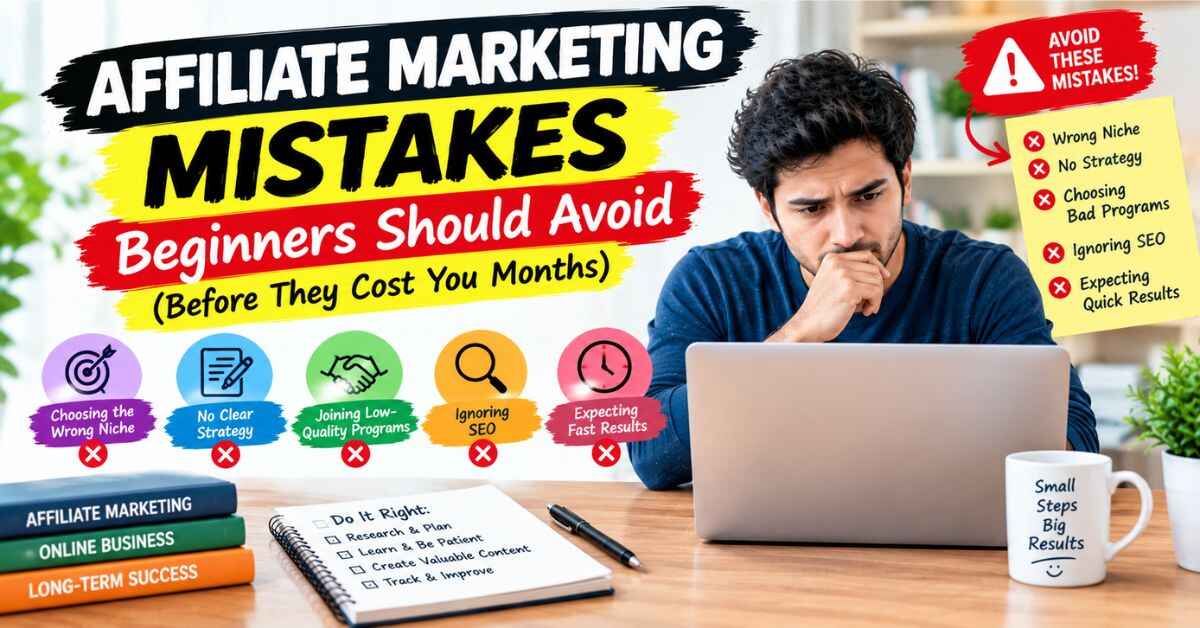
Affiliate Marketing Mistakes Beginners Should Avoid (Before They Cost You Months)
Here’s the odd thing about the affiliate marketing mistakes beginners should avoid: hardly any of them are dramatic. Nobody wipes out their savings in one bad week. It’s quieter than that. You back the wrong product, or give up a month too early, or spend three weeks fiddling with a logo, and a year on you’re wondering where the time went.
The good news is that the mistakes are predictable. The same handful turn up again and again, and once you can see them coming, they’re a lot easier to step around.
A couple of these overlap with my beginner’s guide to affiliate marketing, but here I’m looking at the “why it goes wrong” side of things.
Affiliate marketing mistakes beginners should avoid, starting with expecting fast money
I’ll start with the big one, because it feeds most of the others.
A lot of people arrive believing money should show up quickly. They’ve seen the ads, the screenshots, the promises of easy income. So when week two comes and nothing’s happened, they decide something’s broken.
Nothing’s broken. That’s just how the start looks. You’re building content, and content takes time to be found. A blog post can sit unnoticed for months. A video might get a handful of views before it catches on. If you expect a payout in a few weeks, you’ll quit right before the point where it might have started to work.
Try thinking of your first few months as practice. If money turns up, great. What you’re really earning is knowledge of how the whole thing works.
Promoting things you haven’t checked
This one damages trust, and trust is basically the only thing you’re selling.
It’s tempting to grab an offer, see a fat commission and stick your link on it. But if the product is poor, or the claims are shaky, or the refund policy is hidden where nobody can find it, your name is now attached to all of that. Readers remember. They don’t tend to come back.
Give any product ten minutes before you recommend it. Read the sales page properly. Look for reviews from people who aren’t selling it. Find the refund policy and actually read it. Then ask whether you’d feel comfortable explaining it to a friend who counts every dollar. If not, skip it. There are plenty of other offers out there.
Choosing by commission size alone
Close cousin of the last one, but not the same thing. This is looking at the payout and nothing else.
A product that pays a few hundred dollars a sale sounds fantastic until you think about how few people will spend that much on a stranger’s recommendation. Meanwhile a cheap product people actually want can convert far more often. The commission per sale matters less than how likely anyone is to buy.
So look at the whole picture. What does it cost? Who’s it for? Is it easy to explain? Do people already know they need it? A modest commission on something people are keen to buy often beats a huge one on something nobody’s looking for.
Hiding that you earn from your links
You’d be surprised how many beginners skip the disclosure, either because they forgot or because they assume it’ll put people off.
It works the other way. In many countries you’re required to say when you earn from a link, and the platforms you publish on have their own rules as well. But set the rules aside and readers still tend to like honesty. A short line like “I may earn a commission if you buy through this link, at no extra cost to you” costs nothing and earns more goodwill than you’d expect.
Put it where people will see it, not tucked away in a footer, and keep the wording plain. Then write the rest of the piece honestly enough that the disclosure doesn’t feel like a confession.
The shiny object trap
If I had to name the mistake that wastes the most time, it’d be this one.
You start a blog. A few weeks in, you see someone doing well on YouTube, so you start a channel. Then you hear about newsletters. Then somebody swears by short videos. Before long you’ve got four half-built projects and none of them has enough behind it to work.
Every method has a stretch at the start where it feels like nothing’s happening. That stretch is the price of getting in. If you jump to something new each time you hit it, you keep paying the price and never get through the door.
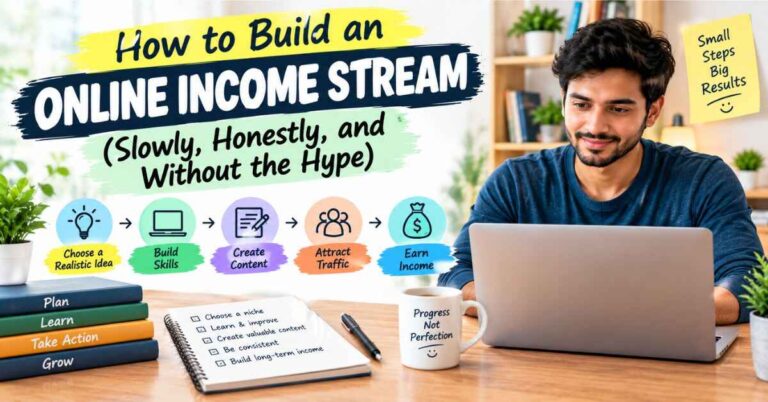
Pick one platform. Give it at least three months of steady effort. If it truly isn’t for you after that, switch with a clear head, not because something else looks exciting this week. I said something similar in my post on how to build an online income stream, and it bears repeating, because nearly everyone has to learn it the hard way.
Writing for Google instead of for people
Plenty of beginners read a little about SEO and then start cramming posts with keywords, copying the structure of whatever ranks, and writing in a stiff voice no person would use out loud.
It doesn’t work as well as you’d hope, and it reads badly. Search engines have got good at spotting content that exists only to rank, and readers are quicker still. They leave within seconds when a page feels made for a machine.
Write for one real person with one real question. Answer it clearly, in the words they’d use. Do that and the search side tends to sort itself out over time. If you can’t do it yet, that’s fine. It’s a skill, and it gets better with every post.
Dropping links with nothing around them
Some beginners treat affiliate marketing as a link-sharing game. They post their link in comment sections, forums and feeds with no context and nothing of value attached.
Mostly that’s wasted effort, and it can get you banned from the places you post. A bare link gives nobody a reason to trust you. The stuff around it does the work: the review, the comparison, the how-to, the honest “here’s who this isn’t for.”
Before you share a link, ask what the person gets from seeing it. If the honest answer is “nothing, except me earning a commission,” go and make something helpful first.
Building everything on someone else’s land
Social media is great for getting seen quickly. It’s also rented space. An algorithm change, a banned account, or a platform that fades can wipe out an audience you spent a year building, and you can’t take those followers with you.
The fix is simple, if slow: start collecting email addresses early, even if you only have a handful. A small list is worth more than it looks, because those people chose to hear from you and nobody can switch that off. You don’t need it on day one, but don’t leave it for year two.
Never looking at the numbers
It’s strange how many people publish for months without checking a single stat. Most affiliate dashboards show clicks, sales and earnings, and your site or channel shows traffic. Those numbers tell you what’s working.
Maybe one post gets lots of clicks and no sales, which hints that the offer doesn’t suit the readers. Maybe one topic keeps bringing people in. Maybe a product you were sure would take off gets ignored. You can’t spot any of it without looking.
No fancy tools needed. A quick weekly note of traffic, clicks and any earnings is plenty. Then do more of what’s working and less of what isn’t.
Paying for expensive training before trying anything
I’ll be careful here, because I’m an affiliate for a training program myself and it’d be dishonest to pretend otherwise.
Paid training can be genuinely useful. Structure, coaching and a community save some people a lot of time. The mistake isn’t buying training. It’s buying it first, before you’ve tried anything for free, because then you don’t know what you actually need help with. You end up paying to fix a problem you haven’t found yet.
A better order is to try the free routes for a couple of months. Find out how publishing feels, how traffic behaves, where you get stuck. Then, if you want help, you’ll know exactly what you’re buying and why.
If you do look at a coaching-style program, treat it like any big purchase. Read the refund policy twice. Be wary of income claims with no context. Don’t let a countdown timer hurry you. The Millionaire Partner System is one example of this kind of program. It sits at the expensive end and its marketing makes bold promises, while its own fine print says results aren’t typical, so I wrote up the cost, the refund questions and who it really suits here: Millionaire Partner System Review 2026: Legit Way to Earn Online or Just Another Hype Machine?
If you’d like to see how a system like that is pitched before you decide, you can watch the free training and judge for yourself:
👉 Watch the free Millionaire Partner System training here
And if you’re still working out which kind of setup suits you, I compared the main types in my post on the best affiliate marketing systems for beginners.
Making income promises of your own
This one catches people who’ve soaked up too much of the hype. They start writing “I made X in a week” or “you can earn $Y a day too,” often copying the tone of the ads they once fell for.
Please don’t. You can’t promise anyone a result, you may not be able to prove your own, and in many places exaggerated income claims can land you in real trouble. More than that, they teach your readers to distrust you.
Say what you actually know. If you’ve earned something, describe it honestly, including how long it took and how much work it needed. If you haven’t earned anything yet, say so. Plenty of readers trust “here’s what I’m learning” far more than “here’s how to get rich.”
Quitting just before it starts to work
The last one is the quietest, and it might cost the most.
Most beginners stop somewhere between month two and month four. That’s the stretch where effort is highest and evidence is lowest. You’ve published a pile of things, traffic is tiny, no money’s arrived, and everything in you says this isn’t working.
Sometimes it really isn’t, and that’s worth finding out. But often it’s just early. Content builds slowly, and a lot of people who eventually do well say the turn came after a long quiet patch.
Here’s a practical way through it. Before you start, decide how long you’ll commit, say six months, and write it down. When doubt shows up, you check the plan instead of arguing with yourself. If the six months pass and you’ve done the work with nothing to show, you can change direction with a clear conscience. What you want to avoid is quitting on a bad Tuesday.
A few smaller slips
Not everything needs a long explanation. Leaving out the “who this isn’t for” part of a review makes you sound like a salesperson. Letting posts go stale, with dead links and old prices, quietly drains trust. Skipping each program’s terms can get your account closed over something silly. And never telling anyone what you’re building means no feedback and no accountability, which slows everything down.
If you want a single habit out of all this, make it a short pause before you hit publish. Would I recommend this to someone I care about? Have I said I earn from the link? Does this help the reader even if they never click? Am I telling the truth, including the less exciting parts? If all four are yes, you’ve dodged most of what’s in this post.
Quick questions people ask
What’s the single biggest mistake beginners make? Quitting too early. Most of the others slow you down. This one stops you completely.
Can I recover if I’ve already made some of these? Almost always. You can add a disclosure, update old posts, drop a poor product and narrow your focus whenever you like. None of it’s permanent.
Should I avoid paid programs entirely? No, but I’d avoid buying one before trying free options. Then you’ll know what you’re paying for.
How do I know if a product is worth promoting? If you’d recommend it to a friend, the company is real and reachable, the refund policy is clear and the claims are believable, it’s off to a good start.
How long should I give it before deciding it’s not working? Many people suggest at least three to six months of steady effort. Pick your own number in advance and stick to it.
Last thought
You’ll make some of these mistakes. Everyone does. The aim isn’t to be perfect. It’s to notice sooner, fix things quickly, and keep going while other people drift off.
If you take away one thing, let it be patience paired with honesty. Be patient with the slow start and honest with the people who trust you. That combination beats clever tricks almost every time.
If you’ve already tripped over one of these and have a story, or you’re stuck on something, leave a comment. I’d like to hear it.
Affiliate Disclosure
A quick note: some links in this post are affiliate links. If you click one and buy something, I may earn a small commission, at no extra cost to you. I only point you toward things I think are worth a look, and I try to be honest about the downsides too. This isn’t financial advice, and results vary from person to person, so please do your own research, read the terms and refund policy on any program before you buy, and only spend what you can afford.