Marblism vs Sintra AI (2026): Which AI Employee Team Is Worth Your Money?
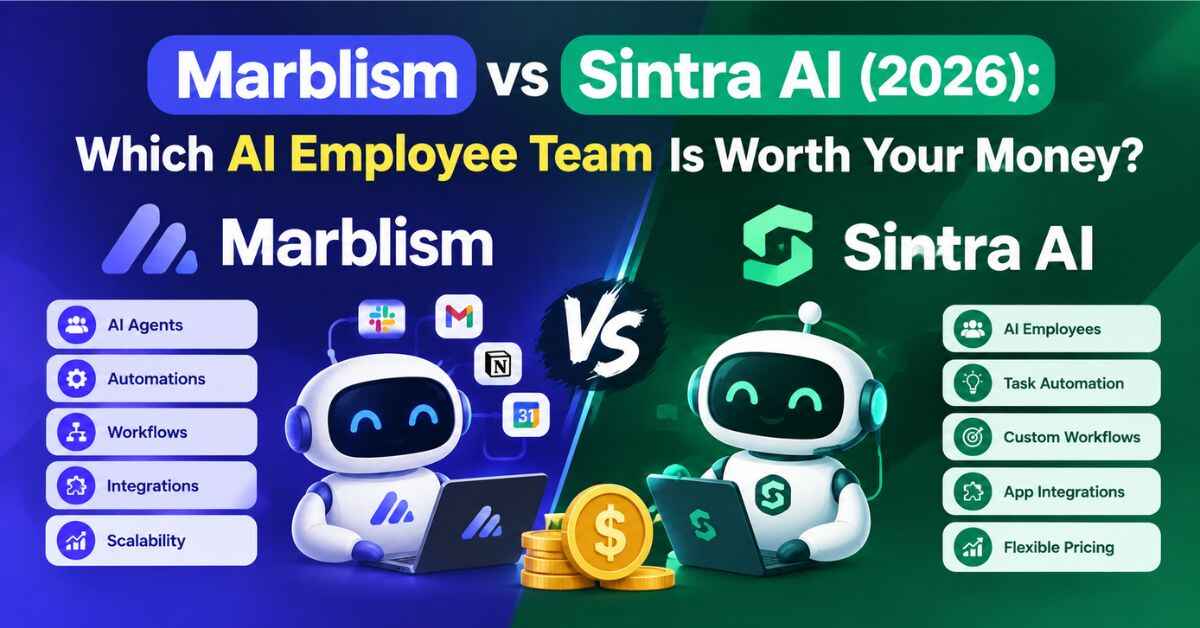
Here’s a situation I’d bet you know. You’ve decided to try AI help for your business, you type “AI employees” into Google, and two names keep showing up side by side. Both have friendly cartoon-style helpers. Both say they’ll save you hours. Both have prices that look almost too good. So the real question becomes Marblism vs Sintra AI: which one is actually worth your money?
I went through both company websites, their pricing pages, and what independent reviewers have written. This post lays out what each one does, what each really costs, where each one has limits, and who should pick which. No cheerleading. If Sintra is the better fit for you, I’ll say so.
The Problem: Two Great-Looking Pages, Zero Clarity
Choosing between these two is harder than it should be, and I think I know why.
Both tools use the same language. “AI employees.” “Works 24/7.” “Saves you hours.” They both show smiling avatars with names like Eva or Soshie. If you squint, the sales pages almost blur together.
Then you look at pricing and it gets weirder. One has a flat monthly price and counts hours of work. The other shows a crossed-out price with a big sale next to it and counts credits. One lists seven employees, the other lists twelve. One says it connects to your accounts and does the work, the other says every helper runs as a chatbot.
What happens next is predictable. You pick the cheaper-looking one, set it up on a Sunday night, and two weeks later you realize it doesn’t do the thing you actually needed. Maybe you wanted something that answers your phone. Maybe you wanted something that publishes your blog without you copying and pasting. Or maybe you wanted twelve different helpers and you only got seven.
That’s wasted time and money, and it’s completely avoidable. You just need to know what each product really is.
Meet Both Tools
Sintra AI: Twelve Chat Helpers With a Shared Brain
Sintra gives you 12 named AI helpers, each focused on a role:
- Soshie for social media
- Penn for copywriting
- Seomi for SEO
- Milli for sales
- Emmie for email marketing
- Cassie for customer support
- Vizzy for virtual assistant work
- Commet for eCommerce
- Dexter for data analysis
- Buddy for business strategy
- Scouty for recruiting
- Gigi for personal growth, like meal plans and workouts
They share a feature called Brain AI, where you add your brand information, websites and files so the helpers can personalize their work. Sintra also says its helpers support more than 100 languages.
One detail worth noticing: Sintra’s own FAQ says every AI worker runs as a chatbot. So the experience is mostly chatting with a specialist, using one-click “use cases,” and getting back drafts, plans and ideas.
Marblism: Seven Employees That Connect and Act
Marblism has seven employees with narrower, more hands-on jobs:
- Eva handles your inbox and calendar.
- Sonny runs your social media.
- Stan finds leads and does outreach.
- Penny writes SEO content.
- Rachel answers your phone.
- Walter builds your website.
- Linda reviews contracts.
They connect to tools like Gmail, Outlook, Instagram, LinkedIn, WordPress and Shopify. The company says more than 40,000 businesses use it and shows a 4.8 out of 5 rating on Trustpilot.
Want to see the Marblism team yourself before reading on? Here’s the official page. It costs nothing to look.
Marblism vs Sintra AI: The Real Differences
Let’s get into it, one piece at a time.
Difference 1: What Each One Actually Does
This is the biggest gap, so it goes first.
Sintra’s helpers are great at thinking and writing. Ask Penn for a blog post, Milli for a cold email, Emmie for a welcome email flow, Buddy for a business plan, or Dexter for a profit-and-loss breakdown, and you’ll get a useful starting point. It also has some task-style features, like Soshie scheduling social posts. But the core experience is conversation: you ask, it answers.
Marblism is built around doing. Eva drafts email replies and manages your calendar. Sonny posts to your social accounts. Penny writes SEO articles and publishes them. Stan searches a database of more than 700 million contacts and does outreach. Rachel answers real phone calls and books appointments. Walter builds a website.
So here’s a simple way to see it. Sintra gives you a team of consultants and writers. Marblism gives you a team that works inside your accounts. Neither is better in the abstract. It depends on whether you want ideas and drafts, or you want tasks completed.
Difference 2: The Roles Themselves
Sintra is broader. It has helpers for recruiting, data analysis, eCommerce, business strategy and personal growth. If you want help drafting a job description in the morning and a profit forecast in the afternoon, Sintra has someone for that.
Marblism is more focused on what small businesses do to get and keep customers: answering calls, posting content, publishing blogs, following up with leads, handling email, building a site, and reviewing contracts.
Two roles stand out as things Sintra’s pricing page doesn’t list: a phone receptionist and a dedicated website builder. If either one matters to you, that tilts toward Marblism.
On the flip side, if you need recruiting or data analysis help, that’s Sintra’s territory.
Difference 3: Pricing
Here’s where it gets interesting, and where Sintra can look cheaper at first glance.
Marblism
- $24 a month on the yearly plan ($288 a year)
- $44 a month if you pay monthly
- All seven employees, unlimited businesses, unlimited team members
- 7-day money-back guarantee
Sintra AI (current listed prices at the time of writing)
- 1-month plan: $48.50 a month, marked down from $97
- 3-month plan: $23.60 a month ($70.80 total), marked down from $59
- 12-month plan: $15.60 a month ($187.20 total), marked down from $52
- All 12 helpers on every plan
- 14-day money-back guarantee
- Individual helpers have been listed at $39 a month each
So let’s be fair about it. On the yearly deal, Sintra’s $187.20 for the year is cheaper than Marblism’s $288. On a month-to-month basis, they’re close: $44 for Marblism versus $48.50 for Sintra.
One thing to know: independent reviewers have described Sintra’s sale as a standing one, meaning the “regular” price you see crossed out isn’t really what most people pay. That’s worth understanding so you don’t treat the big discount as a rare chance. Either way, check the live page before you buy.
But a lower sticker price doesn’t automatically mean a better value. That depends on what you can actually do with your usage, which brings us to the next point.
Difference 4: Credits vs. Hours
Both tools limit how much work you can do each month, just in different ways.
Sintra gives every plan 250 monthly credits. They reset each month, and credits are only used for what Sintra calls advanced AI actions. When you use them up, you can buy top-ups. Reviewers who dug into Sintra’s help docs note that credits don’t roll over and that helpers stop working when a workspace runs out.
Marblism gives every plan 50 hours of AI work per month. Chat and quick tasks don’t use hours. Only advanced actions do. If you run out, you can buy top-ups.
Here’s my honest take. Neither limit is bad, but both reward you for paying attention in the first couple of weeks. Neither company spells out exactly how many credits or hours a typical task will cost, so I’d recommend testing one real job and watching how fast your allowance drops. That tells you more than any spec sheet.
Difference 5: How You Use Them Day to Day
With Sintra, you open a helper, chat with it, use a one-click use case, and copy the result where it needs to go. That’s simple and flexible. If you’re comfortable working in a chat window and don’t mind doing the final step yourself, it feels natural.
Marblism is set up more like delegating. You connect your accounts, describe your business, and the employees work in the background and check in with you for approval. Marblism says you don’t need to be good at prompting.
So ask yourself: do you want to talk to AI, or do you want AI to take things off your list?
Difference 6: Teams and Businesses
Both let you manage multiple businesses. Sintra lets you create unlimited business profiles and share a workspace with your team. Marblism includes unlimited businesses and unlimited team members on its plan too.
This one is mostly a tie, so I wouldn’t make a decision based on it.
Quick Comparison
| Marblism | Sintra AI | |
|---|---|---|
| Number of AI employees | 7 | 12 |
| Style | Connects to accounts and does tasks | Mostly chat-based helpers |
| Price | $24/mo yearly, $44 monthly | Sale prices from $15.60/mo yearly, $48.50 monthly |
| Usage limit | 50 hours of AI work per month | 250 credits per month |
| Phone answering | Yes (Rachel) | Not listed |
| Website builder | Yes (Walter) | eCommerce helper, no dedicated builder listed |
| Recruiting, data analysis | No | Yes (Scouty, Dexter) |
| Money-back guarantee | 7 days | 14 days |
Prices and features come from each company’s website at the time of writing and may change. Marblism Review 2026: Pricing, Honest Pros and Cons, and Who Should Actually Use It
Real-World Examples
Let me put real people in the picture, because this is where the choice usually becomes obvious.
The home-service owner. He’s on a roof when his phone rings, and he misses calls every week. Rachel answering and booking could pay for the subscription alone. Sintra doesn’t list a phone receptionist.
The coach who needs content. She wants social posts and a weekly blog without copying and pasting. Marblism’s Sonny and Penny work inside her accounts. Sintra’s Soshie and Seomi can write great content, but she may handle more of the final steps herself.
The online store owner who wants ideas. She’s planning a product launch and wants strategy, product descriptions, email flows and a margin calculator. Sintra’s Buddy, Commet and Emmie are built for exactly that kind of thinking and writing.
The founder who’s hiring. He needs job descriptions, resume screening help and interview plans. That’s Scouty, and it’s something Marblism doesn’t offer.
The solo consultant on a tight budget. She wants some help and doesn’t need much. Sintra’s annual sale price is hard to beat on paper, and it may be a fine starting point, especially if chat-based help is all she wants.
The small shop that wants fewer moving parts. He doesn’t want to copy, paste and follow up. He wants posts going out, leads being contacted and calls being answered. Marblism fits that better.
The Honest Downsides
Marblism: The 50 hours are shared across all employees, so heavy use can run through them. You’ll need to review what the employees produce, and setup takes some effort, especially for leads and brand voice. Human support works business hours, with an AI bot covering the rest.
Sintra AI: The 250 monthly credits don’t roll over, and reviewers say helpers stop when they hit zero. The experience is chat-first, so you’ll often do the last step yourself. The pricing page shows large discounts that reviewers describe as ongoing, which makes it harder to judge what the “real” price is. And with twelve helpers, some of which (like meal planning) have little to do with business, it can feel broad rather than deep.
Neither of these is a dealbreaker. They’re just good to know before you hit the buy button.
So Which One Should You Pick?
Here’s the simple version.
Pick Marblism if:
- You want AI that works inside your accounts instead of just chatting
- Missed calls, an empty content calendar or slow follow-up are costing you
- You want a simple, predictable plan with all seven employees
- You’d rather review and approve than copy and paste
Pick Sintra AI if:
- You mainly want ideas, drafts, plans and analysis from a chat window
- You need helpers for recruiting, data analysis or business strategy
- The lowest annual price matters most to you
- You’re happy doing the last step yourself
And if you can’t decide, use the refund windows. Sintra gives you 14 days and Marblism gives you 7. Test the one task you care about most, on a real job, and let the result decide.
If you’re in the first group, take a look at what Marblism’s employees can handle for you.
Why I’d Lean Marblism for Most Small Business Owners
I’m not saying Sintra is bad. It has real strengths, and plenty of people like it. But for the typical small business owner, three things tip the balance for me.
First, the work actually gets done. Most small business owners don’t need more ideas. They need things posted, answered and followed up. Marblism’s employees work inside your accounts.
Second, the roles match real problems. Phone calls, blogs, social posts, leads and email are the problems I hear about most. Marblism has a dedicated employee for each.
Third, it’s easy to test. A 7-day money-back guarantee means you can try your most painful task and decide with real results, not promises.
If that sounds like your week, give Marblism a proper test and see which employee you’d put to work first.
Quick FAQ
Is Marblism better than Sintra AI? It depends. Marblism is better if you want AI that connects to your accounts and does tasks like answering calls and publishing content. Sintra is better if you want a broad set of chat-based helpers, including recruiting and data analysis.
Which is cheaper, Marblism or Sintra? On Sintra’s current annual sale price, it’s cheaper: $187.20 for the year versus $288 for Marblism’s yearly plan. Month to month, they’re close, at $44 for Marblism and $48.50 for Sintra. Prices change, so check both pages.
How many AI employees does each one have? Marblism has seven. Sintra has twelve.
Do they have refunds? Yes. Marblism offers a 7-day money-back guarantee and Sintra offers 14 days.
Can either one answer my phone? Marblism can, through Rachel. Sintra’s pricing page doesn’t list a phone receptionist.
Affiliate disclosure: Some links in this post are affiliate links for Marblism. If you click one and decide to buy, I may earn a small commission at no extra cost to you. I’ve tried to be fair to Sintra and to give you the real trade-offs, and I only recommend what I think can genuinely help. Thanks for supporting the blog.