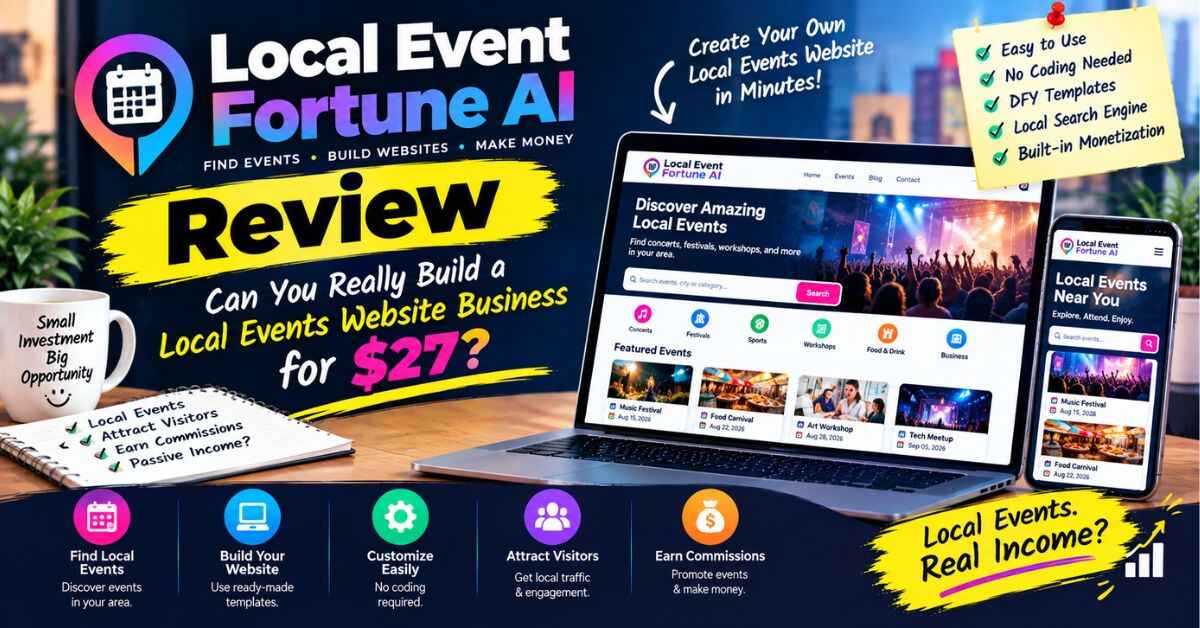
Local Event Fortune AI Review: Can You Really Build a Local Events Website Business for $27?
Think about the last time you searched for something to do on a Saturday in your town. Odds are you jumped between Facebook groups, a few clunky websites, and a friend’s text message. Now flip that around. What if you ran the website where everyone in your area looked first, and event organizers paid you to be featured? That’s the idea behind this Local Event Fortune AI review. The product promises a ready-made, branded events directory you can set up on your own WordPress site, with tools to find events, list them, and sell promotion services to organizers.
It’s an interesting idea, and it’s more grounded than most things I see in this space. But “interesting” isn’t the same as “easy,” so I went through the sales page carefully. Here’s what I found, including a few costs and limits you should know about before you spend anything.
The Problem: Local Events Are Scattered Everywhere
Let me tell you a small story.
My cousin runs a weekend farmers market in a mid-sized town. Great vendors, lovely atmosphere, and not nearly enough visitors. She posts on Facebook, hangs a few flyers, and hopes for the best. Meanwhile, a book fair, a food truck night, and a charity run all happen the same weekend, and none of them know about each other.
That’s the everyday mess of local events. Information is spread across a dozen places. Nobody owns it. If you’re a resident, you miss things you would have loved. If you’re an organizer, you pay for ads that reach the wrong people, or you do nothing and hope.
Now think about it from the side of someone who wants to earn online. You’ve heard that local businesses and organizers need marketing. You like the idea of building something real in your own community. But then you hit the practical questions.
How do you build a site that looks professional? Where do you find enough events to fill it? How do you write good descriptions for dozens of listings? How do you charge organizers, deliver what they paid for, and keep it all organized? Doing that by hand means a lot of spreadsheets, copy-pasting, and late nights.
Most people try for a week and quit. Not because the idea is bad, but because the setup work wears them down.
That’s the gap this product is aiming at.
So What Is Local Event Fortune AI?
In plain words, Local Event Fortune AI is a WordPress-based system that helps you run your own local events directory, under your own brand.
You install it on your site, choose a style, and fill the directory with events. The page says an AI “scout” can search for event candidates for you, up to 50 per run, and AI can help write the descriptions. Event organizers can create accounts, manage their own listings, and buy promotion services from you. The system then handles checkout and delivers what they ordered.
The vendor listed on the page is DFYFortune, with Dawn Vu named as the founder.
So it isn’t just a list of events. It’s a small business in a box: a directory to attract visitors, a portal for organizers, and a way to get paid. Let’s look at what’s actually included.
A quick thought on why this kind of business can work at all. Local is the one area where a small site can still beat the giants. A huge national events platform can’t know which church bake sale or neighborhood concert matters to people on your street. You can. People trust someone who clearly knows their town, and organizers like working with a real person they can call.
That’s the real asset here. The software is a tool for building it faster, but your local knowledge is what makes the site worth visiting.
Local Event Fortune AI Review: What You Actually Get
The sales page covers a lot. Here’s the useful stuff in everyday language.
One-click WordPress install. The page describes a guided setup, so you’re not wrestling with files. You’ll still need your own hosting and domain, which I’ll cover below.
Three ready-made styles. You pick a look and add your own branding, with no coding needed. That means you can get something presentable without hiring a designer.
An AI event scout. You tell it what kind of events you want, and it hunts for candidates, up to 50 at a time. It also supports importing from URLs and calendars. This saves hours of digging.
AI-assisted writing. It drafts event descriptions, plus event and venue pages. You still need to check them, but a first draft beats a blank page.
An organizer portal. Organizers can register, edit their events, track orders, and access private materials. There’s also an approval step when someone claims a listing.
Ways to earn. You can sell featured listings, banner ad spots, countdown images, and social media graphics. Services can be one-time or subscription-based, with built-in checkout and automatic delivery of the finished materials.
Unlimited sites for your own business. You can build as many event sites as you like for yourself, say one town and then the next.
What I appreciated is that the page is clear about what the product is for. It’s a platform to run an events business, not a magic traffic machine.
How It Might Work in Real Life
It’s easier to understand with a picture. Here’s how I imagine a month.
Week one: you pick a town you know, set up the site, and choose a style. You run the scout a few times and publish forty or fifty events that look good. You tweak the text so it sounds like you, not a robot.
Week two: you start telling people. You post in local groups, share a few events on social media, and tell organizers you’ve listed them for free. Some respond. A few create accounts.
Week three: you offer upgrades. A bakery hosting a tasting wants a featured spot. A school wants a countdown graphic for its fair.
Week four: you check your orders, deliver materials, and refine what you offer.
Notice what’s happening. The tool takes care of the heavy setup and the routine work. But finding people, building trust, and getting the word out is still you. That’s real work, and it’s also where the business is.
Who Could Actually Use This?
A few people come to mind.
Maya, a community blogger. She already writes about her town and has a small following. A directory fits naturally. Readers get a one-stop events page, and she earns from organizers who want attention.
Sam, a freelance marketer. He helps local businesses with social media. An events site gives him a way to meet organizers and a product to sell, like promotion packages, instead of just selling his time.
A small agency. If you already work with local clients, a branded directory can be a new service line or a lead magnet.
Priya, a side-hustler who loves her neighborhood. She has a few hours a week and likes the idea of a business tied to a place she knows. She doesn’t want to learn web design.
What they have in common is some tie to a local audience. That’s the thing the software can’t give you, and it’s what makes it work.
Curious what the directory and the organizer portal actually look like? The easiest way to judge is to see the official page and demo for yourself. Take a look at Local Event Fortune AI and the current launch offer here
What It Really Costs
This is the section I think matters most, because some pages bury it. This one doesn’t, which I give them credit for.
The product itself: $27 one-time during launch, listed at $97 regular. There’s also a coupon, “EVENTFORTUNE,” for $2 off. That includes the platform, the three styles, installation and strategy training, email support, updates, and a 30-day money-back guarantee.
What it does not include: The page is upfront about this. You’ll pay separately for a domain name, WordPress hosting, and OpenAI API usage for the AI features. If you take payments, your payment processor takes its usual fees too.
Those costs are normal for this kind of system, and they won’t be huge for a small site. But they exist, and you should add them up before deciding. The $27 is the entry fee, not the whole bill.
Upgrades: Other reviews mention several optional add-ons, with prices from around $47 up to $497. One extends the system with scheduled discovery, automatic publishing, and weekly roundups. Another lets you sell finished event websites to others. You don’t need them to start, and I’d wait until I’d proven the basic version works for me.
The Part to Think About First
I like that this sales page is more honest than most. Still, here are the things I’d weigh carefully.
It doesn’t bring you traffic. The page says plainly that it doesn’t automatically drive visitors or post to social media. A directory nobody visits earns nothing. You’ll need to promote it yourself, through local groups, partnerships, SEO over time, and word of mouth.
It isn’t a ticket marketplace. It doesn’t sell tickets or pay out revenue to organizers. If you were picturing that, this isn’t it.
Organizers have to want your services. Some will. Many already get free exposure elsewhere, and plenty of small organizers have tiny budgets. You’ll need to show value, start with modest prices, and be patient.
The revenue example is just an example. The page includes a calculator showing something like $1,976 a month, and it’s clear that this is an illustration with editable sample numbers. It also states that no income is guaranteed and that this isn’t a passive income scheme. I’d read it the same way: a way to understand the model, not a forecast.
You carry the responsibility. You’re in charge of checking events, dates, images, and permissions before publishing, and for keeping your site secure and backed up. If the scout pulls in the wrong date, that’s on you to catch.
There are no testimonials on the page. That’s honest, but it also means you can’t see how real buyers are doing.
None of this makes it a bad idea. It means you should see it as a business-building kit that needs your effort, not as a button that pays you.
What I Like, and What Made Me Hesitate
What I like: The idea of owning a local audience is a solid one. The price is tiny. The page is open about extra costs and limits. The organizer portal and automatic delivery take away a lot of busywork. And the 30-day guarantee gives you time to test.
What made me hesitate: It needs outside costs and your own hosting. It doesn’t solve traffic or organizer outreach. And the earning potential depends entirely on how well you can sell to local organizers.
Questions I’d Ask Before Paying
If I were about to click buy, I’d want answers to a few things.
Do I know my town well enough, and do I have a way to reach people there?
Am I comfortable talking to organizers and asking them to pay for promotion?
Can I handle basic WordPress hosting, or will I need help with it?
And what would my budget be for hosting, domain, and AI usage over the first six months?
If you can’t answer those yet, that’s fine. Just notice which ones make you hesitate. It tells you how much homework to do first.
Also Read: AstrAI Review 2026: Can You Really Create Videos, Websites, and Music Just by Talking?
Who Should Probably Skip It
If you want income with no effort at all, this isn’t for you. The page itself says it isn’t a passive income scheme.
If you don’t want to deal with hosting, a domain, and WordPress, even in a simplified form, you may find the setup annoying.
And if you have no connection to any local community and no interest in building one, the whole model will feel forced.
A Simple First-Week Plan
If you decide to try it, here’s how I’d use the guarantee window.
On day one, pick one town or niche, like family events or live music, that you actually care about. Set up hosting and a domain, then install the system.
On days two and three, choose a style, add your branding, and run the scout. Read every event it finds, fix the descriptions, and delete anything doubtful.
On days four to six, publish a good batch, then message five or six organizers to tell them they’re listed and invite them to claim their pages.
On day seven, check what happened. Did anyone respond? Did the setup feel manageable? If yes, keep building. If no, ask for your refund while you still can.
So, Is Local Event Fortune AI Worth It?
For the right person, I think so. If you like the idea of building something tied to your community, and you’re willing to do the human part of finding events, meeting organizers, and spreading the word, the price is low enough to try without much worry. The platform handles the clunky bits, and the guarantee covers you.
Just go in realistic. Count the extra costs. Don’t expect traffic to appear by itself. And treat the earning examples as examples.
If it clicks, you could end up with a small, steady local business you actually enjoy. If it doesn’t, you’ll know within a few weeks and you can walk away.
If you’ve read this far, you probably have a feel for whether this fits you. If it does, check the current Local Event Fortune AI offer and see exactly what’s included before the launch price changes. Read the checkout page, note the guarantee terms, and give it a real week of effort.
Affiliate Disclosure
Just so we’re upfront: the links in this post are affiliate links. If you buy through one, I may earn a small commission at no extra cost to you. It helps me keep writing these reviews.
I did my best to give you an honest picture, based on the official sales page and the details I could check. I haven’t tested the product myself, and nobody promised me anything for saying nice things. I’d never want you to buy just because I earn from it. Do your own research, read the terms, and make the call that’s right for you. Results vary, and nothing here is a guarantee of income.