GPTHub AI Review 2026: Features, Pricing, Pros & Cons (Worth It?)
If you’ve ever hit a message cap halfway through a big ChatGPT task, this GPTHub AI review is for you. GPTHub AI is a web dashboard that says it gives you OpenAI’s newest flagship, GPT-6 Astra, along with the rest of the GPT lineup, for a single one-time payment instead of another monthly plan. The launch price I saw was $14.95.
Here’s the part most people feel but don’t say out loud. The best AI models are locked behind $100 or $200 a month plans, the cheaper plans come with limits, and every new release seems to ask for another upgrade. If you’re a freelancer, a creator or a small business owner, that adds up fast.
So before recommending anything, I did what I’d want a friend to do. I went through the sales page line by line, checked the GPT-6 Astra claims against independent news coverage, and read the guarantee terms. I’ll be upfront about one thing: this review is based on what’s published and what I could verify, not on months of daily use. Where the page leaves questions open, I’ll tell you.
By the end you’ll know what GPTHub AI is, how it works, what’s inside, who it suits, what it costs, and whether it deserves your money.
GPTHub AI Review: Quick Overview
| Product | GPTHub AI |
| What it is | Cloud-based dashboard for accessing GPT models, including GPT-6 Astra |
| Models listed | GPT-6 Astra, the Sol / Terra / Luna family, older GPT versions, future releases |
| Extras | Prompt library, multi-model chat, GPT Image bonus mode, commercial license |
| Price | $14.95 one-time (launch price on the sales page) |
| Upgrade offer | Business upgrade at $9.95 one-time (limited spots shown) |
| Refund | 30-day money-back guarantee |
| Works on | Any browser, any device (no download) |
| Best for | Freelancers, creators, marketers, small agencies, curious beginners |
| Official OpenAI product? | No, it’s an independent platform |
If you only have a minute: it’s a low-cost, beginner-friendly way to use several GPT models from one place, with a real refund window to protect you. The questions worth asking are about usage limits and long-term sustainability, and I’ll get to those honestly further down.
What Is GPTHub AI?
GPTHub AI is an independent web app that connects to OpenAI’s models through the official API and wraps them in one simple dashboard. You log in, pick a model, type what you need, and get your result. No API keys to manage, no software to install.
The headline model is GPT-6 Astra. This one is real, by the way. OpenAI launched it on September 3, 2026, and news coverage describes it as the company’s most capable model so far, with strong results in computer use, coding and professional work. Its API pricing is $10 per million input tokens and $50 per million output tokens, which is exactly why a lot of people feel locked out of it.
GPTHub’s pitch is simple: instead of paying a monthly plan for one model, you pay once and get access to the whole GPT family in a single workspace. According to the sales page, that includes GPT-6 Astra, the Sol, Terra and Luna models, older GPT versions, and new releases as they arrive.
One honest note. The sales page isn’t perfectly consistent with its model names. In one place it lists “GPT-5.6 Sol, Terra and Luna,” and in another it shows “GPT-6.1 Sol, GPT-6.1 Terra and GPT-6 Luna.” It’s probably just sloppy copywriting, but it’s worth asking support which exact model versions are live when you sign up.
The page also says clearly that GPTHub isn’t affiliated with or endorsed by OpenAI. I appreciate that, because some tools in this space quietly imply otherwise.
How Does GPTHub AI Work?
The process is intentionally boring, and I mean that as a compliment. Here’s how it works based on the product’s own walkthrough.
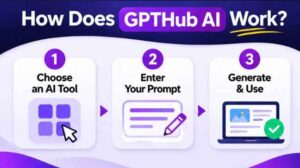
Step 1: Getting Started
You buy access, then log in to the dashboard from any browser. There’s nothing to download and nothing to configure at the start. Because it’s cloud-based, it works on Windows, Mac, iPhone, Android or a tablet, as long as you have internet.
Step 2: Setting Up the Product
There’s very little “setup” to speak of. You don’t need a ChatGPT subscription, and you don’t need to create or paste in an API key. You choose the model you want from the list. GPT-6 Astra is the heavy hitter for deep work, while the lighter models are meant for faster, cheaper everyday tasks. The page also describes adjustable thinking levels for Astra, from quick answers to a deeper “Max” mode for harder problems.
Step 3: Using the Main Features
Now you actually use it. Type a request or pick a ready-made prompt template, send it to a model, and read the result. If you’re not sure which model gives you the best answer, you can send the same task to two models and compare the outputs side by side. Switching models mid-project takes a click, so you can draft with a fast model and polish with Astra.
That’s the whole loop: log in, choose a model, generate. If you’ve ever used ChatGPT, you’ll feel at home within a few minutes.
GPTHub AI Features and Benefits
The sales page lists a long stack of features. Many of them overlap, so I’ve grouped the ones that matter most in real life.

Feature 1: GPT-6 Astra Plus the Whole GPT Lineup
This is the core of the offer. Instead of one model, you get a lineup, and each model has a different job. Astra is for the hard thinking: research, strategy, long documents, coding help. The lighter models handle quick drafts, high-volume tasks and everyday questions faster and at lower cost.
Why does that matter? Because the most powerful model isn’t always the right tool. If you only need ten email subject lines, you don’t need the heaviest model in the building. Being able to match the model to the job is how experienced AI users actually work, and it’s rarely possible when you’re locked into one plan.
The page also says new GPT releases get added to your account automatically, so you’re not buying into a model that’s outdated in six months. That’s a promise worth holding the vendor to, and it’s another reason to keep the refund window in mind.
Feature 2: Long-Context Mode and Deep-Think Reasoning
GPT-6 Astra’s context window is around a million tokens, and the API documentation reported in the news lists up to 128,000 tokens for a single response. In plain English, you can feed it a very long report, a stack of notes or a book-length document and ask it to summarize, compare or pull out the key points. You can also ask for long-form writing without the dreaded “continue” every few paragraphs.
Pair that with the adjustable reasoning levels and you get a useful workflow. Use the fast setting for simple jobs, then crank up the thinking when you’re dealing with something that needs real analysis, like a competitor breakdown or a content plan.
For anyone who writes or researches for a living, this is where the value shows up. Long documents are exactly where cheaper models tend to lose the thread.
👉 Curious what the dashboard looks like in action? You can watch the GPTHub AI demo and check the current launch price here.
Feature 3: Multi-Model Workspace, Prompt Library and Copy Tools
This is the day-to-day productivity layer. The multi-model workspace lets you compare outputs side by side. The built-in prompt library gives you ready-to-use prompts for sales copy, emails, scripts, ads and funnels, which is handy if you’re new to AI and stare at a blank box wondering what to type.
There’s also a commercial license, which the page says lets you use GPTHub for client work, freelancing and agency services. If you plan to sell writing, research or content services, that’s a meaningful detail, and you’ll want to read the license wording yourself before building a business on it.
And for visuals, there’s a bonus GPT Image mode so you can create images from the same dashboard instead of paying for a separate tool.
Who Is GPTHub AI Best For?
Let me make this practical, because “everyone” is never the right answer.
Freelancers and service providers. If you write sales pages, emails, scripts or reports for clients, faster first drafts mean more projects per week. A $14.95 one-time cost is easy to recover on the very first small job.
Content creators and bloggers. Long-form drafts, content calendars, video scripts and research summaries are all things a model like Astra handles well. Creators who post daily will feel the time savings the most.
Small business owners. Product descriptions, ad copy, customer emails and basic business plans don’t need a copywriter on retainer anymore. You still need to edit, but the heavy lifting gets done.
Beginners who feel behind on AI. The interface is simple, and the prompt templates give you a starting point. You can learn by doing instead of watching ten tutorials first.
Who it’s probably not for: large companies that need enterprise security controls, contracts and guaranteed service levels. If your IT team has to sign off on every tool, you’ll want a direct relationship with the provider. Also, if you’re happy with your current ChatGPT plan and rarely hit its limits, you may not need this.
GPTHub AI Pros and Cons
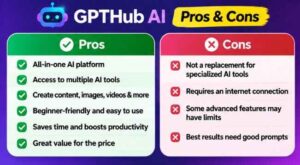
Pros
- One-time payment instead of a monthly subscription
- Access to GPT-6 Astra and several other GPT models in one place
- Very beginner-friendly, no technical skills or API keys needed
- Works in the browser on any device
- Side-by-side model comparison saves time and guesswork
- Built-in prompt library for marketing and content work
- Commercial license mentioned for client and freelance use
- Bonus image generation mode included
- 30-day money-back guarantee lowers the risk
- Clear statement that it’s independent of OpenAI
Cons
- Usage limits and fair-use rules aren’t clearly spelled out on the sales page
- “Lifetime access” to API-powered models is a bold promise, and long-term sustainability is an open question
- Model names on the page are inconsistent
- The “real price $597 per month” figure is a marketing anchor, not a real comparison
- Income claims are generic, and the page itself says results aren’t typical
- Upgrade offers appear after the main purchase, so you need to read each one carefully
- You depend on a third-party platform rather than OpenAI directly
None of these are dealbreakers at this price, but they’re the reason I’d treat the first week as a test drive and not a leap of faith. Also read: BookBloom AI Review 2026: Features, Pricing, Pros & Cons (Worth It?)
GPTHub AI Pricing and OTOs
Here’s the pricing as shown on the sales page when I checked it.
Front-end (main product): $14.95 one-time. This gets you the GPTHub AI dashboard, GPT-6 Astra and the other models, the multi-model workspace, the prompt library, the commercial license and the lifetime access promise. The page shows a “real price” of $597 per month, but I wouldn’t take that number seriously. The only price that matters is the one you actually pay.
Business upgrade: $9.95 one-time. The page shows this as normally $397, with limited spots. It’s described as unlocking turbo GPT models, a premium creation dashboard and VIP support with round-the-clock priority help. The FAQ says the core product works fine on its own, so this is optional.
The page I looked at showed only that one upgrade offer. Other upsells sometimes appear at checkout, so read every screen before you click “yes.” My general rule with any one-time offer: use the main product for a few days first, then decide whether a paid upgrade solves a problem you actually have.
For perspective, the sales page compares itself to ChatGPT Plus at $20 a month, Pro plans at $100 to $200 a month, and the API at pay-per-token rates. Even a single month of the cheapest of those costs more than the whole GPTHub launch price. Whether the comparison is fully apples to apples is a different question, and I’ll cover that in the alternatives section.
GPTHub AI Bonuses
The vendor includes a few bonuses with the main offer.
- GPT Image bonus mode: create AI images from the same dashboard, with lifetime access.
- Premium GPT-6 Astra prompt pack: ready-made prompts for sales pages, email swipes, ads, funnels and long-form reports.
- Astra Code Studio and Astra Agent Mode: the page says the first 100 buyers get these activated free. That’s a limited early-bird perk, so if it’s still showing when you visit, it’s worth grabbing.
The prompt pack is the one I’d use first if I were starting out. A good prompt template saves more time than people expect, especially while you’re still learning what AI can do for your work.
My GPTHub AI Evaluation
I’m scoring this based on what’s published and what I could verify, so treat these as informed estimates, not lab results.
- Ease of use: 4.5 / 5. The login, choose-a-model, generate flow is as simple as it gets.
- Value for money: 4.5 / 5. At $14.95 one-time, the risk is tiny compared with monthly plans.
- Features: 4 / 5. Multi-model access, long context and the prompt library cover most needs. I’d like to see more detail about usage limits.
- Transparency: 3.5 / 5. The independence disclaimer and refund terms are clear. The model naming and the vague limits are not.
- Support and trust: 4 / 5. A 30-day refund window and a business upgrade with priority support are good signs, though I haven’t tested response times.
Overall: 4.2 / 5. It’s a strong, low-risk offer for people who want flexible access to GPT models without monthly bills. The missing pieces are details, not red flags.
The real value shows up in how you use it. A freelancer who writes five client drafts a week with Astra’s help will get far more out of this than someone who opens it twice a month. The tool is only as good as the habit you build around it.
👉 Want to see if it fits your workflow? Try GPTHub AI risk-free with the 30-day guarantee and judge it with your own tasks.
GPTHub AI vs. Alternatives
Let’s be fair about how this compares, because the sales page makes it sound like a clean sweep.
| GPTHub AI | ChatGPT Plus / Pro | OpenAI API | |
|---|---|---|---|
| Cost model | One-time payment | Monthly ($20 up to $100-$200) | Pay per token |
| Models | Multiple GPT models in one dashboard | Depends on your plan | Any model you choose to call |
| Setup | Log in and go | Log in and go | Needs technical setup |
| Usage limits | Not clearly stated | Defined by OpenAI’s plan | Limited only by your budget |
| Official support | Third-party vendor | Directly from OpenAI | Directly from OpenAI |
| Best for | Budget-conscious creators and freelancers | Daily chat and the full ChatGPT ecosystem | Developers building products |
Where GPTHub wins: upfront cost, simplicity, and having several models side by side without juggling accounts.
Where the alternatives win: ChatGPT plans give you OpenAI’s own ecosystem, official support and clearly published limits. The OpenAI API gives developers full control. And rivals like Claude or Gemini have their own strengths, so if you rely on a specific tool for a specific job, GPTHub isn’t a replacement for everything.
To its credit, the sales page admits that GPT-6 Astra is expensive per token, that lighter models are better for quick chats, and that some rival models edge ahead on certain benchmarks. That honesty is a good sign.
Is GPTHub AI Legit?
Short answer: it looks legitimate, with a few things you should verify yourself.
What checks out. GPT-6 Astra is a real OpenAI model, so the core promise isn’t built on something made up. The page states it’s an independent platform using the official API, it includes privacy and refund policies, and it offers a 30-day money-back guarantee.
What I’d keep an eye on. First, usage limits. A lifetime plan powered by pay-per-use models has to have some kind of limit somewhere, even if it’s generous, so ask support exactly what the fair-use rules are. Second, the inconsistent model names. Third, the income claims: the page lists many ways to make money with AI, but its own fine print says results aren’t typical. AI can speed up your work, yet it doesn’t print money by itself. You still have to find clients, edit the output and deliver.
Here’s how I’d handle it. Buy, use it hard for a week on real work, ask support a couple of direct questions, and request a refund if the answers or the results don’t satisfy you. At this price and with that guarantee, you’re in a strong position to test it safely.
GPTHub AI Refund Policy
The product comes with a 30-day money-back guarantee. According to the sales page, if GPTHub doesn’t deliver the speed, power or results you expected, you can contact support within 30 days and get a full refund, with no complicated forms.
A few tips if you go that route. Test it early, not on day 29. Use it on the real tasks you bought it for. Keep screenshots of anything that doesn’t work as promised. And contact support in writing so there’s a record. I’d also read the refund policy page itself before buying, since that’s the version that counts.
Frequently Asked Questions
Is GPTHub AI a one-time payment?
Yes. The main product is listed as a one-time payment with no monthly fees. Optional upgrades may be offered, but the page says the core system works on its own.
Do I need a ChatGPT subscription to use it?
No. GPTHub runs from its own dashboard, so you don’t need ChatGPT Plus or Pro.
Is GPTHub AI affiliated with OpenAI?
No. It’s an independent platform that connects to OpenAI models through the official API. OpenAI, ChatGPT and GPT-6 Astra are trademarks of their owner.
Do I need technical skills?
No. You log in, choose a model and type your request. There’s nothing to install and no coding involved.
Does it work on mobile?
Yes. It’s cloud-based and works in a browser on Windows, Mac, iOS, Android and tablets.
Can I use GPTHub AI for client work?
The sales page says a commercial license is included for client work, freelancing and agency services. Read the license terms yourself so you know exactly what’s covered.
Will new GPT models be added?
According to the vendor, yes. New GPT releases are meant to be added to your account automatically at no extra cost.
What if I don’t like it?
You can request a refund within 30 days by contacting support.
Final Verdict: Is GPTHub AI Worth Buying?
Let me bring this back to where we started. The real frustration isn’t that AI is expensive. It’s that the newest, best models keep sitting just behind a bigger monthly bill, and you end up paying for tools you barely use.
GPTHub AI takes a different approach: one payment, one dashboard, several GPT models, including GPT-6 Astra. For freelancers, creators and small business owners who want to work faster without adding another subscription, that’s a genuinely appealing setup. The interface is simple, the prompt library helps beginners get moving, and the 30-day guarantee takes most of the risk off the table.
It isn’t perfect. The usage limits aren’t spelled out, the model naming is messy, and “lifetime” is a big word for anything powered by pay-per-use models. But at $14.95, with a refund window, those concerns become things to check, not reasons to walk away.
My take: if you’d use GPT-6 Astra or a few GPT models regularly for writing, research or client work, GPTHub AI is worth testing. If you rarely use AI, or you need enterprise-grade guarantees, stick with what you have.
👉 If you’re on the fence, the easiest way to find out is to get GPTHub AI at the current launch price and put it through a week of real work. If it doesn’t earn its place, you have 30 days to ask for your money back.
Affiliate disclosure: Some of the links in this post are affiliate links. If you buy through them, I may earn a small commission at no extra cost to you. I only recommend products I’ve researched, and my opinions are my own. Please do your own homework and read the vendor’s terms before you buy.