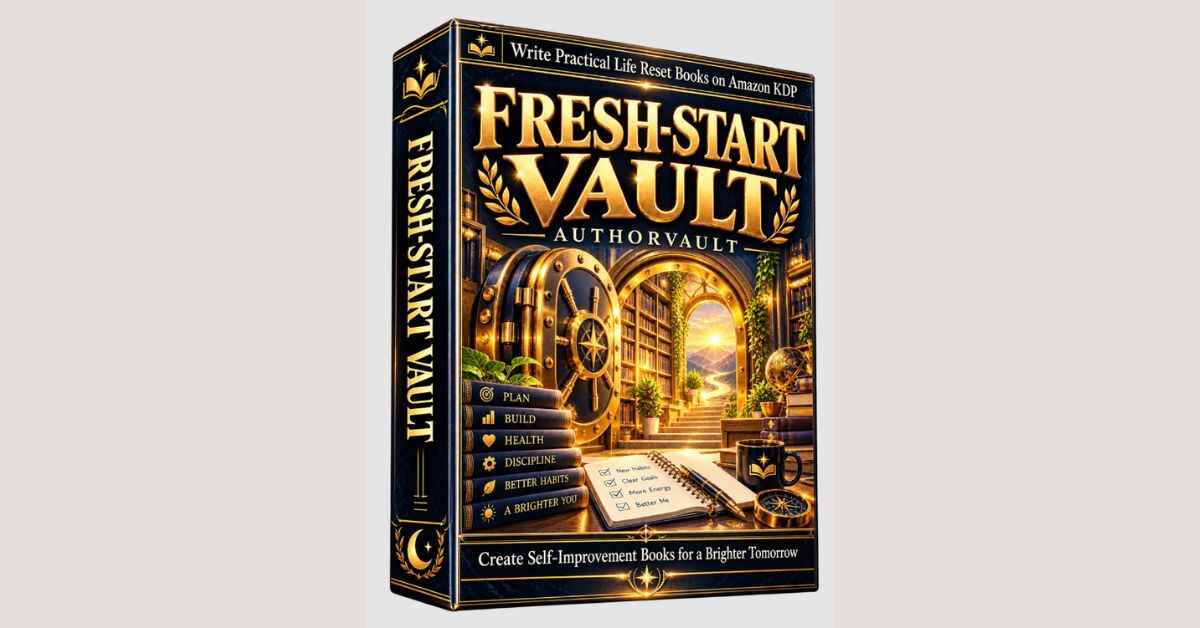
Fresh Start Author Vault Review 2026: Five Full-Book Bots for a Timely January Catalog
Every year, the same thing happens. January arrives, millions of people decide this is the year they build better habits, set real goals, clean up their lives, or change careers, and they head straight for the books. Meanwhile a lot of would-be authors watch the whole thing go by because they started too late. This Fresh Start Author Vault review is for anyone who’d like to be on the other side of that wave this year, with books already live when the rush begins.
I went through the sales page in detail: what you get, how it works, what it costs, and what it expects from you. I’ll also tell you where it falls short of the hype, because every product has a catch, and you deserve to hear it before you spend a cent.
The January Problem Nobody Plans For
Let me describe a scene that probably feels familiar if you’ve ever thought about publishing.
It’s early November. You tell yourself you’ll write a New Year book this time. Something on habits, or goals, or starting over. You even open a document and type a working title. Then life gets busy. Work picks up, family stuff happens, the holidays arrive. By the time you look up, it’s the second week of January, and everyone else’s books are already ranking.
The timing is the cruel part of seasonal publishing. Fresh-start topics get attention before the New Year, not after it. A book that lands in February has missed the moment, no matter how good it is.
The page makes this point too. It cites a YouGov figure saying about 31% of Americans planned resolutions for 2026, and notes that many authors try to list early so their books are in place when the seasonal interest peaks. I can’t verify that number myself, but the pattern behind it matches what most of us already know: January is when people go looking for help changing their lives.
And Then There’s the Blank Page
Even if you do start on time, there’s another hurdle. Writing a full nonfiction book is a real project.
You need a clear reader in mind. You need a promise that makes someone want to buy. You need chapters that build on each other instead of repeating the same advice in different words. You need a consistent voice. And you need to keep all of it organized while real life keeps pulling you away.
If you’ve ever tried to write a book with a general AI chat window, you’ll know how it goes. The first answer looks promising. Then the tone drifts. One chapter sounds like a pep talk, the next sounds like filler. Drafts end up scattered across a dozen different chats. You spend more time copying, pasting, and reorganizing than actually writing.
The sales page describes the same frustrations: fluffy motivation with no usable chapter structure, a vague outline instead of a focused angle, tone that wobbles, and a deadline that quietly slips away. I’ve heard the same complaints from other writers who tried to do this with a blank chat box.
So you end up stuck between two options. Either you push through slowly and miss the window, or you give up on the idea until next year.
What Is the Fresh Start Author Vault?
The Fresh Start Author Vault is a set of five purpose-built writing bots, designed to help you produce full nonfiction books in five New Year niches. It comes from Ryan Mac, a UK software developer and publisher who runs AuthorVault, and it’s built to turn a repeatable book-making process into guided software.
The idea is simple. Instead of starting with an empty chat and a vague prompt, you pick a bot built for a specific kind of book. It walks you through deciding who the book is for, what it promises, and how the chapters will flow, before you start drafting. After that, you write chapter by chapter, keep the manuscript in one workspace, and export it when you’re ready.
Everything is built around full books. The page is clear on this: no journals, no trackers, no low-content filler. These are readable, practical, chapter-based books.
The Five Bots
Here’s what you get, in plain English.
1. Micro Habit Stack Book Bot. For books about habit systems and stacking small behaviors. Think how-to books readers can start using the same week.
2. New Year Goal Systems Book Bot. For books on 90-day and annual goal systems, written as real prose frameworks and not blank planner pages.
3. January Reset Lifestyle Book Bot. For how-to books on resetting your home and life, aimed at the clean-slate crowd that shows up every January.
4. Productivity Stack Book Bot. For books on routines, focus, and energy management that stay practical rather than preachy.
5. Career Restart / New Job Book Bot. For books aimed at people reinventing their careers or starting a new job.
Having five lanes matters more than it might sound. A single topic is a bet on one idea. Five lanes give you five different books from one purchase, so you can test several angles instead of putting everything on one title.
How It Actually Works
The process is laid out in four steps, and it’s easy to follow.
Step 1: Choose your bot and your direction. Pick the niche bot, then decide the topic, the reader, the angle, and the transformation the book offers.
Step 2: Build the blueprint. Before any chapter is written, you set the title direction, the central promise, and the chapter journey. Every chapter has a job to do.
Step 3: Draft chapter by chapter. You develop explanations, modern examples, reflection prompts, and exercises while keeping a consistent voice.
Step 4: Review, package, and export. You do your editing pass, create a cover direction, and export your manuscript as MD, DOCX, or EPUB.
The page suggests a typical starting point of a focused book with around 10 to 12 chapters, drafted and reviewed one at a time. That sounds realistic to me. Smaller, focused practical books are easier to finish than giant ones, and finishing is where most projects fail.
Curious How the Workspace Looks?
Software is much easier to judge when you can see it. The sales page shows screenshots of the workspace, the five bot boxes, and a walkthrough of the concept-to-export flow. If you’ve ever wondered whether a tool like this feels clumsy or smooth, a few minutes with those visuals will tell you a lot.
👉 Take a look at the Fresh Start Author Vault and see how the five bots work
What’s Inside the Vault
Beyond the five bots, the vault includes the tools that carry a book from idea to finished draft. Here’s how they fit together.
Book Concept Builder
This turns a broad topic like “habits” into a specific angle, a clear reader, and a promise worth reading. If you’ve ever stared at a topic and thought, “But what’s my angle?”, this is the step that helps.
Book Blueprint
You build the chapter order and the key takeaways before drafting. It’s the difference between building a house from a plan and nailing boards together hoping it works out.
Guided Chapter Drafting
You develop the manuscript one chapter at a time, with practical examples, exercises, and applications. The page describes a repeating pattern for each chapter: idea, modern problem, example, exercise, takeaway. That consistent structure helps books feel organized instead of random.
Manuscript Workspace
Chapters, revisions, and word counts live together in one place. No more hunting through old chats for the paragraph you liked last Tuesday.
Cover Creation and Preview
You can create and preview a cover direction suited to a January fresh-start listing. Covers matter in nonfiction, and having a preview inside the same workspace saves a step.
Publishing Export
Download your manuscript as MD, DOCX, or EPUB for your final review and publishing process. These are the formats most people need to move into KDP or other tools.
The Free Bonus Worth Knowing About
There’s a bonus I think deserves a mention. You also get project files for all five bots, plus a step-by-step setup guide, so you can run the same bots inside your own ChatGPT or Claude account.
Why does that matter? Because the main AuthorVault workspace needs a connection to your own AI API key, and some people would rather work in a chat tool they already use. With the project files, you can do that too. The manuscript workspace, cover preview, and export features stay in AuthorVault, but the bot logic travels with you. Also read: Kids Activity Book Engine Review 2026: Make a Complete Puzzle Book With Answer Key and KDP Cover in Minutes
A Few Examples of Who This Could Help
These are illustrations of how different people might use it, not promises or testimonials.
The publisher who already uses KDP. Claire publishes a few books a year and wants a seasonal lane. She picks the Productivity Stack bot, builds a blueprint in an evening, and drafts a chapter or two each week through November and December. Her goal is to have the book listed before the New Year rush.
The writer tired of generic AI output. Mark has tried writing with a chat window and was disappointed by how flat everything sounded. He likes that each bot is aimed at one niche, with the reader and promise settled before drafting. He still edits heavily, but he starts from something with direction.
The side-project author. Priya works full time and has maybe an hour on weeknights. She likes that her blueprint, chapters, and word counts stay in one place, so she can pick up where she left off without hunting for context.
The catalog builder. Tom doesn’t want to bet on one book. He plans one title in each of three lanes (habits, goals, and career) and uses the same workflow for each. The repeatable pattern is what appeals to him.
What ties these together is simple: they all want structure and speed without losing control of the finished book.
About Those Sales Screenshots
The page includes screenshots from a book research tool called KDSPY, showing estimates for existing self-improvement titles on Amazon UK. The numbers vary a lot. One shows roughly 40 estimated monthly sales, another about 1,730, another around 17.
I’d treat these as context, not as a forecast. They’re estimates for other people’s books, captured in October 2026, and they show that this category has both quiet titles and very busy ones. Nothing about them says your book will sell. The page says so itself in the FAQ: no sales, income, or ranking outcome is guaranteed, and how a book sells depends on your topic, cover, listing, and marketing.
That honesty is part of why I trust the page more than most.
Fresh Start Author Vault Review: Want the Full Breakdown?
If you’d like to see every feature, the bonus details, and the order form in one place, the official page has it all. It’s worth a look before you decide anything.
👉 See everything included in the Fresh Start Author Vault
What It Costs
The launch price is $17, a one-time payment, with no AuthorVault subscription. The page says that price holds until 11:59 p.m. ET on Saturday, November 7, 2026, and then rises to $27.
At the time I’m writing this, that’s only a few days away, so if you’re interested, it’s worth checking the official page for the current price instead of relying on my date.
There’s also an optional add-on at checkout, a Quick-Launch Pack sold separately. It includes KDP listing helpers like keywords, title formulas, and blurbs for the five lanes, plus pen-name personas and a January publish checklist. You don’t need it to use the vault, so treat it as an extra you can take or leave.
For $17, you’re getting five niche bots, a structured workspace, cover preview, export, and the ChatGPT/Claude project files. That’s a low entry price for a planning and drafting system.
The Guarantee
The vault comes with a 14-day money-back guarantee. If it isn’t right for you, you email support within 14 days of purchase with your WarriorPlus receipt, and you’re refunded in full.
Fourteen days is shorter than some guarantees, so if you’re going to try it, do it properly. Pick a bot, build a blueprint, and draft a chapter in that window. You’ll know quickly whether the workflow suits you.
The Honest Part: What You Should Know First
I said I’d be straight with you, so here’s the other side of the story.
You need your own AI API key. To use the bots inside AuthorVault, you connect your own supported API key after a short setup. That keeps the vault a one-time purchase, but it also means your AI provider may charge you separately for usage. Check the pricing for your provider so you know what to expect. The bonus project files work in your own ChatGPT or Claude account instead.
It doesn’t publish the book for you. The vault helps you plan, draft, organize, and export. You’re still responsible for editing, fact-checking, formatting, uploading, and marketing. That’s a lot of work, and nobody can skip it.
AI-drafted text needs disclosure on KDP. Amazon requires you to disclose AI-generated text. The page explains that bot-drafted chapters should be treated as AI-generated for disclosure purposes, even after you edit them. Policies can change, so read the current KDP content guidelines before you publish.
It’s not for medical or clinical books. The vault is meant for practical fresh-start nonfiction. It isn’t designed for medical, clinical, addiction, or treatment content, and books shouldn’t be positioned as cures.
Sales aren’t guaranteed. A good book with a weak cover or a poor listing can still go unnoticed. Do your own research on your topic and competition before you commit hours to a title.
Review everything. The page itself recommends checking every chapter, fact-checking claims, and adding your own judgment and voice. Raw AI output isn’t a finished book. The best results will come from people who treat the drafts as a starting point.
None of this is a dealbreaker. It just means the vault is a tool that helps you work faster and more clearly, not a machine that produces bestsellers while you sleep.
Who Should Think About It
I think the Fresh Start Author Vault suits you if you:
- Already publish on KDP and want a seasonal lane
- Want a structured way to plan and draft full nonfiction books
- Use AI but dislike generic, shapeless output
- Prefer one organized workspace over scattered chats
- Like the idea of five different angles from one purchase
Who Might Want to Skip It
It’s probably not for you if you:
- Want a book published without reviewing or editing anything
- Aren’t comfortable setting up an API key
- Prefer to write every word yourself with no AI involved
- Are looking for medical or therapy-style content
Why the Timing Matters
Here’s what stands out to me most. This isn’t a general writing tool. It’s built around one specific window.
The page lays out a simple runway. In November you lock your concepts and chapter plans. In December you draft, create the cover, and list. By January your books are already live as the New Year begins. It’s a clear schedule, and it works backward from the moment buyers are paying attention.
If you’ve ever missed a seasonal window, you know how much that structure matters. Starting from a plan in early November feels very different from starting in mid-January.
My Final Thoughts
When I step back from the details, the question comes down to this: does the vault make it easier to finish a focused, timely nonfiction book? I think it probably does, for the right person.
The strengths are clear. Five niche bots keep each book in its own lane. The blueprint step settles the reader and promise before you write. The workspace keeps everything in one place. Export in MD, DOCX, and EPUB covers most publishing paths. And the price is low, with a 14-day guarantee behind it.
The limits are just as clear. You supply the API key, you do the editing, you handle the KDP rules, and you do the marketing. Nobody can promise that a book will sell.
But if you’ve been meaning to publish a January book and keep running out of time, a clear path and a short deadline might be exactly the push you need. Look at the page, see the bots and the workspace, and decide whether it fits the way you want to work.
👉 Check out the Fresh Start Author Vault and see if it’s the right fit for your January catalog
Pricing, bonuses, and the guarantee are as shown on the official page at the time of writing and can change, so please confirm the details there before you buy.
Affiliate Disclaimer: This post has an affiliate link in it. If you buy through that link, I may earn a small commission, and it won’t cost you anything extra. I only write about products I think are worth a look, and the opinions here are my own. Please do your own research before buying, and keep in mind that results are different for everyone and aren’t guaranteed.