MineMint AI Review (2026): Minesweeper Puzzle Books for KDP, Etsy and TPT Without the Weekend Grind
Picture a Sunday afternoon. You’ve got a decent idea for a puzzle book, a coffee going cold and a blank document staring at you. Three hours later you’ve drawn exactly four grids, one of them doesn’t line up, and you haven’t even started on the answer key. That’s the moment a lot of would-be publishers quietly give up. It’s also why I wanted to write this MineMint AI Review. The promise is simple: pick a theme and a difficulty, click generate, and get a finished Minesweeper-style puzzle interior with instructions and a matching answer key, ready to turn into a book.
I went through the whole sales page, the feature list, the FAQ, the sample PDF description, the pricing and the refund terms. Here’s what I found, what I liked, and what you should know before you spend a dollar.
The Problem Nobody Mentions About Low-Content Publishing
If you’ve ever looked into selling puzzle books, activity books or printable packs, you’ve probably heard the same advice everywhere: the money is in repetition. One book rarely does much. A series does. Volume 1, Volume 2, Large Print, Kids, Holiday Edition. Each new book borrows a bit of trust from the last one and gives returning buyers a reason to come back.
That sounds great, until you try to actually produce the next book.
Here’s the honest reality for most sellers. The first interior feels exciting. The second one takes longer than expected. By the third you’re spending whole weekends in Word, Canva or Illustrator, nudging grids around and double-checking answer keys. And that’s before the cover, the title, the keywords and the listing.
So people usually end up in one of two traps.
The slow trap. You keep researching. You keep tweaking. You keep “almost” finishing. Meanwhile other sellers keep uploading in the same niche.
The rushed trap. You throw something together to get it live. The margins clip, a grid is slightly off, the answer key is missing or wrong. Then a buyer opens it, can’t solve a puzzle, and leaves a one-star review.
And that second trap is expensive. Amazon doesn’t care that you meant well. An Etsy buyer doesn’t care that it was your first try. A teacher on Teachers Pay Teachers who opens a confusing worksheet won’t write you a kind note. She’ll ask for a refund and move on. One weak interior doesn’t just lose one sale. It can drag down your reviews, and reviews are hard to fix.
Then there are the other options people reach for. Canva templates are quick, but everyone’s listing ends up looking the same. Freelancers can be great, but you pay per project and wait on someone else’s schedule, and some people have stories about deposits that vanished. And generic AI image tools can produce something that looks like a puzzle for about five seconds, until a real person tries to solve it and discovers the logic doesn’t work.
The real bottleneck usually isn’t creativity. It’s finished files.
Meet MineMint AI
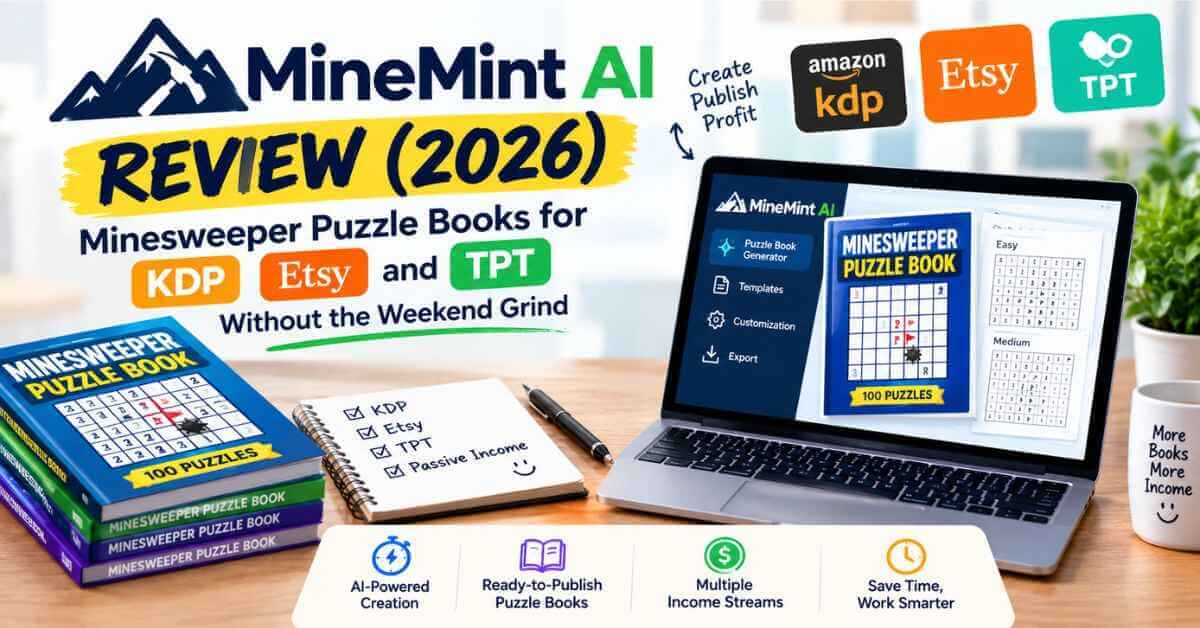
MineMint AI is hosted software built for one specific job: producing Minesweeper-style puzzle book interiors as PDFs, aimed at sellers on Amazon KDP, Etsy, Teachers Pay Teachers and other PDF shops.
I want to be clear about what it is and isn’t, because the page is pretty upfront about it too. It’s not a general AI book writer. It’s not a cover maker. It’s not a course or a prompt pack. It’s a studio that builds the actual interior: the grids, the clues, the how-to pages, the answer keys and the print layout.
The workflow is straightforward:
- You choose a theme, a difficulty and a clue density.
- You generate the puzzle set.
- You check a puzzle against its answer key.
- You run a print check before export.
- You export the finished PDF.
You still bring the parts that need a human publisher: the niche choice, the cover, the title, the keywords and the listing. MineMint handles the repetitive interior work.
It’s also web-based, so there’s nothing to install. And, importantly for anyone who’s been burned by AI tools before, there’s no API key to buy or paste. You’re not wiring up ChatGPT or paying a separate usage bill. You log in and generate.
👉 Curious what a finished export actually looks like? Take a look at MineMint AI and see the sample book for yourself.
Why These Puzzles Aren’t Just “AI Junk”
This is the part that made me pay attention.
My biggest worry with any AI puzzle tool is whether the puzzles actually work. Plenty of tools will happily drop random numbers into a grid and call it a Minesweeper puzzle. It looks right from a distance. But if a buyer tries to solve it and has to guess, or finds it has two answers, you’ve got a refund request and an unhappy customer.
MineMint addresses this with a No-guess option. According to the sales page, when it’s switched on, the studio keeps adding clues until a built-in solver confirms the puzzle can be solved logically without guessing. If the puzzle doesn’t pass that check, the tool adds clues until it does. The answer key is then generated from the very same board data as the puzzle page, so the key matches exactly what the player sees.
In plain terms: generate, check that it’s solvable, then export the puzzle and its matching answer. That’s very different from “AI art that looks like a puzzle,” and it’s the main reason I’d take this tool more seriously than a generic generator.
The page also does something I appreciate. It offers a real sample book you can download and inspect before buying: 24 puzzles on 12×12 Classic grids, a how-to page and the matching answer key. It’s clearly marked as a sample to inspect, not a free book to list for sale. I’d absolutely open that file first. If the grids and answers look right to you, you’ve learned more than any review can tell you.
What Print Spec Guard Actually Does
Every self-publisher has a story about a file that looked fine on screen and then came back wrong from the printer. Margins too tight. Wrong trim size. A page count that made no sense.
MineMint includes something called Print Spec Guard (light), which runs before you export. On the Standard plan it gives you warnings rather than hard blocks. It looks at:
- Safe margins: KDP-friendly interior margins.
- Trim size: for example Letter 8.5×11 inches, with a reminder to match it to your listing.
- Orientation: it flags uncommon landscape interiors for paperbacks.
- Page count: it shows the estimated interior page count and flags possible pagination issues, including odd counts.
I like that the page is honest about the limits here. It says outright that this is an early checklist, not marketplace approval. Amazon’s page-count minimums vary by trim size, paper and ink, and KDP may add padding to odd counts, so you still need to confirm everything in KDP’s own preview before publishing. In other words, it’s a helpful safety net, not a substitute for checking the final file yourself. That’s exactly the kind of straight talk that makes me trust a product more.
The Time Difference, Illustrated
The sales page includes a little story I found relatable, and it’s clearly labeled as an illustration, not a testimonial.
Two sellers, same niche, same month. Dana builds Minesweeper grids by hand all weekend. Six weeks later she has one half-finished interior, no listing and no feedback from buyers. Marcus picks a theme and difficulty, generates a full interior, checks the print warnings, exports and moves on to the cover and keywords. Then he does it again.
Dana still has a draft. Marcus has listings and real signals about what buyers respond to.
I think the point is a fair one, even if it’s a simplified example. Shipping teaches you things polishing never will. You learn which titles get clicks, which difficulty levels people like, and whether a Volume 2 is worth making. You can’t learn any of that from a half-finished file sitting in a folder.
What You Get for $17
Let’s get specific about the offer, because this is where I’d read carefully.
The Standard plan is $17, one time. For that you get:
- 40 complete book exports per calendar month. A “book” means one successfully exported complete PDF with puzzles, instructions and matching answer key together.
- Unlimited page-by-page building. Building or previewing puzzles one at a time isn’t capped and doesn’t use a credit. A credit is only used when a full book PDF exports successfully, and failed exports don’t count.
- A Letter, KDP-friendly PDF workflow.
- Theme, difficulty and clue-density controls.
- How-to pages and answer keys.
- No-guess mode and Print Spec Guard (light).
- Commercial use of the PDFs you generate, for your own KDP, Etsy, TPT and similar listings.
- No API key, no ChatGPT account and no design skills needed.
After you pay, the thank-you page shows your username and password, and you can change the password inside the app.
I’ll also point out the wording around “lifetime.” This is hosted software, and the page is honest that it isn’t unconditional forever access. There’s no recurring Standard subscription fee, and you can keep logging in as long as the hosted service is offered and your account is in good standing. The export quota resets monthly. PDFs you’ve already exported remain yours under the commercial terms. I’d rather a seller tell me this plainly than hide it, and this one does.
Who Could Actually Use This
Features only mean something when you picture real people, so here’s who I think could get the most from MineMint AI.
The KDP beginner. You want to publish your first puzzle book but the idea of building interiors by hand makes you tired already. With this, you pick a theme, generate, check, export, then spend your energy on the cover and listing where your judgment actually matters.
The Etsy printable seller. Printable activity packs are a natural fit. The same interior can often become a downloadable pack, with some publisher work on your side, rather than a full rebuild. That’s a second marketplace from one file.
The Teachers Pay Teachers creator. A clean, solvable puzzle sheet with an answer key is exactly what a busy teacher wants to print and hand out. The how-to page also helps, since not every kid (or parent) knows how Minesweeper works.
The series builder. If you want Volume 1, Volume 2, a Large Print edition and a Kids version, the difficulty and clue-density controls help each book feel different instead of being a photocopy of the last one.
The seller who’s already busy. Maybe you run listings, ads and reviews already, and interiors are the production headache that never ends. Even if you only make a handful of books, getting that weekend of work back is worth something.
👉 Wondering whether this fits the way you work? See how the MineMint AI studio works before you decide.
One Export, Step by Step
To make this concrete, here’s what a single export looks like based on the page’s example.
You log in and choose Letter size, portrait orientation, KDP-friendly margins. You pick a puzzle count, say 24, and a grid style such as 12×12 Classic. You include a how-to page, the puzzle pages and the answer keys. You generate, spot-check one puzzle against its answer, and run Print Spec Guard to see the estimated page count and any warnings. Then you export one complete book PDF. That counts as one of your 40 monthly books.
Next comes the part that’s yours: adding your own cover, title and listing, and confirming the rules for the marketplace you’re using.
One honest note from the page that’s worth repeating: 24 puzzles doesn’t automatically meet the minimum page count for every trim size, paper and ink combination. Use the Guard’s estimate, then check the final PDF in KDP’s preview. Also read: KDPGlobal Review 2026: My Honest Look at the AI Publishing Agent Built for Global Amazon KDP
How It Compares to the Usual Options
The way I think about it, there are a handful of ways to get a puzzle interior, and each has a tradeoff.
Canva templates are fast, but they’re weak for original, properly solvable Minesweeper logic, and listings often end up looking alike.
Hiring someone works if you have the budget and patience, but you pay per project and depend on someone else’s schedule.
Building it yourself costs nothing in software, but it costs a lot of hours per interior.
Generic AI image tools can make something that looks like a puzzle, but the logic often isn’t validated.
MineMint AI is purpose-built for one thing: Minesweeper-style interiors with matching keys, a light print checklist and 40 book exports a month. It’s narrow, and that’s the point. If you want Sudoku, word searches or mazes, this isn’t that tool. But if Minesweeper-style puzzles are your niche, narrow is exactly what you want.
A Few Honest Things to Keep in Mind
Reviews that only say nice things aren’t worth much, so here’s what I’d want to know before buying.
It’s Minesweeper-only. The page is clear that it’s a Minesweeper-style book studio. It’s not a general puzzle generator.
It doesn’t make covers or listings. You still need to create a cover, write a title, choose keywords and craft a listing. If you hate those parts, this won’t fix that.
No tool can promise approval or sales. The page says it directly: nobody can guarantee that Amazon, Etsy or TPT will approve your book or that it will rank or sell. Results depend on your niche, your covers, your titles and a lot of things outside anyone’s control.
The light Guard gives warnings, not guarantees. It’s an early checklist. You should still verify the final file against the marketplace’s current rules.
There are optional upgrades. After you order, you’ll see offers for more books, a stronger print guard and series tools. The page says Standard works on its own and upgrades are for people who later feel a volume or quality bottleneck. I’d start with Standard and see how it feels.
The refund policy is specific. You get a refund within 30 days if there’s a genuine technical issue that support can’t resolve. Changing your mind, deciding it isn’t for you or deciding not to publish aren’t eligible reasons, because it’s instant-access software. That’s less flexible than a typical “no questions asked” guarantee, so it’s worth knowing before you click. The good news is the sample PDF and screen recording let you check the output beforehand.
Marketplaces care about quality. Cranking out near-identical books isn’t a strategy. Varied titles, honest descriptions and respect for each platform’s rules matter. MineMint speeds up production, but it doesn’t replace good publishing judgment.
None of this changed my overall opinion. It just means you’ll go in with realistic expectations, which is where good results usually start.
Why the Price Feels Fair
At $17 one time, the entry cost is lower than a single pizza night. A freelancer might charge more than that for one page. Even hiring help for one interior would cost far more than the whole Standard plan.
The real question isn’t whether $17 is cheap. It’s whether the tool does what it says. And you can check that for free first. Download the sample, open the grids, compare puzzles to the answer key, watch the screen recording. If it looks solid to you, the price is hard to argue with.
I also appreciated that the page doesn’t invent a fake countdown timer. It says so outright, which is refreshing. Still, there’s a practical cost to waiting. Every week without a finished book is another week without a listing, without buyer feedback and without data on what works. You don’t need pressure to see that tradeoff.
👉 Want to check the sample before spending anything? Open the MineMint AI page and download the real sample book.
MineMint AI Review: Is MineMint AI Worth It?
Here’s where I land.
MineMint AI solves a narrow problem really well. If your bottleneck is the interior file, if you’ve got the niche idea and the cover and listing skills but not the time to build grids by hand, it takes the slowest, most repetitive part of the job off your plate. The solvability check, the matching answer keys, the how-to pages and the print warnings add up to something much closer to a real publishing tool than a gimmick.
It won’t make money by itself. Nothing will. You still need to pick a sensible niche, make attractive covers, write honest titles and keep your catalog varied. But if what’s been stopping you is the production grind, then a $17 one-time purchase with 40 exports a month is a small bet with a clear upside: finished files you can actually list.
My suggestion is simple. Download the sample first. Look at the grids. Solve one puzzle and check it against the key. If it feels right, try Standard, make your first book this week, and see what the market tells you. A finished book you can hold in your hands beats a perfect one that never leaves your drafts folder.
Whatever you decide, I hope this MineMint AI review gave you a clearer picture and saved you some guesswork. Good luck with your publishing.
👉 Ready to turn that idea into a finished interior? Get MineMint AI and generate your first Minesweeper puzzle book today.
Affiliate disclosure: Just so you know, the links in this post are affiliate links. If you buy through them, I may earn a small commission at no extra cost to you. I only share things I think could be genuinely useful, and I’ve tried to be honest about the good and the not-so-good. Results vary from person to person, and nothing here is a promise of income.