CreatorClawAI Review 2026: Can You Really Turn One Topic Into a Sellable Video Course?
You know something useful. Maybe it’s how to budget on a tight income, how to cook a decent meal in twenty minutes, or how to get started with Excel without wanting to throw your laptop. And somewhere in the back of your mind there’s a small voice saying, “I could turn this into a course.” Then the voice shuts up, because you remember what making a course involves. That’s exactly the gap this CreatorClawAI Review is about, so let’s look at whether this tool actually closes it or just sounds good on a sales page.
I went through the official page carefully, and I’ll tell you what it does, what I like, what made me raise an eyebrow, and who should probably skip it.
Why Most Courses Never Get Made
Online courses are one of those ideas that sound easy until you try one. People buy courses on tiny, specific topics every day, things like sourdough for beginners or pivot tables or Canva basics. The demand is real. So why aren’t more people selling them?
Because of everything that sits between “I know this” and “here’s my course.”
You have to plan the curriculum, which means deciding what goes in lesson one, what goes in lesson nine, and what to leave out. You have to write every script. You have to make slides. Then you have to record yourself, probably several times, because the first take sounded weird and the third one had a barking dog in it. Then comes editing, captions, a cover image, a catchy title, and a listing that fits whatever the marketplace wants.
Each of those is a small job. Together they’re a mountain.
I know someone, I’ll call her Nadia, who is a really good home baker. Everyone told her to teach a course. She bought a microphone, a ring light and a video editing subscription. She recorded two lessons, hated how she looked and sounded, and the gear is now sitting in a drawer. She didn’t lack knowledge. She ran out of energy somewhere around the editing software.
That story is incredibly common. People don’t fail at course creation because they have nothing to teach. They quit because the process eats them alive.
What Does the Delay Cost You?
It’s easy to shrug and say “I’ll do it when I have time.” But time never shows up on its own.
Meanwhile, the options for getting help aren’t great. You can hire a freelancer, but course creation services on sites like Upwork and Fiverr often take days or weeks per course and can cost real money. You can try to stitch together a stack of tools: one for writing, one for slides, one for voiceover, one for editing, one for captions, one for thumbnails, one for keywords. That’s a lot of logins, a lot of bills, and a lot of moving files from one tab to another.
Or you do nothing, which is the most popular choice. And doing nothing has a price too. It’s the course that never exists, the income that never starts, and the knowledge that stays stuck in your head.
So What Is CreatorClawAI?
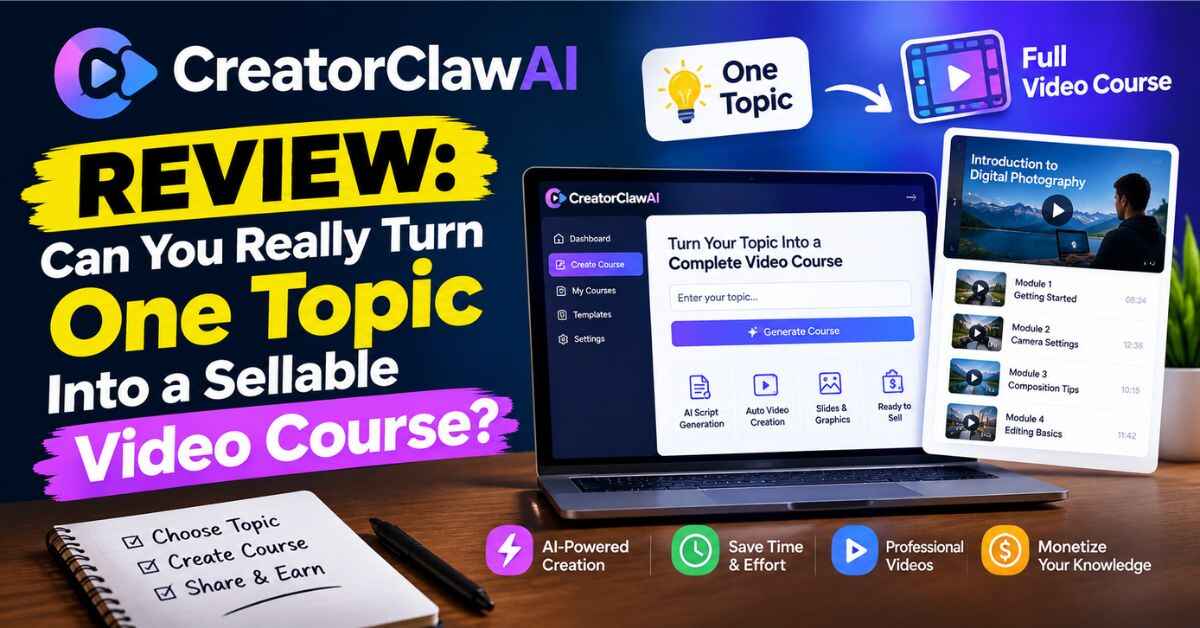
CreatorClawAI is a cloud-based tool that tries to handle that whole chain in one place. According to the sales page, you give it a topic, and a set of AI agents (they say seven) work through the job: researching the topic, writing the course, building slides, recording an AI voiceover, rendering the lesson videos, creating a marketplace listing, and making promo clips.
You don’t need to appear on camera. You don’t need to write scripts. There’s nothing to install, since it runs in your browser.
The pitch is basically “type a topic, click create, download your videos and your listing, then upload and set your price.” Whether it lives up to that is something you’ll want to test for yourself, and I’ll cover how to do that safely a bit later.
What It Actually Does
Here’s what the page says you get, in plain language and without the hype.
Three ways to start. You can type a topic from scratch, upload a PDF, DOCX or TXT file and have it turned into a course, or paste a YouTube link and build from that video. There’s also a “don’t know what to create?” niche finder that suggests topics people are searching for.
The course itself. It builds an outline with modules and lessons, writes scripts meant for video, and generates slides for each lesson. It also makes quizzes for each module and a downloadable workbook and PDF guide.
The videos. Each lesson is turned into a finished video with AI voiceover, in multiple voices, plus captions. There’s an optional AI avatar presenter and a course trailer. Everything exports as MP4.
The selling side. It suggests a price for your niche, titles and subtitles, bonus ideas, and sales copy. It also builds listing packs for Udemy, Skillshare, Gumroad and Teachable, with SEO titles and keywords, plus a cover image and thumbnails.
The promotion side. It makes short clips for Reels, Shorts and TikTok, along with hooks, captions, hashtags, social posts and promo emails.
Extras. Courses and voiceovers can be made in multiple languages. You can edit or regenerate any output. And a commercial license is included, so you can sell what you make and keep the full amount of each sale.
That’s a long list, and I’d rather you judge it by what matters to you than get lost in the checkmarks. So let me pull out the parts I think deserve the most attention.
The Benefits That Actually Matter
It solves the “I hate being on camera” problem
For a lot of people this is the real blocker, not skills or ideas. If the thought of recording yourself makes your stomach drop, a tool that produces the video with an AI voice and slides removes the biggest emotional hurdle. You can focus on the topic and let the tool deal with the performance.
It starts you with something instead of a blank page
Even if you plan to tweak everything, having an outline, scripts, slides and a workbook to react to is a very different experience from staring at an empty document. Editing is easier than creating. Most people who’ve written anything know that. Reading a draft lesson and thinking “that part is wrong, let me fix it” is a lot less scary than inventing the whole thing from nothing.
The listing help is genuinely useful
This is the part many people underestimate. Making the course is only half the job. A course with a weak title, a vague description and no keywords can sit unseen on a marketplace forever. Getting a listing pack written to fit each platform’s format, plus a cover image, saves you from the “guessing what Udemy wants” stage that trips up beginners.
You can build from what you already have
If you’ve got old PDFs, a webinar recording, client training documents or a YouTube video of your own, you can feed that in and turn it into course material. For consultants and coaches who’ve been sitting on a pile of content, that’s a practical way to get value out of it.
One dashboard instead of nine tools
The sales page lists the tools you’d otherwise need: an AI writer, a script tool, a slide tool, a voiceover tool, a video editor, a captions tool, a thumbnail designer, a short-clip tool and an SEO keyword tool. Whether or not you’d need all nine, the point stands. Fewer tabs and fewer subscriptions mean fewer places to get stuck.
You keep what you earn
The commercial license means you can sell your courses on the marketplaces or on your own site and keep 100% of the sales. That’s worth noting if you’re comparing it to promoting someone else’s product for a split.
If you’re curious how the dashboard looks and what the process feels like, it’s worth a few minutes of your time to see it yourself. Screenshots on a page only tell you so much.
👉 Have a look at CreatorClawAI here and see the full walkthrough
Who Would Get the Most From It
Here are the situations where this kind of tool makes the most sense.
The person with knowledge but no content
Think of someone who’s been “meaning to make a course” for a year. They know the subject. They’ve just never gotten past the setup, the recording or the editing. For them, a tool that produces a working first version can be the difference between a course that exists and one that doesn’t.
The camera-shy
If your biggest barrier is your face or your voice, this removes it. You’ll still need to decide what to teach, but the production burden mostly goes away.
The freelancer or consultant
Say you’re a marketing consultant with a stack of client PDFs and a few years of lessons learned. Turning those into a structured mini course, maybe as a lead magnet or a paid product, is the sort of thing you’d never get around to by hand. A tool that does the heavy lifting could finally make it happen.
The person who wants a service to offer
The page also suggests selling course creation to clients under the commercial license. The idea is that many business owners have expertise and no time. If you can produce a course for them faster than a freelancer typically could, that’s a service some people pay for. I’d treat this as an opportunity to test rather than a sure thing. You’d still need to find clients and deliver good work.
The niche site builder who wants a catalog
If you like the idea of building several small courses across different topics instead of betting on one, the speed of a tool like this makes testing multiple ideas more realistic.
CreatorClawAI Review: A Quick Illustration
Let me paint a picture, and to be clear, this is an example and not a promise of results.
Imagine Imran, a bookkeeper. He’s spent years helping small shop owners understand their numbers, and he keeps explaining the same things over and over: how to track expenses, how to read a profit and loss statement, how to prepare for tax season.
He decides to turn that into a beginner course. Instead of spending weeks scripting and recording, he types in his topic, then uploads a couple of his own guides so the course uses his real advice. He reviews the outline, rewrites a few lessons to include his own client stories, fixes a few details the AI got slightly off, and lets it render the videos.
A day or two later he has a course with videos, a workbook and a listing ready to upload. It isn’t perfect, but it exists, and he can improve it over time based on feedback. Compare that with the version of Imran who is still “planning” his course next year.
That’s the point. Done and imperfect beats perfect and imaginary. Also Read: AI BlogBuilder Review 2026: Can It Really Get a Blog Live Without the Usual Headache?
The Honest Part: What to Think About Before Buying
I don’t trust reviews that only say good things, so here’s where I’d slow down.
AI output needs your eyes. Scripts can sound generic, facts can be slightly off, and an AI voice won’t have the warmth of a real teacher. If you teach something where accuracy matters, like finance, health or legal topics, review every lesson carefully. Treat the draft as a starting point and add your real examples and experience. That’s what makes a course worth paying for.
Marketplace approval isn’t guaranteed. The sales page FAQ itself says each marketplace makes its own approval decisions and that policies change. Some platforms have rules about AI-generated content, so read the current guidelines for Udemy, Skillshare, Gumroad or Teachable before you submit anything.
Sales aren’t guaranteed either. The page includes a disclaimer saying results aren’t typical and don’t promise income. That’s honest, and you should take it seriously. A great tool doesn’t create demand by itself. You still need a topic people want, a decent listing, and some effort promoting it. The testimonials on the page are also labeled as samples, so I wouldn’t lean on those as proof of anything.
Check the limits. The offer box says the plan includes all seven agents, 10 courses per month and 30 minutes of video rendering. That’s plenty for getting started, but if you plan to produce a lot of long courses, factor it in. The Update Agent, which refreshes old courses, is marked as unlocking in Pro, so it may not be part of the basic plan.
Watch the pricing and upsells. This is the part I’d read slowly. The page shows more than one launch price in different spots: $17 in some places and $37 in the main offer box, with a regular price listed at $97 per month. It also mentions a coupon, EARLYCLAW, for 10% off. There’s also an optional “Premium AI Features” add-on shown at a small extra cost. I can’t tell you which number you’ll see at checkout, so confirm the final price, what’s included and whether it’s one-time, before you pay.
None of this makes the tool bad. It just means you should go in with your eyes open.
How to Get the Most Out of It
If you decide to try it, a few habits will help.
Start with a narrow topic. “Fitness” is too broad. “Beginner stretching routines for desk workers” is something you can own. Specific topics are easier to teach, easier to title and easier to find.
Check demand first. Use the niche finder, but also search the marketplaces yourself. See what already sells, what it’s priced at, and what reviews say is missing.
Add your own stories. Swap a few generic examples for real ones from your own experience. This is the single biggest upgrade you can make to any AI-generated lesson.
Test one course before you plan ten. Build a single course, watch it from start to finish as a student would, and fix what feels off. Then decide whether to scale.
Use the promo tools. A course nobody sees doesn’t sell. Short clips and social posts can help, even if you only post a few a week.
Is It Worth It? My Take
Here’s where I land.
If you’ve got knowledge in your head, nothing for sale, and a strong dislike of cameras and editing software, CreatorClawAI is worth a look. It goes after exactly the parts of course creation that make people quit, and it bundles the course, the videos, the listing and the promotion in one place. For beginners, that’s a very appealing package.
If you want guaranteed income with zero effort, this isn’t it, and nothing honest could be. If you already have a smooth course production process you love, you may not need it. And if you teach something where deep, original expertise is the whole selling point, you’ll want to spend more time editing the output.
For everyone in between, the sensible move is to look at the details, confirm the price, and take advantage of the 30-day money-back guarantee the page offers. If it doesn’t do what the page says, the page says you can email within 30 days for a full refund. That lowers the risk, though I’d still read the terms yourself.
Final Thoughts
The gap between “I know a lot about this” and “I have a course people can buy” has always been wide, and for most people it’s been too wide to cross. A tool that shrinks that gap won’t do the thinking for you, but it can take a huge chunk of the grunt work off your plate.
If you’ve been sitting on an idea, this might be the push. Look at the page, read the fine print, and decide for yourself. The worst case is that you decide it’s not for you. The best case is that the course you’ve been putting off finally exists.
If you’re ready to stop planning and see what a finished course could look like, here’s the easiest next step: 👉 Check out CreatorClawAI and see what’s included today
Someone out there is searching for exactly what you know. The sooner your course exists, the sooner they can find it.
A quick note before you go: This post contains affiliate links. If you click one and decide to buy, I may earn a small commission at no extra cost to you. That helps me keep writing posts like this. I only share things I think could be useful, but please read the official page and make your own decision before buying anything.