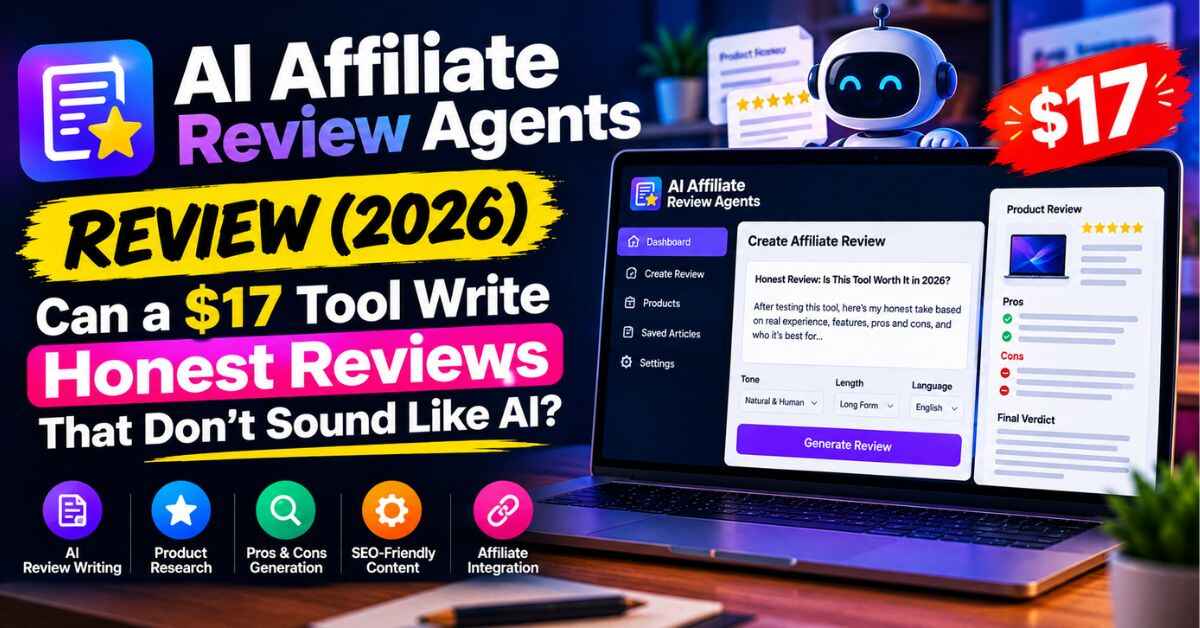
AI Affiliate Review Agents Review (2026): Can a $17 Tool Write Honest Reviews That Don’t Sound Like AI?
It’s 11 PM. You’ve got eight browser tabs open, a half-written product review, and a nagging feeling that it sounds exactly like every other review on the first page of Google. You still need a comparison section, an FAQ, a video script and some emails to go with it. That late-night grind is why I spent time on this AI Affiliate Review Agents Review.
The tool says it can handle the research, the review, the comparison, the YouTube script and the emails, and it makes a big point of not inventing prices, statistics or experiences you never had. That last part got my attention, because it’s the thing that usually goes wrong with AI writing. So I read the whole sales page, the terms and the fine print. Here’s what I found.
Why Writing Good Reviews Takes So Long
If you write product reviews, you already know this, but let me say it out loud anyway.
A good review isn’t five paragraphs about features. To write one, you have to understand the product, find out what real buyers are saying, spot the weak points, compare alternatives and answer the questions people are actually typing into Google. That’s research, and research takes hours.
Then you have to turn it into something people want to read. Not a feature list. Not “Awesome product, highly recommended.” A real review with a clear point of view, a fair look at the downsides and an ending that helps someone decide.
And after all that, you’re expected to repeat the effort in other formats. A comparison article. A “best alternatives” list. A YouTube script. A five-email sequence. A how-to post. Each one means opening another tool or starting from a blank page.
So what do most people do? They cut corners. They paste in a generic AI draft that sounds like a brochure. Readers feel it immediately. Or worse, they exaggerate, guess at a price they didn’t check, or hint at an experience they never had. That might get a click today, but it costs you trust, and trust is the only thing that makes an affiliate site work over the long run.
The real problem isn’t a lack of tools. It’s that good reviews are slow to make, and fast reviews are usually bad.
Meet AI Affiliate Review Agents
AI Affiliate Review Agents (the dashboard inside is called ReviewAgent) is a web-based platform built around one idea: research first, create second. The sales page frames it as one place for three kinds of people:
- Affiliates and reviewers who want to turn product research into reviews, comparisons, scripts and emails
- KDP creators and authors who want help researching niches and preparing an Amazon book listing
- Shoppers who want to look past star ratings before they spend money
The page’s headline promise is that you can “write long, publish-ready affiliate reviews that do not read like AI and never invent a price, a statistic or an experience you did not have.”
The current price listed is $17 (marked down from $27), with a 7-day money-back guarantee. I’ll come back to that number, because the refund window is shorter than what you usually see.
Curious how the dashboard actually looks? There’s a video explainer and demo clips on the official page: Take a look at AI Affiliate Review Agents here
AI Affiliate Review Agents Review: What’s Inside the Dashboard
The tools are grouped into a few sections, so I’ll go through them in plain English.
The content tools for affiliates and reviewers
This is the heart of it for most readers of this blog. Each tool produces one type of content:
- Full Product Review. A long review with a day-to-day walkthrough, what it costs over a year, an honest list of weaknesses and a Q&A at the end.
- Compare Two Products. A head-to-head with a big comparison table at the top, then four rounds with a winner in each.
- Best Products List. A ranked list of seven, with your product at number one and six real alternatives, each with who it suits, the price and its catch.
- Review Plus Your Bonuses. A short review followed by your own bonus offer in a table, with numbered claim steps. Useful when lots of people promote the same product.
- 30-Day Experience Story. A month-by-month diary format. The page says you add your own notes and it turns them into your story.
- “Is It a Scam?” Review. Headings written as the questions people actually search, with a claims-versus-reality table and a checklist readers can use to verify things themselves.
- YouTube Video Script. Five title options, a thumbnail brief, a word-for-word script with shot and on-screen text cues, and a description with chapters.
- Five Promotion Emails. Five emails with different angles and subject lines, ready to paste into an autoresponder.
- Helpful How-To Article. A non-salesy article answering a question your buyer asks before they know your product exists.
- Write Up My Own Experience. You paste your rough notes and it shapes them into a clear write-up in your voice. The page says it won’t invent an experience you didn’t have.
KDP Studio
If you publish books on Amazon, there’s a separate set of tools: niche research with a SWOT analysis, a price and royalty planner, a cover design brief, an Amazon book description, keywords and categories, an author bio and a review-request kit.
Research for shoppers
There’s also a research side for buyers. It’s meant to help you analyze available reviews, spot recurring complaints, compare alternatives and understand what you’re about to buy before you click “buy now.” The page also mentions infographic and visual-asset creation, so research can become more than plain text.
How It Works
The workflow in the page is simple: pick the job, give it the product or topic, and let the tool build the draft.
- Choose your goal. A review, a comparison, a video script, an email series, a book listing.
- Do the research step first. The tool works through the product, the buyer feedback, the strengths and weaknesses, and the alternatives.
- Generate the draft, then make it yours. You get a structured first draft, and the page’s own terms say plainly that you must review, fact-check and edit before publishing.
That last point is one I actually like. A tool that tells you “this is a first draft” is more believable than one that promises finished articles with a click.
The Benefits That Actually Matter
Here’s what I think is truly valuable, without the shouting.
It starts from structure, not a blank page. Each content type has its own shape. A “best products” list always has the same parts for each entry. A comparison always has a table and rounds. A scam review always answers the questions people search. That consistency alone saves a lot of thinking.
One research session can become many pieces. The page makes a good point here: research a product once, then turn it into a review, a comparison, a video script and an email series. If you’ve ever done the same research three times for three formats, you’ll see the appeal.
It encourages honesty, which helps conversions over time. The tool is built around weaknesses, costs and real buyer questions. Readers who see a fair, balanced review tend to trust you more, and trust is what makes people click your links without hesitation.
It handles formats you might avoid. Plenty of affiliates skip YouTube because scripting feels like a chore, or never build an email sequence. A ready structure with titles, thumbnail briefs and subject lines lowers the barrier.
The price is low. At $17, even one or two reviews’ worth of saved time would cover it for most people. That makes it easy to test.
It works for more than affiliates. If you’re an author preparing a KDP listing, or a shopper trying to avoid a bad purchase, there are tools for you too, so it’s not a one-trick product.
There are useful bonuses. The page lists three, valued by the vendor at $427 in total: an Affiliate Site Starter Pack (ready-to-paste disclosure and privacy pages), a “Your First 50 Articles” publishing roadmap, and an Amazon Associates Survival Guide covering the 180-day clock and the three-sale rule. I can’t judge the value number, but the topics are things new affiliates really do trip over. Also read: AI Prospect Genie Review (2026): Can AI Really Find Paying Local Clients on Autopilot?
Who Could Actually Use This?
These are examples of how someone could use it. They aren’t guaranteed results.
The niche blogger. Say you run a site about software or home gear. You pick a product, run the research, generate a full review, then a comparison against its main rival, then a “best alternatives” list. You edit each draft, add your own screenshots and opinions, and publish a small cluster of related posts that support each other.
The YouTube reviewer. Instead of staring at a blank document, you generate a script with title options, a thumbnail idea and shot cues. You still film it and add your own voice, but the skeleton is ready.
The email marketer. You have a list and a product to promote. A five-email sequence with different angles gives you something to send, and you rewrite it in your own voice.
The bonus promoter. When many affiliates push the same launch, a “review plus your bonuses” page gives buyers a reason to choose your link. That’s a common tactic, and having the format ready makes it faster.
The KDP author. Researching a niche, checking pricing and royalties, drafting your book description and picking keywords are separate chores. Having them in one place may make publishing less scattered, though specialist tools may go deeper in some areas (the vendor says that itself).
The careful shopper. If you’re about to buy a product, the research tools can help you look at complaints and alternatives first. That’s a nice side use, even if you never write a single review.
What I’d Double-Check Before Buying
This is the part where I try to earn your trust, so here are the things I’d look at closely.
It makes first drafts, not finished articles. The vendor’s own terms say every piece is a draft that you must review, fact-check and edit. Take that seriously. AI can get prices, features and claims wrong. Check every number against the real sales page before you publish.
Don’t treat “dozens of reviews a day” as a goal. One testimonial on the page jokes about writing dozens of reviews a day. Publishing piles of lightly edited AI articles is a risky strategy. Search engines tend to reward content that’s useful and original, and readers can tell when no human looked at a page. A few strong, well-edited reviews beat fifty thin ones.
The experience tools are only honest if the experience is real. The 30-Day Experience Story and the “Write Up My Own Experience” tools are fine if you really used the product and have real notes. If you haven’t, don’t present yourself as someone who did. Fake experiences mislead readers, and in many places fake or deceptive reviews break advertising rules. The vendor says the same thing in its FAQ, and I agree with it completely.
Ask how the credits work. One bonus mentions using “the first 50 credits in your account.” That suggests there’s a credit system, but the page doesn’t explain how many credits a review costs or what happens when they run out. That’s the first question I’d put to support.
It isn’t clear where the research data comes from. The page talks about analyzing available reviews and customer feedback, but it doesn’t say which sources or how fresh they are. Test the research tool on a product you already know well and see how accurate it is.
The testimonials come from the vendor’s own page. I couldn’t verify them independently. The page also shows a “launching soon” banner, so ask yourself whether you want to be one of the first people testing it.
The refund window is short. It’s 7 days, which is shorter than many launches. If you buy, use the tool right away. Don’t wait two weeks to try it.
There may be upgrades. I could only see the front-end page. Offers like this often show extra upgrade options after checkout. Read each screen, and don’t add anything until you know you need it.
Follow the platform rules. If you publish on Amazon KDP, you’re expected to follow its AI-content disclosure rules. If you earn affiliate commissions, you need proper disclosures on your pages. The terms say this is your responsibility.
“Is it a scam?” isn’t a verdict. The scam-investigation workflow helps you organize questions and checks. It isn’t an automatic judgment of any company, and you shouldn’t treat it as one.
None of this makes AI Affiliate Review Agents a bad idea. It means the tool is a helper, and you’re still the editor.
Price, Coupon and Refund
On the sales page, the price is $17, marked down from $27. There’s also a coupon, REVIEWAGENT20, shown for 20% off. Prices and coupons change, so check the checkout for what applies.
You’re covered by a 7-day money-back guarantee. To make good use of it, test the things you actually care about in your first couple of days:
- Run one full review on a product you know well, and check the facts.
- Try a comparison and a video script.
- Read the writing out loud. Does it sound like something you’d say?
- Ask support how credits work and save the answer.
If it saves you real time and the drafts are good starting points, you’ve found an inexpensive helper. If not, ask for your refund inside the window.
So, Is It Worth a Look?
Here’s my take. If you want a button that publishes ranking articles while you sleep, this isn’t it, and I’d be suspicious of anything that claims to be. The vendor doesn’t claim it either, which I appreciated.
But if your problem is the time it takes to go from “I should review this” to “here’s a solid, well-structured draft,” AI Affiliate Review Agents looks like a practical shortcut. The research-first approach, the structured formats, the focus on weaknesses and real buyer questions, and the small price make it an easy tool to test.
I’d treat it as a drafting assistant. Let it do the heavy lifting on structure and first drafts, then add what only you can: your real experience, your screenshots, your opinion and your voice. That’s the combination that builds a site people trust.
If that sounds useful, you can see the demos, the full tool list and the current price here: See AI Affiliate Review Agents and today’s offer
Affiliate disclaimer: Quick heads-up, this post contains affiliate links. If you buy through them, I may earn a small commission at no extra cost to you. That helps me keep writing reviews like this one. I’ve tried to be honest about both the good and the not-so-good, but please do your own research before buying. Prices, features and offers can change, and nothing here is a promise of income or results. What you get will depend on how you use it.