TrafficZest vs Udimi: Which Is the Smarter Way to Buy Solo Ad Traffic in 2026?
Picture this. You’ve finished your landing page, tested the opt-in form twice, and checked that the welcome email actually sends. Everything’s ready. The only thing missing is people. You open a new tab, search “buy solo ads,” and within five minutes you’re staring at a dozen options that all say the same thing. That’s usually the moment the TrafficZest vs Udimi question shows up, because these two keep coming up when people want email traffic without gambling on a stranger in a Facebook group.
I spent some time looking at how each one works, what people say about them, and where each could trip you up. By the end, you should know which one fits your situation, or whether it makes sense to try both.
I’ll be upfront about my approach. I’m not going to crown a universal winner, because there isn’t one. The right pick depends on how you like to work, how much control you want, and how comfortable you are choosing between sellers. I’ll also point out the places where either option can disappoint you, because pretending otherwise would waste your money and my credibility.
The Real Problem With Buying Traffic
Let’s talk about why this feels so hard.
Building an offer, a page and a follow-up sequence is the part most people expect to struggle with. But a surprising number of marketers say the harder part is getting the first real visitors. You can have a great page and still get silence, because nobody knows it exists.
So you think about the options.
Organic methods like blogging, social media and SEO work, but slowly. You might wait months before you know whether your offer has any pull. That’s a long time to stay motivated when you don’t even know if the idea works.
Paid ads on the big platforms are faster, but they come with a learning curve, strict policies, and the very real possibility of an account getting flagged. Beginners often burn through a budget just figuring out the settings.
Solo ads sit in between. You pay someone with an email list to send your link to their subscribers. If the list matches your niche, you can get real visitors and real sign-ups within a day or two. That speed is why so many affiliate marketers and list builders keep coming back to them.
The catch is the same one that has burned plenty of people: you’re trusting someone else. Some sellers send bot clicks. Some send tired, recycled traffic. Some disappear after payment. And even the honest ones vary from batch to batch.
So the question isn’t just “should I buy solo ads?” It’s “where should I buy them so I don’t get burned?” That’s exactly what this comparison is about.
They’re Not Quite the Same Kind of Thing
Before we go head to head, here’s the single most useful thing I can tell you: these two options aren’t built the same way, and that shapes everything else.
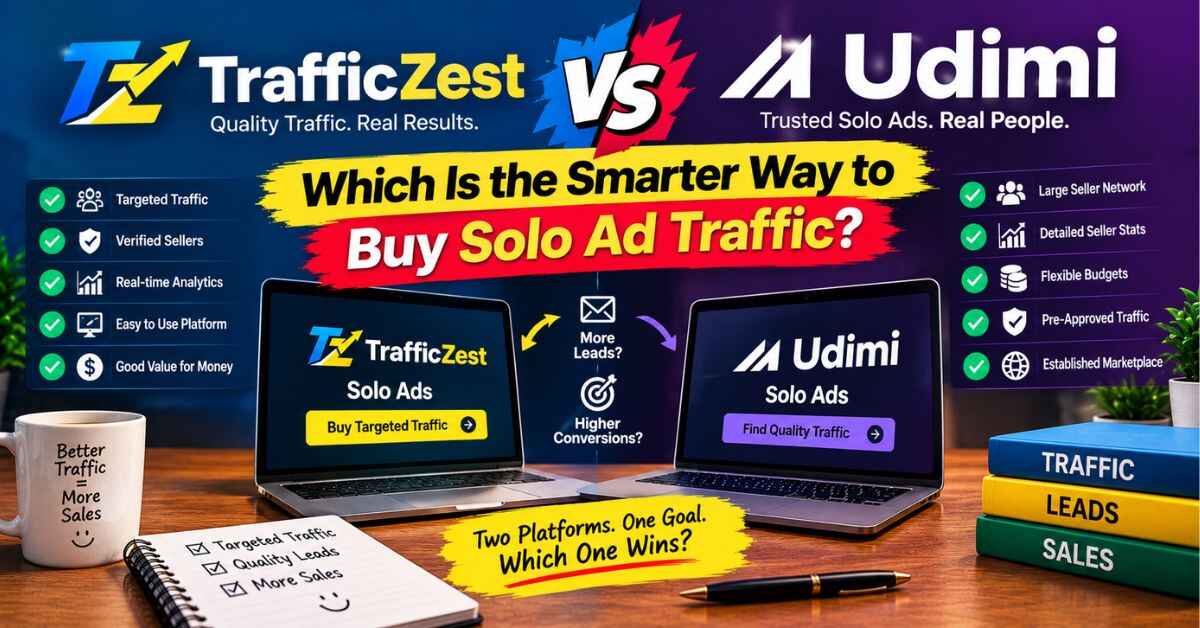
Udimi is a marketplace. You browse many individual sellers, each with their own ratings, reviews, prices and traffic mix. You choose one, place an order, and Udimi sits in the middle handling payment and verifying clicks.
TrafficZest is described more like a platform. From what I found, you set up a campaign inside one dashboard, pick your targeting, set a speed and budget, and the traffic arrives from established marketers’ audiences. Rather than shopping for a specific seller, you’re working through a single system.
Think of it like choosing between a farmers’ market and a meal-kit service. At the farmers’ market, you pick every ingredient yourself, you can talk to each stall holder, and you get to be as picky as you like. With the meal kit, the choices are narrower, but it’s quicker and there’s less to figure out. Neither is better in the abstract. It depends on whether you enjoy the choosing.
What Is TrafficZest?
TrafficZest is a paid traffic service aimed at people who want to send visitors to their own pages, such as an opt-in page, a bridge page, a funnel or an offer.
Based on third-party write-ups, here’s how it’s usually described:
- You create a campaign and add the page you want to promote
- You choose targeting through tags and categories
- You pick how fast the traffic should be delivered and how much to spend
- You preview the campaign before launch
- Visitors typically start arriving within hours
- It uses a credit-style approach rather than a fixed monthly subscription
I couldn’t read the sales page itself, so I’d treat that as a guide to what to look for and confirm every detail on the official page before buying.
What appeals to me about the concept is simplicity. There’s no seller shortlist to compare, no back-and-forth messages, and no waiting for someone to reply. For a beginner who finds marketplaces overwhelming, that can be a relief.
What Is Udimi?
Udimi is one of the better-known names in solo ads, and it’s been around for a long time. It’s a marketplace where buyers like you browse sellers who own email lists and pay them to send your link.
Here’s what’s consistently mentioned about it:
- A seller marketplace. You can browse sellers, read their reviews and compare them. Filters let you look at things like ratings and the share of top-tier country traffic.
- Udimi sits in the middle of payment. Rather than paying a stranger directly, the platform handles the transaction, which protects both sides.
- Click verification. Independent write-ups mention an in-house traffic filter that checks clicks for authenticity.
- A refund route for undelivered clicks. If a seller doesn’t deliver what you ordered, there’s a process for getting that money back.
- Seller reviews and ratings. Past buyers leave feedback, so you can see who delivers and who doesn’t.
- Extras like a forum, tutorials and a deals section that give beginners some guidance.
Pricing varies by seller, niche and traffic quality. One long-time buyer’s review mentioned paying around $50 for about 100 clicks in their niche, and other sources mention sellers starting in the low $40s. Treat those as rough examples rather than a price list, since your costs will depend on your niche and the seller you choose.
TrafficZest vs Udimi: Head-to-Head
Here’s where things get practical. I’ll go through the points that actually matter when you’re about to spend money.
Quick comparison:
| What matters | TrafficZest | Udimi |
|---|---|---|
| Type | Campaign platform (single dashboard) | Marketplace of individual sellers |
| How you pick traffic | Targeting by tags and categories | Browse and choose a specific seller |
| Setup feel | Quick, guided | Slower at first, more choices |
| Control | Over speed, budget, targeting | Over which seller you trust |
| Transparency | Dashboard stats | Seller ratings, reviews, history |
| Buyer protection | Check the official terms | Payment handled by Udimi, refund process for undelivered clicks |
| Best for | People who want simple and fast | People who want to choose and compare |
| Learning curve | Gentle | A bit steeper, but lots of guidance |
If you’d like to take a look at the simpler, campaign-style route, here’s TrafficZest: 👉 See how TrafficZest works
And if you’d rather browse sellers and read reviews before you buy, here’s Udimi: 👉 Browse solo ad sellers on Udimi
Ease of Getting Started
TrafficZest sounds quicker to start. You set up a campaign, choose a target and go. Udimi asks you to do some research first. You’ll look through sellers, read reviews, compare prices and maybe message a couple of them. That’s more work, but it’s also how you learn what good traffic looks like.
If you want to be up and running this afternoon, TrafficZest’s approach is appealing. If you don’t mind spending an hour choosing, Udimi’s approach gives you more to go on.
Choosing Who Sends Your Traffic
This is the biggest difference. On Udimi, you pick a specific seller, and you can see their track record. That means you can favour someone with hundreds of ratings over someone brand new. It’s also the part many beginners find stressful, because choosing wrong costs money.
With TrafficZest, the choosing happens through targeting rather than through a seller’s profile. You tell it what kind of audience you want. If you’d rather not evaluate individual sellers, that’s a plus. If you like having a named person to hold accountable, it’s less satisfying.
Protection When Things Go Wrong
Udimi’s setup has a clear structure here. The platform sits between you and the seller, checks the clicks, and offers a refund path for undelivered traffic. That doesn’t make every order a success, and some Trustpilot reviewers describe refund disputes, so it isn’t flawless. But there’s a real process.
For TrafficZest, I’d check the official page for its refund and support terms before buying. I’m not going to guess, because this is exactly the kind of detail that matters.
Targeting and Matching
Both let you aim at the right audience, in different ways. Udimi lets you look at what niche a seller serves and what share of their traffic comes from top-tier countries. TrafficZest uses tags and categories. In either case, good targeting is half the battle. Sending a weight-loss audience to a software offer is wasted money no matter how good the platform is.
Speed
Both are known for fast results compared with organic methods. TrafficZest is described as launching in minutes and delivering within hours, with speed settings you can adjust. Udimi delivery depends on the seller, so it can vary from a day or two upward. If speed matters, check the stated delivery window before you order on either.
Cost
This one depends on your niche and your order size, so I won’t give a number I can’t back up. Udimi prices vary by seller, and you can compare them openly. TrafficZest is described as credit-based. Whatever you choose, start with a small order. A test batch is cheap, and the information it gives you is worth far more than the cost.
Learning and Support
Udimi has a forum, tutorials and a big community of buyers and sellers, which is genuinely helpful if you’re new. TrafficZest is described as simpler, so there’s less to learn, though I’d confirm what support and training come with it.
Benefits of Each (In Plain English)
Why you might like TrafficZest:
- It’s simple. Fewer decisions, fewer tabs, less overwhelm.
- It’s fast. Quick setup and delivery mean you can test sooner.
- You control pace and spend. Start small, scale only if the numbers justify it.
- No hunting for sellers. You skip the research phase that puts a lot of people off.
- Credit-style buying. No monthly commitment, as described. Good for occasional tests.
Why you might like Udimi:
- You can see track records. Ratings and reviews let you choose based on evidence.
- A middle layer protects the money. The platform handles payment and offers a refund route for undelivered clicks.
- Click verification. An in-house filter checks for fake traffic.
- Lots of choice. You can pick sellers by niche, price and traffic quality.
- Community and learning. A forum and tutorials help you avoid common mistakes.
Real-World Examples: Which One Would You Pick?
Let me turn this into situations you might recognise.
Priya, the first-time list builder. She’s built a simple opt-in page for a free guide and has never bought traffic. She’s nervous about picking the wrong seller. A guided, single-dashboard setup might feel safer to her, so she’d probably try TrafficZest first with a small test, and look at Udimi later once she understands what good traffic looks like.
Marcus, the affiliate marketer who likes data. He tests offers weekly and wants to compare sellers. He enjoys reading reviews and comparing click quality. Udimi’s marketplace suits his style, because he can run the same funnel through two or three different sellers and see who performs.
Elena, the coach with a small budget. She needs a few dozen leads, not hundreds. She’d start with the smallest order available on either option, track sign-ups, and decide from the cost per lead whether it’s worth repeating.
David, the funnel builder who split-tests pages. He needs a steady stream of visitors to compare two landing pages. Speed and control matter more to him than which seller sends it, so a campaign platform with adjustable pacing could make sense.
Sam, the cautious one. He’s been burned before and wants as much protection as possible. He’d lean toward the option with the clearest buyer protections and the biggest paper trail of seller reviews, and he’d start tiny.
The curious tester. Someone who just wants to understand how paid traffic behaves can try a small order on each and compare the numbers side by side. That’s honestly the best education you can get.
Mistakes That Hurt You on Either One
Here’s the part most comparisons skip. The platform matters less than people think. These mistakes will sink a campaign anywhere.
Sending traffic to a weak page. If your headline is vague or your form is confusing, the best traffic in the world won’t save it. Test your page yourself, on your phone, before you spend anything.
Not tracking. Install analytics or use a tracking link, and make sure your email tool works. If you can’t tell where sign-ups came from, you can’t learn anything.
Ordering too much too soon. Run a small test first. Scale up only after you’ve seen real numbers.
Judging by clicks alone. Clicks aren’t sign-ups, and sign-ups aren’t sales. Look at what people actually do after they arrive.
Ignoring the follow-up. Most of the money in list building comes from the emails you send afterwards. If you don’t have a welcome sequence, you’re leaving it on the table.
Expecting instant income. Some people get sales quickly, and a lot of people don’t. Buying solo ads is a test, not a guarantee.
Mismatching the audience. Always choose targeting or a seller whose list actually fits your offer.
My Honest Thoughts (Because You Deserve Them)
I try to be balanced in these comparisons, so here’s where I land.
On TrafficZest. The idea of one dashboard with targeting, pacing and a preview step is attractive, especially if marketplaces feel like too much. The honest caveat is that I couldn’t verify the sales page myself, so please read the current pricing, traffic rules and refund terms before you commit. Also, with any platform where you don’t pick the individual sender, you’re relying on the system’s quality control rather than a seller’s reputation, so track results carefully from the first order.
On Udimi. It has a long track record, a large pool of sellers, and real buyer-protection mechanics, which is why it keeps appearing in recommendations. But it isn’t perfect. Public reviews are mixed on a few things, including refund disputes, and no marketplace can promise every seller is excellent. The ratings help you filter, but they don’t remove the need to start small and check your own numbers. Buying email traffic is never 100% predictable, even with a good platform.
On both. Neither one can fix a weak offer. If your page doesn’t convert, more visitors just means more people leaving. That’s not a flaw in the platforms. It’s the nature of paid traffic.
So my honest summary is this: choose based on how you like to work, not on who has the loudest marketing. If you prefer simple and guided, lean TrafficZest. If you prefer to compare and choose, lean Udimi. If you’re not sure, try a small test on each.
A Simple Testing Plan (If You Want to Try Both)
Here’s the plan I’d follow if I were in your shoes.
Step 1: Get your page ready. Test the opt-in form, the thank-you page and your first email.
Step 2: Set up tracking. Use analytics or a tracking link so you know where each visitor and sign-up came from.
Step 3: Pick one clear offer and audience. Don’t test five things at once.
Step 4: Place a small order on each. Keep the amounts equal so the comparison is fair.
Step 5: Wait a few days. Don’t judge on hour one. Subscribers often engage over time.
Step 6: Compare the numbers. Look at cost per sign-up, quality of leads (do they open your emails?) and any sales.
Step 7: Keep what works. Scale the one that gives you the best results for your offer. Drop the other without guilt.
This turns the whole question into an experiment rather than an opinion. And you’ll learn more from your own numbers than from any review, including this one.
So, Which One Should You Choose?
If I had to boil it down:
Choose TrafficZest if you want a simple, guided way to launch campaigns quickly, you’d rather not research individual sellers, and you like adjusting speed and budget yourself.
Choose Udimi if you want to compare real sellers by ratings and reviews, you like the idea of a middleman handling payment and verifying clicks, and you don’t mind spending a little time choosing.
Try both if you’re curious and have a small budget to test with. Honestly, that’s what I’d do.
If you’d like to take a look at the simpler, campaign-style route, here’s TrafficZest: 👉 See how TrafficZest works
And if you’d rather browse sellers and read reviews before you buy, here’s Udimi: 👉 Browse solo ad sellers on Udimi
Prices and terms change, so check the current details on each page:
Quick FAQ
What’s the main difference between TrafficZest and Udimi? Udimi is a marketplace where you choose between individual sellers. TrafficZest is described as a campaign platform where you set targeting and budget in one dashboard.
Which is better for beginners? It depends on your style. TrafficZest sounds simpler to start with. Udimi offers more guidance and track-record information, but asks you to make more choices.
Are solo ads safe? They carry risk. Fake clicks and poor-quality lists exist in this space, which is why tracking and small test orders matter.
How much should I spend to test? As little as the platform allows. A small batch gives you enough data to learn from without much risk.
Can I use them for affiliate offers? Many marketers do, but check each platform’s rules for the specific offer you plan to promote.
What if the traffic doesn’t deliver? Udimi has a refund process for undelivered clicks. For TrafficZest, check the official refund and support terms before you buy.
Do I need an email tool? Yes. Solo ads work best when you capture subscribers and follow up with emails.
Final Thoughts
When I step back, the TrafficZest vs Udimi question really comes down to a simple trade-off. Do you want fewer decisions, or more control? Both can get real visitors in front of your offer. Both can disappoint you if your page isn’t ready or your tracking isn’t set up. And both are best approached with a small test and a bit of patience.
If you’ve been stuck at the “nobody sees my page” stage, picking one and running a small, tracked campaign is the fastest way to find out what you actually need to fix. You’ll come away with real numbers, and real numbers beat guessing every time.
(Placement tip: put CTA #1 after the “What Is TrafficZest?” section as a soft nudge, and CTA #2 after the “What Is Udimi?” section or where it appears above in the verdict. If you only want two links in the post, keep them as shown in “So, Which One Should You Choose?”)
Quick note: this post contains affiliate links. If you click one and decide to buy, I may earn a small commission at no extra cost to you. It helps me keep writing these comparisons. I only recommend things I think are worth a look, and I’d always rather you choose what actually helps you. Please do your own research, and remember that results depend on your own effort.