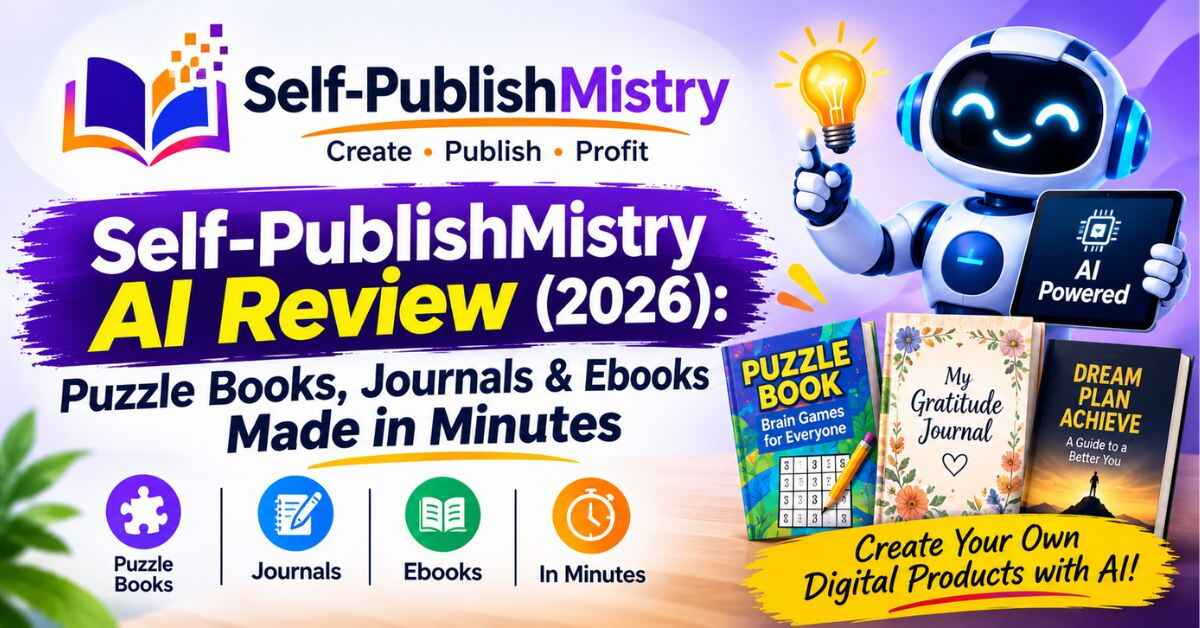
Self-PublishMistry AI Review (2026): Puzzle Books, Journals & Ebooks Made in Minutes
A few years ago, a friend of mine told me she’d made her first $40 from a book she had published over the weekend. It wasn’t a novel, and it wasn’t even a book with much writing in it. It was a large-print word search book for seniors, and her grandmother had been her test audience.
I laughed at first. Then I looked at the listing, saw the reviews, and stopped laughing. Those little books sell. They’re not glamorous, but they sell steadily to people who want something to do with their afternoons.
I kept thinking about that story when I came across this product. If you’ve ever wondered whether you could publish books without writing a hundred pages or hiring a designer, this Self-PublishMistry AI review is for you. I’ll tell you what it does, who it suits, what I like, and where you should keep your expectations in check.
Let’s get into it.
The Dream Everyone Has (and Why Most People Never Start)
Almost everyone has thought about publishing a book at some point. Maybe you wanted a recipe collection, a journal for your own niche, or a guide on something you know well. Or maybe you just liked the idea of royalties showing up in your account every month, from something you made once.
So you open a blank document. You write a title, and then you stare at it.
If you’ve ever tried, you know what comes next. The idea that felt exciting on Monday feels like a mountain by Thursday. And the writing isn’t even the whole job. Here’s what else a “simple” book asks of you:
- A cover that doesn’t look homemade
- Margins, trim size and bleed that Amazon won’t reject
- A table of contents that actually works in a Kindle file
- Page numbers, front matter, back matter, a copyright page
- A description and keywords so people can find the thing
- A clean EPUB if you want it on other stores
And if you’re thinking about puzzle books, it gets worse. Building two hundred Sudoku grids with answer keys by hand is not a hobby, it’s a punishment. Puzzle software exists, but it often comes with a monthly bill.
I’ve watched people get through the hard part of an idea and then die at the formatting stage. The upload gets rejected because the margin is off by a hair. They fix it, upload again, and get a different error. After three tries, the file goes in a folder and stays there forever.
That’s the quiet reason most books never get published. It isn’t a lack of ideas. It’s the grind between the idea and the “publish” button.
What If One Tool Handled the Boring Parts?
Picture a different kind of week.
You log in on Monday and pick “Puzzle Book.” You type something like “Large-Print Word Search for Seniors, Garden Theme.” A few minutes later, you have a finished interior with answer keys, a cover, and a file sized for KDP.
Tuesday, you make an ebook. Wednesday, a gratitude journal. Thursday, a recipe logbook. By Friday, you have a small catalog sitting in a folder, ready to upload.
That’s the pitch behind Self-PublishMistry AI. It isn’t a miracle. It’s a way to remove the most tedious steps between “I have an idea” and “my book is live.”
So let me explain exactly what it is.
What Is Self-PublishMistry AI?
Self-PublishMistry AI is a cloud-based publishing app that creates three kinds of books for you:
- AI ebooks, like how-to guides, self-help, business books, kids’ stories and cookbooks
- Puzzle books, including sudoku, word search, crosswords, mazes, cryptograms and number puzzles, with answer keys
- Low-content books, such as journals, planners, logbooks, notebooks and trackers
It doesn’t just generate the content. It also builds the cover (ebook covers and full paperback wraps with the spine calculated from your page count), formats the interior for popular trim sizes, and exports files you can upload to Amazon KDP, plus a clean EPUB for ebook stores.
It also comes with a “5-Platform Publish Pack.” That means files organized for Amazon KDP, Gumroad, IngramSpark, BookSpace and Draft2Digital. You still create your own accounts on those platforms, and the included training walks you through each one.
Because it’s cloud-based, there’s nothing to install. It works on a laptop, tablet or phone.
And here’s the part that made me pay attention: the launch price I saw was a one-time payment, with no monthly fees. Plenty of tools in this space charge a subscription for one narrow job. Having the ebook creator, puzzle generator, cover designer and formatter in one place for a single payment is unusual.
Curious what a finished book from this tool actually looks like? The creators show a demo on the official page, and it takes just a couple of minutes to watch. Take a look at Self-PublishMistry AI here.
My Honest Self-PublishMistry AI Review: How It Works Step by Step
I went through the full sales page, the feature list, the sample categories and the FAQ. I haven’t used the software myself, so I’ll describe it as the creators present it. The workflow is refreshingly simple:
Step 1: Log in and choose a book type.
You pick ebook, puzzle book or low-content book. Then you choose your niche, your theme and your trim size (5″×8″, 6″×9″, 8.5″×11″ and others).
Step 2: Describe your idea.
You write a sentence about what you want. No complicated prompts, no technical setup.
Step 3: Let the AI build it.
The content, puzzles, answer keys, interior and cover get generated. You can open the built-in editor to change text, regenerate puzzles or tweak the layout before you export.
Step 4: Download and publish.
You download your KDP-ready PDF, EPUB and cover, follow the training, and upload to the platforms you want to use.
There’s also a KDP compliance check that scans trim size, margins and bleed before you upload. That’s a small detail, but it’s the kind that saves real frustration. File rejections are the most annoying part of self-publishing, and anything that cuts them down has value.
The Features That Actually Matter
Sales pages like to list twenty-plus features. I’ll skip the endless list and focus on what changes things for a real person.
Puzzle books without puzzle software
This is the feature I’d look at first. Puzzle and activity books are some of the most popular books in the “low-content” world, and they sell to a loyal audience. The generator covers sudoku, word search, crosswords, mazes, cryptograms and number puzzles, with easy-to-expert levels and automatic answer keys.
There’s also a large-print mode. Senior-friendly puzzle books and journals are a big market, and not many people serve it well.
Low-content books that take minutes
Journals, planners, logbooks, gratitude books, workout trackers and recipe journals fall under this category. They need very little writing, which makes them the fastest books to publish. The tool comes with ready-made interior layouts and themes (floral, kids, minimal, vintage, seasonal and more), so you aren’t starting from nothing.
KDP-ready formatting
If you’ve ever fought with margins, you’ll love this one. The interiors export with the correct trim size, margins, gutter, bleed and page numbers, and the paperback PDF has embedded fonts. In plain English: fewer weird errors when you upload.
EPUB export
EPUB is the standard ebook format for Kindle, Apple Books, Kobo, Barnes & Noble and Draft2Digital. The tool exports a clean, reflowable EPUB with a clickable table of contents. If you’ve ever tried to build one by hand, you know why that matters.
Cover design
Covers are where many beginners get stuck, or pay $50 to $300 per book. This tool builds ebook covers and full paperback wraps with the spine width calculated for you. I can’t tell you how every cover looks without seeing it in person, but having a decent starting point you can tweak is a big step up from a blank canvas.
Metadata and keyword kit
Writing a title, subtitle, description and keywords is its own skill. The tool generates copy-paste-ready metadata and category ideas, and it includes an AI niche and title finder to help you decide what to publish. Choosing the right niche is half the battle, so that’s helpful.
Series builder and multi-language support
You can create Volume 1, 2, 3 and so on in one go, and you can make books in different languages. Series tend to sell better because readers who like one book want the next.
A royalty calculator
You can see estimated royalties per sale on each platform before you publish. It’s a small feature, but it helps you price your books like a business instead of guessing.
Training and a commercial license
The training covers all five platforms, from your first book to a larger catalog. The commercial license lets you publish under your own name or a pen name and sell your books and services, including to clients.
That last piece opens another door, which I’ll get into next.
Who Is This Actually For?
I like to be practical about this, so here are real scenarios where the tool could fit.
The complete beginner. You’ve never written a book and you’re nervous about the technical side. A one-sentence prompt and a guided workflow lowers the barrier. You still have to do the learning, but you won’t be stuck at the formatting stage.
The side-income seeker. You want to publish simple books alongside a day job. Low-content and puzzle books fit into evenings and weekends because each one takes far less time than a written book.
The existing blogger or creator. You already have an audience, and you’ve been thinking about a product. A journal, planner or small ebook in your niche is a natural next step, and a Gumroad printable can go live quickly.
The Gumroad seller. The tool exports printable PDFs for instant download, so you can sell puzzle packs, planners and journals directly. The page says you keep about 90% of direct sales, though you should check Gumroad’s current fees yourself.
The freelancer or small agency. This is the one I find most interesting. With a commercial license, you could offer services like custom puzzle books for schools, events or senior centers, ebook creation for coaches and consultants, or formatting and cover design for other authors. The sales page suggests price ranges for these services, but treat those as examples, not promises. Your pricing depends on your market and your skill at finding clients.
The seasonal publisher. Themes like holidays, summer, back-to-school and gift-giving seasons are easy to produce quickly. If you can turn a book around in an afternoon, you can react to trends faster than someone doing everything by hand.
Want to see all the book types and sample niches in one place? The official page lists dozens of examples across ebooks, puzzles and journals. Browse what you can create here.
A Realistic Example of How This Could Go
Here’s a made-up but realistic example so it doesn’t all feel abstract.
Meet Rina. She works part-time, loves crosswords, and has a feeling that puzzle books for older adults are underserved. She buys Self-PublishMistry AI.
In her first week, she uses the niche finder to pick a few ideas. She makes a large-print word search book with a garden theme, a crossword collection, and a simple gratitude journal. Each one takes an afternoon, mostly because she’s reviewing and tweaking, not because the tool is slow.
She uploads the paperback files to KDP, and she lists the printable PDF versions on Gumroad. She follows the training for the compliance steps and disclosure rules. Two of the books get a handful of sales in the first month. One gets none.
That isn’t a get-rich story. It’s a normal story. Some books sell and some don’t. But Rina now has three listings, a process she understands, and the ability to make the next batch faster and better based on what she learned. In a few months, she has fifteen books. That’s the “catalog” idea the product leans on: more books, more chances for someone to find you.
I’d rather give you that picture than a fantasy. Publishing is a numbers game, and a tool that makes each book cheaper and faster to produce changes the math in your favor. It doesn’t guarantee a result. Also read: MineMint AI Review (2026): Minesweeper Puzzle Books for KDP, Etsy and TPT Without the Weekend Grind
What I Like About It
- The price model. A one-time payment is a big deal when the alternatives are several monthly subscriptions.
- The all-in-one approach. Content, puzzles, covers, formatting and metadata in one dashboard means fewer tools and fewer logins.
- KDP and EPUB focus. The tool is built around file requirements, which is where beginners usually stumble.
- Training included. Software alone isn’t enough. A click-by-click guide for each platform fills the gap.
- The commercial license. You can publish under a pen name and offer services to clients.
- The 30-day money-back guarantee. You can try it and see if it fits your plans.
- Honest FAQ answers. The page says plainly that it can’t promise any specific income, and it notes that Amazon allows AI-generated content as long as you disclose it when you publish.
What to Keep in Mind
You know I’d never leave this part out.
Results aren’t guaranteed. The page says its earnings examples are illustrative and not typical. Some books sell every day, others barely sell. Your niche, pricing, competition and effort all play a role.
Quality still matters. AI makes creating books easy, which means more people are doing it. Books that are thoughtful, well-targeted and reviewed by a human will do better than ones pushed out without a second look. Take the time to check your work.
Platforms have rules. Amazon KDP asks you to disclose AI-generated content and has its own publishing limits and quality guidelines. Always read each platform’s current policies before you publish. The training covers this, but the responsibility is yours.
The “normal price” claims vary. The page shows different “normal” prices in different places, so I wouldn’t lean on those numbers. Judge the product by what it does and what you pay today.
The launch price won’t last. The page says the price goes up after the launch period and the bonuses disappear, so check the current price before you decide.
None of these are dealbreakers for me. They’re the reality of any publishing business, and knowing them upfront makes you a smarter buyer.
Pricing, Bonuses and the Guarantee
At the time I looked, Self-PublishMistry AI was priced at $14.95 as a one-time payment during its launch period. That’s roughly the cost of a couple of coffees, for software that does the job of several tools.
Here’s what’s included:
- Lifetime access to the platform, including future updates
- The AI ebook creator, puzzle book generator and low-content book builder
- KDP-ready interiors and one-click EPUB export
- The AI cover designer (ebook covers and paperback wraps)
- The 5-Platform Publish Pack
- The metadata and keyword kit
- Step-by-step royalty training for all five platforms
- A commercial license
Early buyers also get three bonuses: a vault of 100 profitable book niches with title ideas, a Royalty Quick-Start Kit with setup checklists and a 30-day publishing plan, and a pack of book description templates. The niche vault alone could save you hours of research.
Finally, there’s a 30-day money-back guarantee. If it doesn’t make creating and publishing books easier for you, you can ask for a refund within 30 days. Between the low price and the guarantee, the financial risk is small.
Thinking about it? Prices and bonuses on launch offers can change quickly, so it’s worth checking the current details before you decide. See today’s price and what’s included.
Why This Makes Sense Right Now
Here’s why I think the timing is interesting.
Self-publishing has never been easier to enter, and it has never been more crowded. The people who do well tend to be the ones who publish consistently, test different niches, and learn from what sells. The biggest barrier has always been the time and effort it takes to make each book.
A tool like this lowers that barrier. It doesn’t replace your judgment about what readers want, but it takes a lot of the repetitive work off your plate. That frees you to spend your energy on the part that actually matters: choosing good niches, reviewing quality, and writing listings that make people click.
And if you want to go beyond your own books, the commercial license gives you options. Many local businesses, coaches and organizations want a book or a puzzle collection but have no idea how to make one. Being the person who can deliver it is a real service.
Is Self-PublishMistry AI Worth It?
Let me answer it plainly.
If you’re looking for a button that prints money, no product will give you that, and I’d walk away from anyone who promises it. But if you want a faster, cheaper way to create ebooks, puzzle books and low-content books that are ready to upload, this tool covers a lot of ground for a small one-time price.
For a beginner, it removes the most common roadblocks: the blank page, the formatting headaches and the file rejections. For someone who’s already publishing, it could speed up your process and cut your costs. And for freelancers, the commercial license adds a way to earn without relying only on royalties.
Is it perfect? I can’t say until you test it with your own ideas. That’s what the guarantee is for. You can make a book or two, see how the files look, follow the training for one platform, and decide whether it earns its place in your workflow.
If you’ve been sitting on an idea for a book for months, maybe years, this might be the nudge that gets it out of your head and into the world. The cost of trying is low, and the cost of never starting is a catalog of zero.
Ready to turn that book idea into a real file? Check out Self-PublishMistry AI, look at today’s price, and make your first book risk-free.
Quick note: this post contains an affiliate link. If you buy through it, I may earn a small commission at no extra cost to you. I only recommend things I think are worth a look, and my opinions are my own. Please read the official page and refund terms before you buy, and remember that results are different for everyone.