Marblism vs ChatGPT (2026): Do You Need an AI Chatbot or an AI Team?
Here’s a scene a lot of business owners know well. It’s Sunday night. You open ChatGPT and ask it to write a week of social posts. It does a nice job. You copy them into a scheduling tool, one by one. Then you ask for a blog outline, copy that into your website, ask for a follow-up email, copy that into your inbox, and by 11 p.m. you’ve done a full evening of work that the AI “helped” with, except you were the one carrying everything from the chat window to the real world. That nagging feeling is exactly why people search for Marblism vs ChatGPT. Both use AI. Both promise to save you time. But they’re built for very different jobs, and picking the wrong one can cost you money or leave you doing the grunt work anyway.
I went through both companies’ official pages, pricing and independent reviews. This post lays out what each one actually does, what each costs, where each falls short, and who should choose what. Spoiler: for many people, the answer isn’t either-or.
The Problem: AI Helps You Think, but You Still Do All the Doing
Let’s be fair to chatbots first. Tools like ChatGPT are astonishingly good. They can draft an email, explain a contract clause, brainstorm product names, summarize a long document, write code, analyze a spreadsheet and help you rehearse a hard conversation. For a lot of tasks, nothing else is as flexible.
But there’s a pattern that shows up again and again with small business owners. A chatbot waits for you. You open it, you type a request, it answers, and then it goes quiet until you come back. Whatever it produces lives in the chat. To get it into your business, you copy, paste, format, post, send and schedule. You are the delivery system.
That creates a few quiet problems.
First, consistency. You only get what you remember to ask for. Busy weeks mean no prompts, which means no posts, no follow-ups and no blog.
Second, context. Every time you start a conversation, you have to remind the AI who you are, what you sell and how you talk, unless you’ve set up memory and project instructions carefully.
Third, reach. A chatbot lives in a window. It doesn’t pick up your phone when you’re with a customer, and it doesn’t send the same follow-up to twenty leads at the right time unless you build that yourself.
And fourth, there’s the time you spend prompting. Many owners tell the same story: they started using AI to save time, then discovered they were spending hours crafting prompts and fixing outputs.
So the real question isn’t which AI is smarter. It’s which kind of AI fits the job: one that advises you, or one that does the work.
The Solution: Two Different Kinds of AI
Here’s the simplest way I can put it. ChatGPT is a brilliant generalist you talk to. Marblism is a team of specialists that work for you.
ChatGPT in Plain English
ChatGPT is OpenAI’s general-purpose assistant. Based on OpenAI’s own pricing page, there’s a free plan, a lower-cost Go plan (which may include ads), Plus, Pro, and Business and Enterprise options for teams. The paid plans add more advanced reasoning models, more messages and uploads, deeper research, longer memory, image creation, voice, projects, custom GPTs and more. Plus and above include scheduled tasks and access to what OpenAI calls ChatGPT Work, which connects to apps and can take on tasks. Pro adds an “always-on agent” called Dot.
It’s a remarkable product, and it’s improving quickly. It also gives you control over your data: on individual plans, OpenAI says you can opt out of having your content used to train its models.
Marblism in Plain English
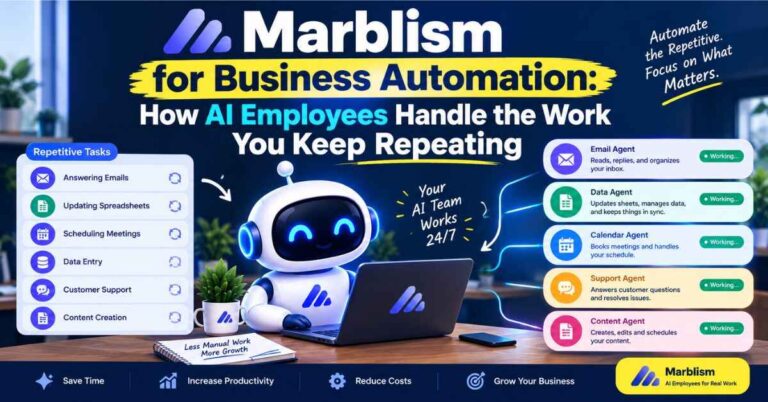
Marblism takes a different approach. Instead of one assistant for everything, you get seven AI employees, each with a defined job. Eva handles your inbox and calendar. Sonny runs your social media. Stan does outreach and follow-ups. Penny writes SEO content. Rachel answers your phone. Walter builds your website. Linda helps with contracts. They connect to your accounts, share a knowledge area called the Brain where you store your business details and voice, and check in with you for approval.
The pricing is simple: $24 a month on the yearly plan or $44 a month if you pay monthly, with all seven employees, unlimited businesses, unlimited team members and 50 hours of AI work per month. There’s a 7-day money-back guarantee.
If you’d like to look at the Marblism team while you read, here’s the official page. It costs nothing to look.
Marblism vs ChatGPT: The Real Differences
Let’s go through them one at a time.
Difference 1: Talking vs. Doing
This is the big one.
With ChatGPT, you ask and it answers. It can draft your posts, but you publish them. It can write your follow-up email, but you send it. Even ChatGPT’s newer agent features, like ChatGPT Work, are sessions you launch and that are metered against your plan. One independent review notes that there’s still no standing “book meetings as requests come in” behavior, and says its Google Calendar connector is read-only, so if it proposes a time, you still book it yourself. Features change quickly, so check the current connector list for your tools.
With Marblism, the employees work inside your accounts. Sonny publishes your posts to Instagram, LinkedIn, X and Facebook. Penny publishes blog posts to your site on a schedule. Rachel answers real phone calls and books appointments. Stan runs follow-up sequences by email and LinkedIn. Eva drafts your email replies, and she never sends them for you, so you stay in control. Since August, they can also run tasks that trigger automatically when something happens in a connected app.
So here’s a clean way to think about it. ChatGPT helps you decide what to do and how. Marblism does a lot of the routine doing.
Difference 2: One Brain vs. Seven Roles
ChatGPT is designed to do almost anything. That’s its strength. You can ask it about law, coding, cooking, history and your marketing plan in a single afternoon. You can set up projects, memory and custom GPTs to give it more context about your business.
Marblism is deliberately narrow. Each employee has one job, and they share the Brain, so Sonny’s posts, Penny’s articles, Rachel’s phone answers and Eva’s emails all draw from the same description of your business. You describe your business once, instead of re-explaining it in every chat.
If you want a flexible thinking partner, ChatGPT is hard to beat. If you want roles that stay in their lane and keep running, Marblism’s structure is easier.
Difference 3: What Each One Can’t Do
I think it helps to be blunt here.
ChatGPT’s pricing page doesn’t list a phone receptionist that answers calls on its own number, a social media manager that posts on a daily schedule, or a lead generation employee that runs outreach campaigns. You can build pieces of those with connectors, tasks and custom setups, but you’d be assembling and maintaining them yourself.
Marblism doesn’t do what ChatGPT does best: open-ended thinking. It won’t debug your code, tutor you in a language, analyze a messy dataset or brainstorm a startup idea at 2 a.m. with the same freedom. It’s not a general-purpose assistant.
Difference 4: Pricing
Here’s where it gets interesting.
ChatGPT
- Free plan with unlimited basic text chats and limits on uploads, images, voice and research
- Go, a low-cost step up that may include ads
- Plus, which has been listed at about $20 a month, with advanced models, scheduled tasks, ChatGPT Work and more
- Pro, a higher tier for heavy users with an always-on agent and the biggest limits
- Business and Enterprise plans for teams
Prices change, and the pricing page I read didn’t show the numbers in plain text, so check OpenAI’s page for today’s amounts.
Marblism
- $24 a month on the yearly plan ($288 a year)
- $44 a month if you pay monthly
- All seven employees, unlimited businesses, unlimited team members and 50 hours of AI work per month
- 7-day money-back guarantee, no free trial
So on sticker price, they’re close. You can start ChatGPT for free, and the typical paid plan is in the same ballpark as Marblism’s. The difference is what the money buys. ChatGPT Plus buys a very capable assistant. Marblism buys a team that runs routines.
Difference 5: How Usage Is Limited
Both have limits, just different ones.
ChatGPT limits messages, uploads, image creation, deep research and agent sessions depending on your plan. Unlimited text chats are described as subject to abuse guardrails.
Marblism gives you 50 hours of AI work per month, shared across all employees. Only advanced actions use them. Chatting and quick tasks don’t. The hours reset monthly, and you can buy top-ups. Marblism doesn’t publish a simple price list for each action, and third-party conversions don’t agree, so test your real workload early.
Difference 6: Setup and Effort
ChatGPT has almost no setup. You open it and start typing. The effort comes later, in writing good prompts, setting up projects and instructions, and moving outputs where they need to go.
Marblism asks for more upfront setup: connecting accounts and describing your business, tone and goals. After that, the employees carry more of the load. Independent reviewers estimate 10 to 45 minutes a day of reviewing and approving, plus a few days of tone adjusting early on.
Difference 7: Privacy
OpenAI says data is encrypted in transit and at rest, and on individual plans you can opt out of training. Business and Enterprise plans add more administrative and security controls.
Marblism says data is encrypted in transit and at rest, that it’s independently audited at CASA Tier 2, and that your data isn’t used to train AI models. Some reviewers note it doesn’t publish a SOC 2 certification. If your business has strict security requirements, check each company’s current documentation.
Quick Comparison
| Marblism | ChatGPT | |
|---|---|---|
| Big idea | Seven role-based AI employees | One general-purpose AI assistant |
| Style | Does routine work in your accounts | Answers, drafts and advises; agent features run when you launch them |
| Price | $24/mo yearly, $44 monthly | Free tier; paid plans from low-cost Go up to Pro |
| Phone answering | Yes (Rachel) | Not listed |
| Social posting and blog publishing | Yes (Sonny, Penny) | Not listed as a managed role |
| Open-ended thinking, coding, research | Not its focus | A core strength |
| Usage limit | 50 hours of AI work per month | Message and feature limits by plan |
| Free option | 7-day money-back guarantee | Free plan |
Prices and features come from each company’s website and independent reviews at the time of writing and may change. Marblism Review 2026: Pricing, Honest Pros and Cons, and Who Should Actually Use It
Real-World Examples
Let’s make it concrete.
Writing a one-off proposal. You need a proposal for a big client by Friday. ChatGPT is perfect: you can iterate, ask for a tougher tone, and have it check your reasoning. Marblism isn’t the right tool for this.
Keeping social media alive. You want posts going out three times a week without thinking about it. Sonny can plan, create and publish them, with approvals. With ChatGPT, you’d write the posts and still post them yourself.
Answering the phone. You miss calls while you’re with customers. Rachel can answer, book and text you a summary. ChatGPT isn’t built to be your receptionist.
Analyzing a spreadsheet or learning something new. ChatGPT is great here, and Marblism isn’t aimed at this.
Following up with leads. Stan can run follow-up sequences by email and LinkedIn. In ChatGPT, you’d write each message and send it.
Brainstorming your business strategy. ChatGPT shines. You can bounce ideas around freely.
Publishing weekly blog posts. Penny can draft and publish on a schedule, with your approval. ChatGPT can write the draft, and you’d handle publishing.
The Honest Downsides
Marblism: It’s not set-and-forget. The 50 shared hours can run out if you push every employee hard, and some users have complained about hours disappearing, especially on video. Reviewers say Penny’s drafts read like AI until edited and Stan’s results vary. Support gets praise from many reviewers, but Marblism has said its around-the-clock support is an AI bot and its human team works business hours. There’s no free trial, only a 7-day refund window, and yearly is $240 cheaper than monthly.
ChatGPT: It waits for you, so consistency depends on you. Agent and connector features are newer and change quickly, and some depend on your plan and region. One review notes that the Google connectors aren’t available in the EU, UK or Switzerland. The Go plan may include ads. It writes confidently even when it’s wrong, so you have to check everything. And for routine work like posting, replying and answering calls, you’d still be assembling the pieces yourself.
So Which One Should You Pick?
Here’s the simple version.
Pick ChatGPT if:
- You want a flexible thinking partner for writing, research, analysis, coding or learning
- You mostly need help with one-off tasks and don’t mind doing the copy-and-paste
- You want to start free and see how far a chatbot takes you
- You like experimenting with prompts and custom setups
Pick Marblism if:
- Your problem isn’t ideas, it’s execution: posting, replying, following up and answering calls
- You want roles that run on a schedule and in your accounts, with approvals
- You don’t want to spend your evenings moving AI output into other tools
- You’d rather describe your business once than prompt every day
Use both if: you want a thinking partner and a doing team. That could mean ChatGPT Plus plus Marblism, which at the listed prices is somewhere around $44 to $64 a month for both. Many owners will find that a sensible setup, and some will find one of the two is enough.
If you’re not sure, test them against the same real task. Try ChatGPT’s free plan on one job and Marblism’s 7-day refund window on another, then see which one actually gives you your time back.
If your problem sounds like the second list, take a look at what Marblism’s employees can handle for you.
Why I’d Add Marblism for Most Small Business Owners Who Already Use ChatGPT
If you already use ChatGPT and like it, I’m not suggesting you drop it. It’s a great tool. But three things push me toward adding Marblism for a typical small business owner.
First, execution. Most owners don’t struggle with ideas. They struggle with getting the posts out, answering the phone and following up on time.
Second, consistency. Employees on a schedule keep working in busy weeks, when you don’t have the energy to prompt.
Third, it’s easy to test. A 7-day money-back guarantee means you can try your most painful task and decide with real results.
If that sounds like your week, give Marblism a proper test run and see which employee you’d put to work first.
Quick FAQ
Is Marblism better than ChatGPT? They solve different problems. ChatGPT is a flexible assistant for thinking, writing, research and coding. Marblism is a team of AI employees that does routine work like posting, publishing, outreach and answering calls. Many people benefit from both.
Can ChatGPT replace Marblism? For drafting and advice, yes, partly. For managed roles that run in your accounts, like answering your phone or publishing on a schedule, you’d need to assemble and maintain them yourself, and some pieces aren’t available.
Is Marblism cheaper than ChatGPT? They’re in the same ballpark. ChatGPT has a free plan and paid plans from a low-cost tier up to Pro. Marblism is $24 to $44 a month for all seven employees.
Do I need both? Not necessarily. If you only need a thinking partner, ChatGPT may be enough. If your real problem is execution, Marblism may be the better first purchase. Some owners use both.
Does Marblism have a free trial? No. It offers a 7-day money-back guarantee instead.
Affiliate disclosure: Some links in this post are affiliate links. If you click one and decide to buy, I may earn a small commission at no extra cost to you. I’ve tried to be fair to ChatGPT and to give you the real trade-offs, and I only recommend what I think can genuinely help. Thanks for supporting the blog.
Prices and features come from each company’s website and independent reviews at the time of writing (October 2026) and may change quickly, so check the official pages before you decide.