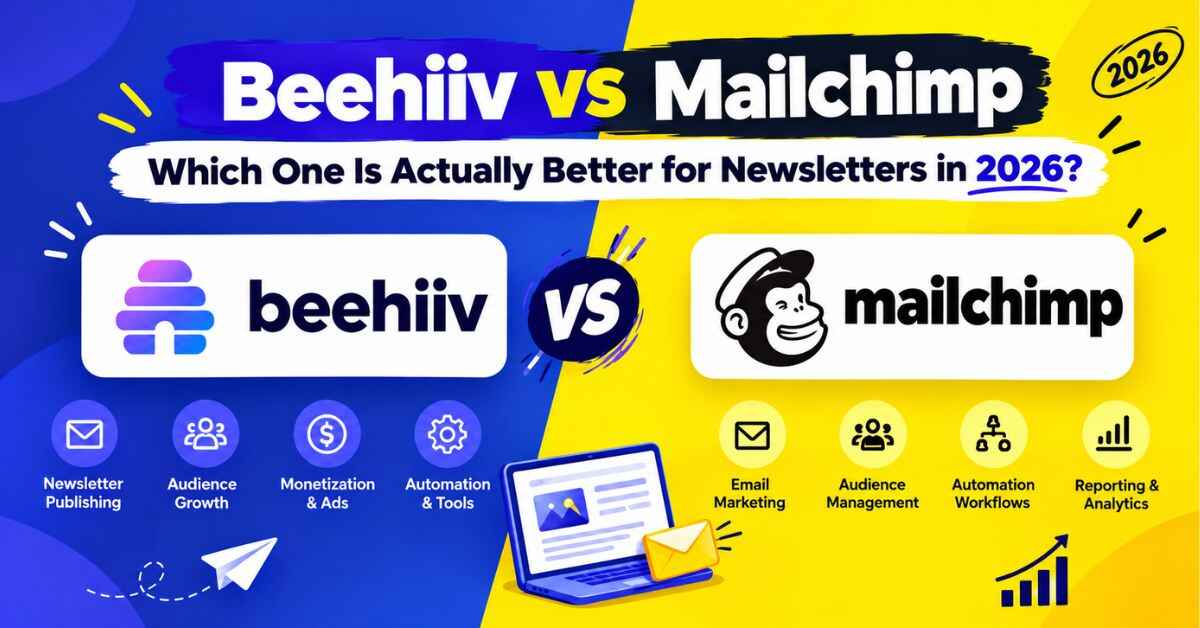
Beehiiv vs Mailchimp: Which One Is Actually Better for Newsletters in 2026?
If you’re weighing Beehiiv vs Mailchimp, there’s a good chance Mailchimp was your first email tool, or the one everyone told you to use. It’s the name that comes up when you say “email marketing.” It’s been around forever, it’s familiar, and for a long time it was the obvious choice.
But a lot has changed. Newsletters have become their own thing, separate from sales emails and promotional blasts. And a growing number of creators have started asking whether a tool built for general email marketing is really the right home for a newsletter they want to grow and earn from.
I’ll be straight with you: for most people building a newsletter as a real project, I think beehiiv is the better fit. But “most people” isn’t “everyone,” and Mailchimp still has its place. So let me walk you through the real differences, and you can decide for yourself.
The Slow Squeeze Nobody Mentions
Here’s a story that’s become really common.
Someone starts a Mailchimp account years ago. The free plan is generous, the templates look decent, and sending to a few hundred friends and followers costs nothing. It feels like a gift.
Then things change. The free plan gets trimmed. Features they used to rely on move behind a paywall. They add a few hundred contacts and get nudged to a paid plan. They want a simple automated welcome email, and it turns out that needs a higher tier. They check the bill six months later and it’s not what they remembered.
None of this is secret. It’s all on the pricing page. But it creeps up on you. And by the time it bothers you, you’ve got a list, a few years of emails, and a vague sense that you’re paying for a lot of things you never use.
That slow squeeze is the reason so many newsletter writers start looking around. Not because Mailchimp is awful. Because it was built for a different job.
The Real Problem: A Marketing Tool Isn’t a Newsletter Platform
Let me say the thing that matters most in this entire comparison.
Mailchimp is an email marketing platform. beehiiv is a newsletter platform.
That sounds like a small difference. It isn’t.
Email marketing tools are built around campaigns: promotions, product announcements, sales funnels, abandoned cart reminders. Their natural customer is a business trying to sell something to a list.
Newsletter platforms are built around publishing: regular issues, a reading experience, an archive, growing an audience, and earning directly from readers or sponsors. Their natural customer is someone whose newsletter is the product.
When you try to run a newsletter on a tool designed for campaigns, you can do it. Lots of people have. But you’ll keep bumping into gaps: no real growth tools, limited monetization options, a clunky reading experience, and pricing that’s tuned for businesses, not writers.
It’s like driving a delivery van to a family road trip. It gets you there. But it wasn’t built for the trip.
A Quick Introduction to Each Platform
Mailchimp
Mailchimp is one of the best-known email marketing tools in the world, owned by Intuit. It offers email campaigns, automations, landing pages, simple websites, and integrations with online stores. It has four plans: Free, Essentials, Standard, and Premium, all priced by how many contacts you have.
Based on recent reports, the free plan now covers just 250 contacts and a small number of sends each month, after cuts in January 2026. Paid plans start around $13 a month for Essentials, $20 for Standard, and $350 for Premium, all at the lowest contact tier and rising as your list grows. Sources differ on a few details, so check Mailchimp’s own pricing page.
beehiiv
beehiiv’s free plan covers up to 2,500 subscribers with unlimited email sends, a newsletter website, templates, and landing pages. Paid plans are now called Lite and Pro, priced by subscriber tier, with custom pricing for large publishers. On paid plans, beehiiv takes 0% of your subscription revenue (payment processing fees still apply).
beehiiv changed its plans and prices on October 1, 2026, so older articles may show the old names (Launch, Scale, Max) and old numbers.
The Free Plans: A Big Gap
Let’s start where most people start: free.
Mailchimp’s free plan has been scaled back repeatedly. Reports say it’s now 250 contacts, with a small monthly send limit. It also comes with Mailchimp branding in your emails, and reviews note it lacks scheduling, A/B testing, and multi-step automations. Support on the free plan has also been described as limited to the first 30 days.
beehiiv’s free plan covers 2,500 subscribers, with unlimited email sends, your own newsletter website, landing pages, templates, and a recommendation network that can help you get discovered. It keeps beehiiv branding, and some tools like automations and ad monetization need a paid plan, but you have far more room to work with.
For a brand-new newsletter, that difference matters. With Mailchimp’s free plan, you can hit your ceiling in weeks if your list grows at all. With beehiiv’s, you’ll probably have months or even a year of runway before you need to pay.
Pricing Beyond Free: Where It Really Shows
Free plans are a starting point. The question that matters is what happens when you grow.
Mailchimp prices by contact count, and it climbs quickly. Reports put the Standard plan at around $100 a month for 10,000 contacts, with other sources quoting figures in the $100 to $135 range depending on the plan and billing. Essentials is a bit less but lacks the automation and journey features. And here’s a detail that bites a lot of people: unsubscribed contacts can still count toward your plan limit, so your list may look smaller than your bill suggests.
beehiiv prices by subscriber tier too, on Lite and Pro. Its prices went up in October 2026, and some creators weren’t happy about it. So I won’t tell you beehiiv is always cheaper. At certain list sizes and plans, it may not be. But there’s a different question worth asking: what do you get for the money?
With beehiiv, your plan includes the writing tools, the newsletter website, the referral program, recommendations, analytics, and (on the right plan) paid subscriptions with 0% platform take, ad monetization, and digital products. With Mailchimp, a lot of the things newsletter writers care about either don’t exist or need extra tools.
So the fair way to compare isn’t “which sticker price is lower?” It’s “what will I need to buy around this tool to do what I want?” For a newsletter, that tends to favor beehiiv.
As always, please check both pricing pages with your own list size, because numbers shift.
Growth: The Biggest Practical Difference
This is where I think the gap is widest.
Mailchimp helps you send email. It gives you signup forms, landing pages, and some list-building tools. But growing a newsletter audience, in the sense of getting strangers to find you, subscribe, and share you, isn’t really its focus.
beehiiv treats growth as a core job:
- A referral program, where readers earn rewards for inviting friends
- Recommendations, so newsletters can promote each other and swap readers
- Boosts, where you can pay to be promoted to relevant readers or earn by recommending others
- A newsletter website that can bring in search traffic over time
- Landing pages and signup forms you can embed anywhere
- Polls and A/B testing on paid plans
Think about what that means in everyday terms. On Mailchimp, if you want a referral program, you probably need a separate tool. If you want a place for old issues to rank on Google, you need a blog or website built elsewhere. If you want to be recommended by other creators, you’ll work that out yourself.
On beehiiv, those things come with the platform. You still have to do the work of writing and sharing. But you aren’t gluing together five different tools to get there.
Writing and Publishing Experience
Let’s talk about the thing you’ll do every week: write.
beehiiv’s editor is built for newsletters. You write in a clean, document-like space, add images, buttons, polls, and sections, then send. Every issue becomes a web page on your newsletter site automatically, so it also works like a blog.
Mailchimp’s editor is built for campaigns. It’s drag-and-drop, designed around building marketing emails with blocks and templates. It’s flexible and capable, and great if you want a polished promotional look. But for a writer who just wants to type and publish, it can feel like more design work than it should be.
Neither is bad. They’re just built for different mindsets. If your newsletter is mostly words, beehiiv will feel lighter. If your emails are mostly product-focused designs, Mailchimp’s approach makes more sense. Also read: Beehiiv Review 2026: An Honest Look at the Newsletter Platform Everyone Keeps Talking About
Making Money From Your Newsletter
This section is where I think newsletter writers get the most out of switching.
Paid subscriptions
beehiiv is built to let you charge readers for premium content. On paid plans, it takes 0% of your subscription revenue, aside from normal payment fees. Mailchimp isn’t designed around paid newsletter subscriptions, so charging readers would require outside tools.
Ads and sponsorships
beehiiv includes an ad network that matches your newsletter with brands, plus tools for direct sponsors. Mailchimp doesn’t have a comparable newsletter ad marketplace. You’d find sponsors yourself and manage everything manually.
A reality check: ad earnings depend on your niche, audience size, and engagement. Some creators say rates haven’t matched what they hoped. Treat any “average earnings” figure as a rough idea, not a promise.
Digital products
beehiiv lets you sell digital products and says it takes no platform fee on them. Mailchimp can connect to online stores, which is useful if you run an e-commerce business, but it isn’t built around selling a simple guide or template pack to newsletter readers.
The bottom line
If you want your newsletter to earn directly through subscriptions, sponsors, or products, beehiiv has far more built in. If your goal is promoting an existing online store, Mailchimp’s store integrations are a real strength.
Automations and Marketing Features
I want to give Mailchimp credit where it’s earned.
Mailchimp has a deep set of marketing tools. Its Customer Journey Builder lets you map out branching sequences, and the Standard plan unlocks multi-step automations, send-time optimization, and dynamic content. If you run an online business with many different customer paths, abandoned cart emails, and product recommendations, Mailchimp offers a lot of firepower. Its integrations, especially with e-commerce platforms, are broad.
beehiiv has automations too, on paid plans, including welcome series and triggered emails, plus segmentation to send the right content to the right readers. For most newsletter writers, that’s more than enough. But if your needs are heavy on complex, multi-branch marketing funnels, Mailchimp’s toolset is more mature.
So ask yourself: Is my newsletter the main thing, or is it part of a bigger sales operation? That answer points you to one platform or the other.
Analytics and Insight
Both give you the basics: opens, clicks, list growth.
beehiiv’s analytics lean toward publishing and growth. You can see where subscribers come from, which posts bring in the most readers, which links get clicked, and how your list changes over time. On paid plans, the history gets longer, and Pro unlocks unlimited history with more advanced reports.
Mailchimp’s reporting is geared toward campaign performance, with deeper analytics on higher plans, including advanced segmentation and comparative reports on Premium.
If you want to know what’s working to grow your audience, beehiiv gives you more directly useful answers. If you want to dig into campaign performance across a marketing operation, Mailchimp’s reports serve that well.
Moving From Mailchimp to beehiiv
If you’re already on Mailchimp, here’s what moving usually looks like. It’s not scary, but it’s worth planning.
- Export your contacts from Mailchimp, including any tags you want to keep.
- Clean your list. Remove people who never open your emails. It can lower your costs and improve results.
- Import into beehiiv. It offers tools to help you bring over subscribers and past content.
- Rebuild your forms and automations. These rarely transfer perfectly, so budget some time.
- Update your links everywhere: your website, social bios, old posts.
- Tell your readers. A short note explaining the move keeps the new emails from looking suspicious.
- Check your sender setup so your messages keep landing in inboxes.
Many people find the hardest part is the decision, not the actual move.
Who Should Choose beehiiv
I’d lean toward beehiiv if you:
- Run a newsletter as your main project, not as a side tool
- Want growth tools like referrals, recommendations, and Boosts built in
- Plan to earn through subscriptions, ads, sponsors, or digital products
- Want a newsletter website that brings in search traffic
- Prefer a writing-first editor over heavy design tools
- Want to start free with real room to grow (2,500 subscribers)
If that’s you, there’s no cost to taking a look. opens a free account, and you can build a page, write a draft, and see if it fits the way you work.
Who Should Stay With Mailchimp
And honestly, there are people who should.
I’d stick with Mailchimp if you:
- Run an online store and rely on its e-commerce integrations
- Need complex, branching marketing automations
- Have a team already trained on Mailchimp and a working setup
- Send mostly promotional email, not editorial newsletters
- Already pay a plan that fits and don’t need growth or monetization tools
There’s no shame in that. A tool that fits your business is worth keeping. Moving for the sake of moving is a bad reason.
Real-Life Style Scenarios
Let me put names to this.
The weekly writer. Anika writes a Friday newsletter about travel on a budget. She started on Mailchimp, but her list has crossed a few thousand, her bill is climbing, and she wants referral rewards and sponsors. She moves to beehiiv, sets up a welcome series, turns on the referral program, and applies for the ad network. She’s no longer paying for tools she doesn’t use.
The online shop owner. Tomás sells handmade leather goods. His emails are mostly product launches, discount codes, and abandoned cart reminders. Mailchimp’s store integrations do exactly what he needs. He stays, and he’s right to.
The brand-new beginner. Mei is starting a newsletter about home gardening. She has 60 followers and a big dream. She doesn’t want to hit a paywall in a month. beehiiv’s free plan gives her thousands of subscribers of runway, plus a site and growth tools from day one.
The curator. Jonas rounds up the best new tools in his industry each week. His list is growing quickly, and sponsors are asking about ad space. A platform with a built-in ad network and clear analytics gives him more to work with than a campaign tool.
The hybrid business. A small company sells software and also publishes a weekly industry newsletter. They might use Mailchimp for product marketing and beehiiv for the newsletter. Using both isn’t a failure. It’s matching the tool to the job.
Different situations, different winners.
The Honest Downsides
No platform is perfect, so let me be fair.
beehiiv’s downsides:
- Paid plans can feel pricey for small publishers who don’t earn, and prices rose in October 2026
- The free plan caps at 2,500 subscribers
- Key features like automations, paid subscriptions, and ad monetization need paid plans
- Less depth in complex marketing automation than Mailchimp
- Weaker e-commerce integrations
- Ad earnings vary a lot
Mailchimp’s downsides:
- The free plan has shrunk and now allows only a small number of contacts and sends
- Pricing climbs quickly as your list grows, and unsubscribed contacts can still count toward your limit
- Useful features sit behind higher plans
- Not built around newsletter growth or monetization
- Support on lower tiers is limited
You’re not looking for a perfect tool. You’re picking the trade-offs that suit your goals.
My Honest Take on Beehiiv vs Mailchimp
If I had to put it in two sentences: Mailchimp is for marketing campaigns and online stores. beehiiv is for newsletters you want to grow and earn from.
For most writers, creators, and independent publishers, I lean toward beehiiv. The free plan is more useful, the growth tools are built in, the money-making options are real, and the whole setup is made for the way newsletters actually work. You’re not bending a marketing tool into something it wasn’t built for.
For store owners and marketers running complex funnels, Mailchimp still earns its place, and I wouldn’t tell you to leave a setup that works.
If you’re unsure, try this: write down the one thing you want your email list to do for you in the next year. If it’s “build an audience and earn from my writing,” lean beehiiv. If it’s “sell my products and automate my customer journey,” lean Mailchimp.
Quick Questions People Ask
Is beehiiv better than Mailchimp?
For newsletters, usually yes. For e-commerce marketing and complex automations, Mailchimp is stronger.
Is Mailchimp still free?
Yes, but the free plan is much smaller than it used to be, with a low contact limit and small monthly send limit.
Is beehiiv free?
Yes. The free plan covers up to 2,500 subscribers with unlimited sends and a newsletter website. Some features need a paid plan.
Which is cheaper?
It depends on your list size and needs. beehiiv’s free plan gives you more room. Beyond that, compare both pricing pages at your list size, since both have changed recently.
Can I move my Mailchimp list to beehiiv?
Yes. beehiiv has import tools. Plan for rebuilding your forms and automations.
Can I make money with beehiiv?
Through paid subscriptions, ads, sponsors, and digital products, yes. How much depends on your audience and niche.
Do I have to switch everything at once?
No. Some people run both for a while: Mailchimp for store marketing, beehiiv for the newsletter.
Final Thoughts
I’ll leave you with this. The tool you pick is less important than whether you actually send your newsletter every week. A consistent newsletter on any decent platform beats a perfect one that never launches.
Still, the right tool makes consistency easier. If your newsletter is something you hope will grow, bring in readers who love your work, and earn something in return, beehiiv was built with that path in mind.
If you’re curious, is a low-pressure place to start. Open the free plan, write a test issue, and look at the growth tools. If it doesn’t feel right, you’ve lost an hour. If it does, you might save yourself months of fighting a tool that wasn’t made for this.
I hope this Beehiiv vs Mailchimp comparison helped you see more clearly.
Affiliate Disclaimer
Just so you know, some links in this post are affiliate links. If you sign up through them, I may earn a small commission at no extra cost to you. It helps me keep writing posts like this. I only share things I think are worth your time, and my opinions are my own. Plans and prices change often, so please check both platforms’ websites for the latest details before you decide.