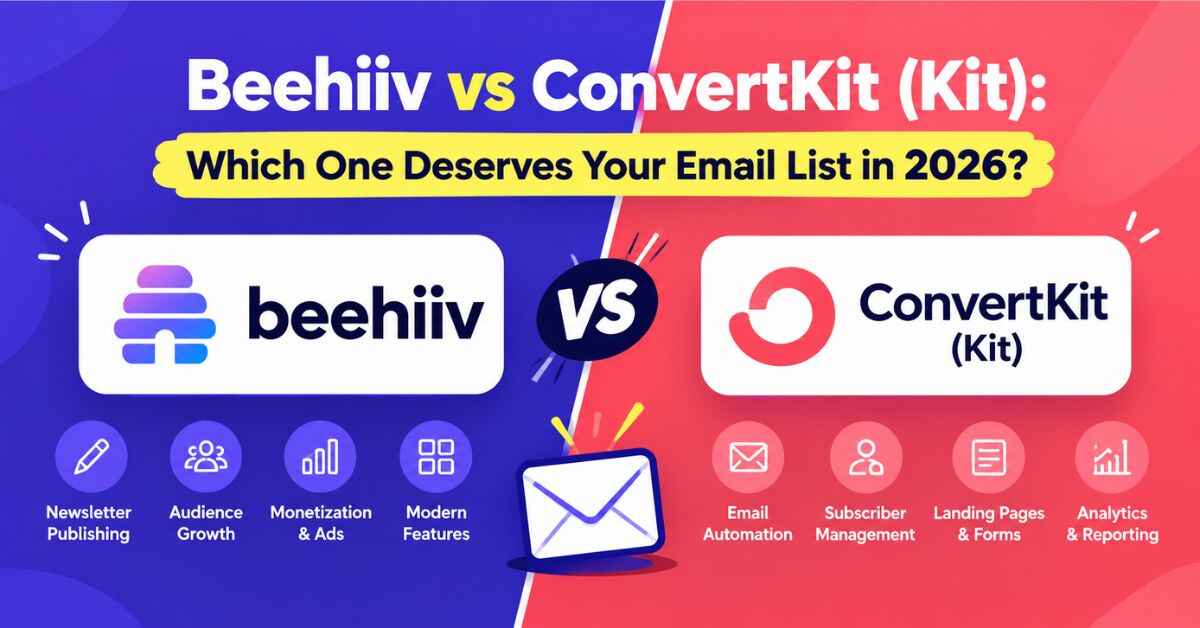
Beehiiv vs ConvertKit (Kit): Which One Deserves Your Email List in 2026?
If you’ve been going back and forth on beehiiv vs ConvertKit (Kit), I’m guessing you’ve already read three or four comparison articles and come out more confused than when you started. That’s normal. Most of them list a hundred features and never tell you what they actually mean for someone like you.
So let me do this differently. I’ll tell you what each platform is really built for, where each one shines, where each one makes you wince a little, and who I’d point toward which. And one quick note up front: ConvertKit changed its name to Kit a while back, so if you see both names around, it’s the same company and the same product.
Let’s get into it.
The Decision Nobody Warns You About
Picking an email platform feels like a small decision. It isn’t.
Here’s what happens. You pick a tool because it looked good in a YouTube video or because someone you follow uses it. You build your signup forms there. You connect your website. You write your first twenty emails. You set up a welcome sequence. Your list grows to a couple thousand people.
And then, one day, you realize something about the tool doesn’t match what you’re trying to do. Maybe the price jumped. Maybe you wanted a feature that doesn’t exist. Maybe your goals changed from “share my thoughts” to “build a real income from this,” and the tool wasn’t made for that.
Now you’re stuck weighing a hard choice: stay and put up with it, or move everything and risk losing a chunk of your audience in the process.
I’ve watched people put this off for a year. A whole year of growth that could have gone somewhere better, wasted on inertia.
That’s why it’s worth taking a few minutes now to understand how these two platforms are different. They look similar from the outside. Underneath, they were built with different people in mind.
Why This Comparison Is Harder Than It Looks
Here’s the tricky part. Kit and beehiiv both say they’re for creators. Both offer email, landing pages, and ways to sell. Both have free plans. Both talk about growth and income.
But their DNA is different.
Kit grew up as a tool for bloggers, course creators, and online business owners. Its core strength is email marketing: sequences, automations, tagging, and selling digital products to your audience. It’s built around the idea that your email list is how you run your creator business.
beehiiv grew up in the newsletter world. Its core strength is publishing: a writing-focused editor, a website for your newsletter, built-in growth tools like referrals and recommendations, and monetization through ads, paid subscriptions, and digital products. It’s built around the idea that your newsletter is the business.
That distinction, email marketing tool versus newsletter publishing platform, is the thread running through everything below. If you remember nothing else from this post, remember that.
A Quick Look at Each Platform
Kit (formerly ConvertKit)
Kit is known for visual automations, tagging, and a deep set of tools for people who sell things: courses, ebooks, templates, coaching, memberships. Its free plan is generous. It covers up to 10,000 subscribers, though it’s limited in features, and on the free plan there are no visual automations or sequences.
Paid plans are called Creator and Pro. Prices climb with your list size. Recent price changes raised the starting cost, with Creator beginning around $39 a month at 1,000 subscribers on monthly billing (a bit less if you pay yearly), and Pro starting around $79. Those figures move around, so check Kit’s own pricing page before you decide.
If you sell products through Kit, there’s also a transaction fee on top of normal payment processing. It’s commonly listed as 3.5% plus 30 cents per sale, and one source says it’s waived on the highest plan. Confirm that on Kit’s site.
beehiiv
beehiiv’s free plan goes up to 2,500 subscribers and includes unlimited sends, a newsletter website, landing pages, and a recommendation network. Paid plans are now called Lite and Pro, priced by subscriber tier, plus custom pricing for the biggest publishers.
On beehiiv’s paid plans, there’s a 0% take rate on paid subscriptions (you still pay normal payment processing fees), and digital products carry no platform fee. The platform changed its pricing on October 1, 2026, so older articles might show old plan names and numbers.
So far, so similar. Now let’s look at where the real differences show up.
Price: The Free Plans Are Not Equal
Let’s start with the obvious.
Kit’s free plan covers 10,000 subscribers. beehiiv’s covers 2,500. On raw numbers, Kit looks far more generous, and I won’t pretend otherwise. If you’re an absolute beginner who wants to build a big list without paying anything for a long time, that’s a real advantage.
But here’s what the numbers hide. Free Kit comes with limits on automations and sequences. Free beehiiv comes with unlimited sends, a website, landing pages, and a recommendation network. So what you can do on each free plan is quite different. One gives you more room, the other gives you more tools.
Once you move past the free plans, the comparison shifts. Some independent comparisons have found that beehiiv’s paid plans cost less than Kit’s at the same list size, though that gap has narrowed since beehiiv’s October price change. The honest answer is that it depends on your list size and which features you need, and the only way to know is to plug your own numbers into both pricing pages.
Here’s a simple way to think about it:
- Small list, tight budget, mostly want to collect emails? Kit’s free plan is hard to beat for sheer capacity.
- Want a newsletter website, growth tools, and a clean writing experience from day one? beehiiv’s free plan offers more of that.
- Planning to pay once you grow? Run the numbers for both at your expected list size.
If you’d like to see how beehiiv’s free plan feels in practice, Find the Right Beehiiv Plan for Your Budget and open an account and look around without spending anything.
Writing and Publishing: Where beehiiv Pulls Ahead
If you write a lot, this part matters.
beehiiv’s editor is designed for newsletters. You write like you’re in a clean document, drop in images, buttons, polls, and sections, and hit send. Every issue automatically becomes a page on your newsletter website, so it also works as a blog. That means your writing can show up in search and bring in new readers long after you’ve sent it.
Kit does have a newsletter editor and a creator profile page, but its center of gravity is email marketing rather than publishing. It’s perfectly capable of sending a good newsletter. It just wasn’t built mainly around the experience of running a publication with an archive, a website, and a reading experience.
Think of it this way. If you’re a writer who also sells things, beehiiv feels natural. If you’re a seller who also writes emails, Kit feels natural.
Automations: Where Kit Is Strong
Now I’ll give Kit its flowers, because it earns them.
Kit’s visual automation builder is one of its best-known features. You can map out a customer journey like a flowchart: someone signs up for a free guide, gets a welcome email, gets tagged based on what they clicked, receives a follow-up series, and later gets an offer for a paid product. It’s smart, visual, and very good at turning subscribers into customers.
If your business runs on funnels, meaning you give something free, nurture people over several emails, then sell something, Kit is built for that. Many course creators and coaches love it for precisely this reason.
beehiiv has automations too, available on its paid plans, including welcome series and triggered emails, plus segmentation to send the right content to the right people. For most newsletter writers, that’s plenty. But if you need very detailed branching logic and complicated funnels, Kit’s tools are more mature in that area.
So the question to ask yourself is: How complicated is my follow-up? If it’s “welcome email, then weekly issues,” beehiiv is more than enough. If it’s “twelve-email nurture sequence that branches by interest and ends in a product pitch,” Kit deserves a close look.
Growth: Different Philosophies
Both platforms want to help you grow, but they go about it differently.
beehiiv’s approach is a toolbox of built-in growth features:
- A referral program where readers earn rewards for inviting friends
- Recommendations between newsletters, so you can swap readers with creators you like
- Boosts, where you can pay to be promoted to relevant readers, or earn by recommending others
- Landing pages and signup forms
- A newsletter website that can rank in search
- Polls and A/B testing on paid plans
Kit’s approach includes:
- Landing pages and forms
- A Creator Network, where creators recommend each other
- A sponsor network on some plans
- Newsletter referral features on its higher plan
- Strong tagging and segmentation to personalize what readers receive
Both give you ways to get discovered. beehiiv’s are more tightly woven into how a newsletter works day to day, especially the referral system and the website. Kit’s are more focused on list-building and funnel conversion.
A quick reality check: neither platform will hand you readers just because you signed up. You still need to share your work, build a presence somewhere, and give people a reason to join. Tools help, but they don’t replace effort. Beehiiv Review 2026: An Honest Look at the Newsletter Platform Everyone Keeps Talking About
Making Money: Subscriptions, Ads, Products
This is where the two diverge the most, so let’s slow down.
Selling digital products
Kit is great here. You can sell ebooks, courses, templates, and more directly through its commerce tools, and it integrates smoothly with the funnels you build. The catch is the transaction fee on top of payment processing, which adds up if you sell often. Check Kit’s commerce page for the current number and which plans waive it.
beehiiv also lets you sell digital products, and it says it takes no platform fee on them. The tools are newer and more bare-bones than Kit’s, so very detailed product funnels may feel limited. But for sharing a guide or a template pack with your readers, it works well.
Paid newsletter subscriptions
If you want to charge readers a monthly or yearly fee for premium content, beehiiv is built for it, with a 0% take rate on its paid plans. Kit supports paid newsletters too, but with the commerce fee mentioned above.
Advertising and sponsorships
This is beehiiv’s territory. It has its own ad network that connects your newsletter with brands, plus tools to manage direct sponsors. Kit has a sponsor network on some plans, but advertising isn’t its main identity.
A fair warning: earnings from ad networks depend entirely on your niche, audience size, and engagement. Some creators have said rates haven’t matched what they hoped for, so treat any “average earnings” number you see as a rough idea, not a promise.
So who earns more?
It depends on how you make money. If you’re selling your own products through carefully built funnels, Kit’s tools are stronger. If you’re building an audience and earning through subscriptions and sponsors, beehiiv has more built in.
Analytics: Knowing What’s Working
You can’t improve what you can’t see.
beehiiv gives you analytics focused on publishing: opens, clicks, subscriber sources, which posts bring in readers, and growth over time. On paid plans, the history gets longer, and the top plan unlocks unlimited history with more advanced reports.
Kit gives you strong data on subscribers and sequences: who clicked what, which automations convert, and how your tags and segments perform. It’s more about understanding the customer journey.
Different lenses on the same goal. If you want to know which article grew your list, beehiiv is natural. If you want to know which email in your sequence made the sale, Kit is natural.
Ease of Use
Both are friendlier than the old-school email tools that look like airplane cockpits.
Kit’s interface is clean and logical, though its automation builder has a learning curve if you want to use it fully. beehiiv’s interface is also clean, with a bit more to explore because it covers writing, website, growth, and monetization in one place.
Give yourself a weekend with either one. Click everything. Build a test page. You’ll feel at home faster than you expect.
Switching Costs: Moving From One to the Other
If you’re already on Kit and thinking about beehiiv, or the reverse, the good news is that moving is possible. Both support importing subscribers, and beehiiv has migration tools for bringing over lists and past content. Kit also offers free migration help to some paid users switching from other platforms, according to one source.
Things to plan for:
- Export your list and any tags you want to keep.
- Rebuild your automations. These rarely transfer perfectly, so budget some time.
- Update your forms and links everywhere they appear: your site, social bios, old posts.
- Warn your readers that you’re changing platforms, so the new emails don’t look suspicious.
- Check your sender setup so your messages keep landing in inboxes.
If your funnels are complex, moving takes more effort. If you mostly send newsletters, it’s a lot easier. That’s another reason to choose carefully early on.
Who Should Choose beehiiv
I’d lean toward beehiiv if you:
- Are building a newsletter as the main thing, not a side tool for something else
- Want a website and archive that can bring in search traffic
- Plan to earn through paid subscriptions, ads, or sponsors
- Like referrals, recommendations, and Boosts as growth tools
- Want clean analytics focused on publishing
- Run a small team or several newsletters
If that sounds like you, a free account is a low-risk test. You can Start Your Newsletter with Beehiiv and see if the toolbox feels right before paying for anything.
Who Should Choose Kit
I’d lean toward Kit if you:
- Run an online business selling courses, ebooks, coaching, or memberships
- Need detailed automations and funnel-building
- Want a big free list capacity (10,000 subscribers) to start
- Care more about email marketing than publishing
- Have complex segmentation needs
- Already use integrations that connect with Kit
Plenty of successful creators run their whole business on Kit, and it’s a strong choice for the right setup. This isn’t a case of one tool being good and the other bad.
Real-Life Style Scenarios
Let me make this concrete.
The course creator. Samira teaches photography. She gives away a free lighting guide, nurtures readers with a seven-email series, then sells a $97 course. Her funnel is the engine of her business. Kit’s visual automations and commerce tools fit her perfectly.
The weekly writer. Daniel writes a Friday newsletter about startup lessons. He wants a clean writing experience, a website where old issues live, a referral system, and eventually a paid tier and sponsors. beehiiv fits him like a glove.
The hybrid. Priya writes a weekly newsletter and also sells templates. She doesn’t need complex funnels, just a good publishing home with a shop on the side. beehiiv’s digital products and subscriptions might cover her needs. If her sales grow into a full funnel business, she might revisit Kit later.
The beginner with a huge audience on social media. Karim has 40,000 followers but zero emails. He wants to collect addresses fast without a big bill. Kit’s 10,000-subscriber free tier is tempting, though beehiiv’s free tier might also serve him well for the first 2,500 while he tests whether he enjoys writing a newsletter.
Different people, different winners. That’s really the whole story.
The Honest Downsides
I said I’d be straight with you, so here are the weak spots on each side.
beehiiv’s downsides:
- The free plan caps at 2,500 subscribers, much lower than Kit’s
- Some of its best features, like automations and ad monetization, need a paid plan
- Prices rose in October 2026, and some creators weren’t happy about it
- Complex funnel-building is less advanced than Kit’s
- Ad earnings vary a lot
Kit’s downsides:
- Prices on paid plans have risen noticeably in 2026
- The free plan lacks visual automations and sequences
- Transaction fees apply when you sell products
- It’s less focused on publishing and newsletter websites
- Costs climb quickly as your list grows
No platform is perfect. You’re choosing which trade-offs you can live with.
My Honest Take on beehiiv vs ConvertKit (Kit)
If I had to sum it up in two sentences: Kit is the stronger choice if your newsletter is part of a product-selling funnel. beehiiv is the stronger choice if the newsletter itself is the product.
For most writers and creators who want to grow a readership and earn through subscriptions and sponsors, I lean toward beehiiv. The writing experience, the built-in website, and the growth tools fit that path nicely, and the free plan lets you try it without any risk.
For course creators and online business owners who live and die by funnels, Kit is the better home, and its big free plan makes it easy to start.
If you’re still unsure, here’s a trick: write down, in one sentence, how you expect to make money from this list in the next year. If your sentence involves subscribers, ads, or sponsors, think beehiiv. If it involves selling your own products through a sequence of emails, think Kit.
Quick Questions People Ask
Is ConvertKit the same as Kit?
Yes. ConvertKit rebranded to Kit in 2024. Same company, same product.
Which has the better free plan?
Kit’s free plan allows up to 10,000 subscribers, but with limits on automations. beehiiv’s free plan allows up to 2,500 subscribers with unlimited sends, a website, and landing pages.
Which is better for selling courses?
Kit generally, thanks to its funnel and commerce tools.
Which is better for ad income?
beehiiv, which has its own ad network built in.
Is beehiiv cheaper than Kit?
It can be at some list sizes, but both have changed prices recently. Check both pricing pages at your own subscriber count.
Can I move from Kit to beehiiv?
Yes. beehiiv supports importing subscribers and content. Plan for rebuilding your automations.
Do I need to pay right away?
No. Both have free plans, so you can start testing without spending anything.
Final Thoughts
The best platform is the one that matches how you actually plan to work and earn. Not the one with the longest feature list, and not the one your favorite creator happens to use.
If you’re building a newsletter you hope readers will love and sponsors or subscribers will support, beehiiv is worth a serious look. Open a free account, set up your page, and send your first issue. You’ll learn more in an hour of real use than from any comparison post, including this one.
If you’re curious, Check Out Beehiiv’s Latest Plans is the simplest way to start. And if you decide Kit is the better fit after all, that’s a perfectly good outcome. You’ll have chosen on purpose, and that’s what counts.
I hope this beehiiv vs ConvertKit (Kit) comparison cleared up some of the noise.
Affiliate Disclaimer
Quick heads-up: some links in this post are affiliate links. If you sign up through them, I may earn a small commission at no extra cost to you. That helps me keep writing posts like this. I only share things I think are worth your time, and my opinions are my own. Prices and features change often, so please check both platforms’ websites for the latest details before you decide.